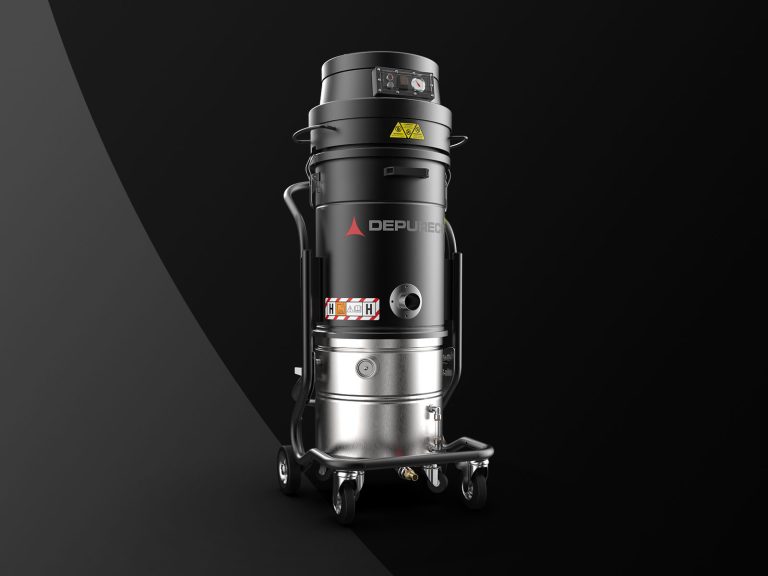
The Industry’s Shield Against Volatile Particulate Hazards
Select the equipment path by material behavior, documented area classification, operating duty, collection method, and discharge requirements.
From food powders and polymer dust to wood particulate, conductive carbon, metal fines, and additive-manufacturing residue, the correct industrial vacuum or dust collection system depends on more than the material name. Particle characteristics, process conditions, pickup location, runtime, filtration strategy, containment, and disposal or recovery requirements can all change the specification.
One combustible-dust problem can lead to very different equipment paths. A facility may need a mobile vacuum for recurring settled-dust housekeeping, model-specific equipment for a documented hazardous location, source capture at the process, a centralized multi-point recovery system, pneumatic operation, or a specialized immersion or inertization path for selected reactive powders.
Start with four questions:
What exact material and process-generated form are being collected?
Is pickup occurring in an ordinary location or a documented hazardous classified area?
Is the objective settled-dust housekeeping, airborne source capture, material recovery, or multi-point centralized cleanup?
What operating duty, collection volume, filtration, containment, and discharge method are required?
The correct path should be established before selecting a model number or copying an incumbent specification.
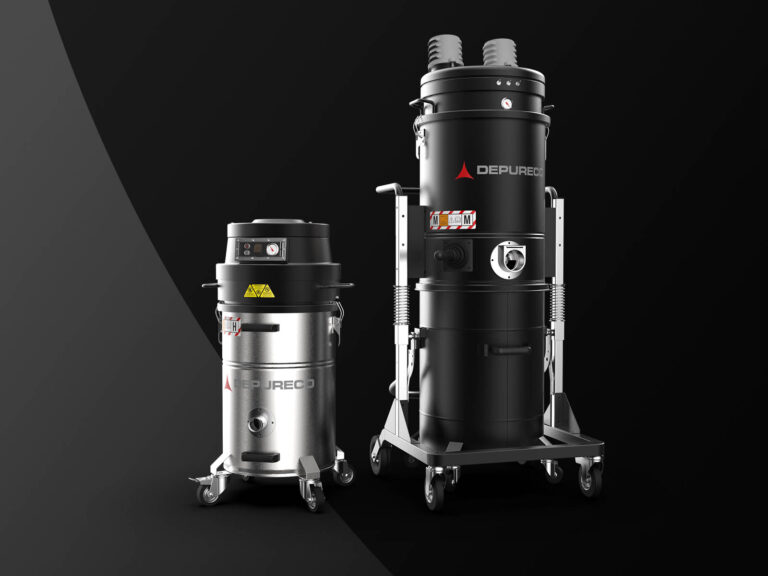
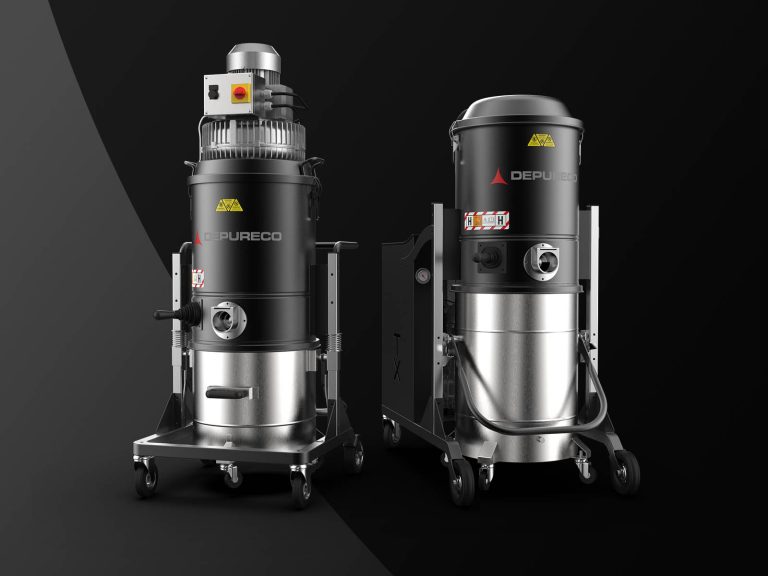
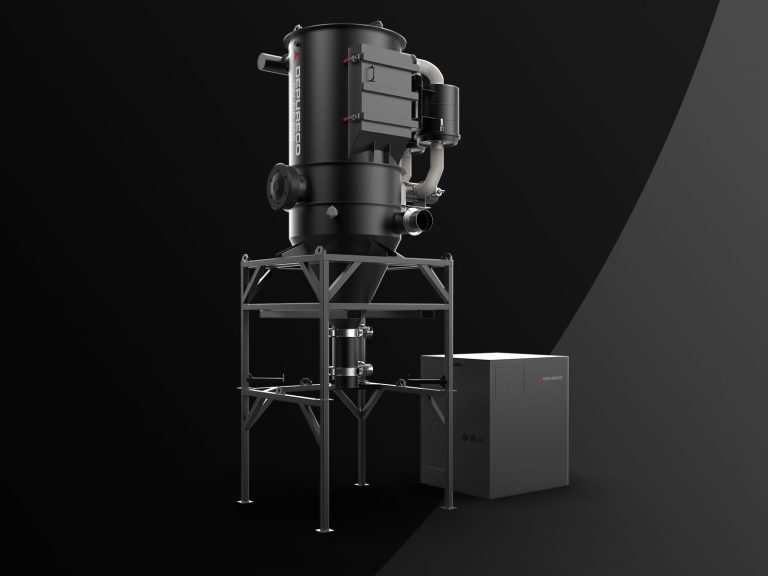


Flour, sugar, starch, cocoa, protein powders, dry blends, and grain dust.

Powder-coating overspray, resin dust, polymer fines, plastic powder, and chemical process particulate.

Sawdust, sanding dust, wood flour, fine biomass particulate, and process residue.

Aluminum fines, titanium powder, magnesium fines, stainless grinding dust, and additive-manufacturing powder.

Carbon black, graphite dust, conductive additives, fine carbonaceous particulate, and battery-process powders.

Lead-bearing particulate, propellant residue, carbonaceous residue, and other process-specific range or defense particulate requiring material-specific review.
The material name is only the starting point. Particle size, morphology, moisture, contamination, bulk density, conductivity, reactivity, process temperature, and collection rate can change the vacuum, filtration, containment, and discharge strategy.
The examples below represent common industrial material streams that may require dust-control or application review. They should not be treated as automatic hazard classifications.
Qualification note:
The presence of a listed material does not by itself determine combustibility, area classification, or equipment suitability. Use available facility documentation, process information, SDS data, dust testing, and engineering review where applicable.
A combustible-dust vacuum should not be evaluated by the motor, blower, or HEPA label alone. Engineering should review the complete path from the pickup tool to final collection and discharge.
Depending on the material and application, the configuration may need to address:
Manual shaker, jet cleaning, reverse-pulse, or other documented methods selected around powder loading, operating duty, allowable downtime, and airflow recovery after cleaning.

A combustible-dust application should not be specified from a material name, maximum CFM number, or generic “explosion-proof” requirement alone. The equipment path can change when any of the following conditions change.
Review the exact material, process-generated form, particle characteristics, available SDS information, and relevant dust-test data. Where available and applicable, engineering may consider parameters such as Kst, Pmax, MIE, MEC, moisture condition, conductivity, reactivity, or other material-specific information.
The same nominal material can behave differently when particle size, moisture, contamination, process history, or physical form changes.
Confirm whether pickup occurs in an ordinary location or a documented hazardous classified area. Where classification applies, provide the actual Class/Division or Zone documentation and any relevant material Group information required for equipment review.
Do not use “combustible dust” as a substitute for the facility’s documented area classification.
Define what the equipment must actually do:
A portable industrial vacuum, source-capture dust collector, and central vacuum system solve different problems.
Quantify:
A facility operating three shifts does not automatically require the same architecture as a vacuum that must remain under continuous loaded suction for three shifts.
Document:
Maximum CFM alone does not describe performance at the actual operating condition.
Review the complete filtration and collection arrangement rather than specifying “HEPA” as a standalone requirement.
Depending on the application, relevant considerations may include:
Estimate how much material is collected per hour or shift and how it must leave the system.
High solids loading may justify:
In these applications, buying a larger vacuum is not always the lowest-lifecycle-cost solution.
When replacing another industrial vacuum, provide the current manufacturer and model and explain what is not working:
The existing specification should be treated as evidence, not automatically copied into the replacement RFQ.
Combustible dust applications are not all the same. In some facilities, the priority is routine housekeeping in ordinary locations where settled dust must be removed safely and consistently. In others, the application involves hazardous classified areas, conductive particulate, or reactive metal dust that requires a more specialized collection method.
When the material, the environment, or the risk level changes, the equipment path changes with it. Ordinary-location housekeeping may call for the right industrial vacuum with proper filtration and dust containment. Hazardous classified areas may require ATEX-certified equipment. Conductive or reactive metal dust may require inertization instead of standard dry collection. Larger-scale dust problems may be better served by a dust collector or a centralized vacuum system rather than a mobile vacuum alone.
The goal is to match the solution to the real application so dust can be collected more safely, handled more effectively, and managed in a way that supports cleaner production areas and a stronger housekeeping program.






















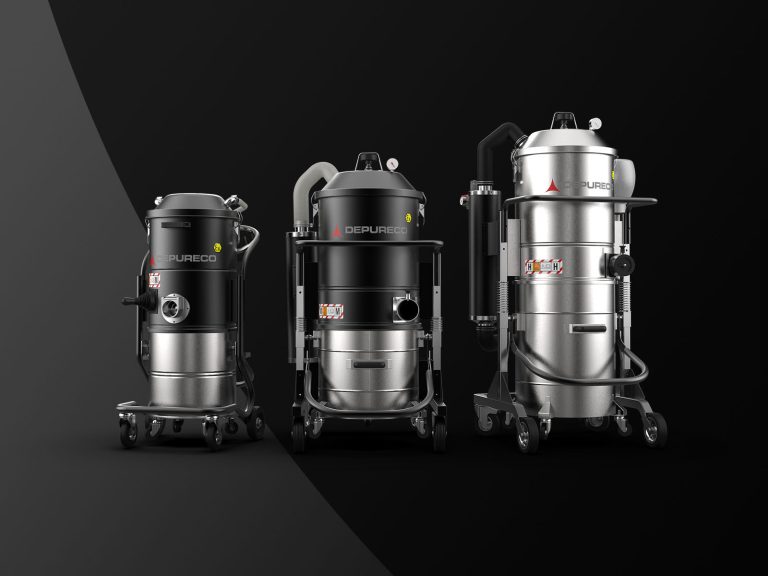
From combustible dust vacuums and anti-static industrial vacuums to air-powered systems, dust extractors, and central vacuum systems, Depureco USA helps facilities build the right solution for the material, the risk level, and the application.
With a wide range of systems in stock in Texas and decades of experience supporting combustible dust applications worldwide, we can help you specify the right setup for safer housekeeping, dust recovery, and plant-wide cleanup.
Contact us today to find the right combustible dust vacuum system for your facility.
Our air-powered units use no electricity and generate no heat, making them inherently safe for the most sensitive Class I and Class II environments without requiring electrical certification.
Every unit features integrated grounding from the tangential inlet to the exhaust, eliminating the arcing and static discharge that triggers dust-air ignitions.
| Industry Sector | Hazardous Material Profile | Required Safety Standard |
|---|---|---|
| Additive Mfg & Metals | Aluminum, Titanium, Iron Dust, & Stainless Steel | NFPA 484 / 660 |
| Food, Grain & Pharma | Flour, Sugar Dust, Protein Powder, & Starch | NFPA 61 / 660 |
| Energy & Battery | Lithium-Ion Battery Dust & Carbon Fibers | NFPA 654 / 660 |
| Surface Tech | Silica Dust, Powder Coatings, & Concrete | OSHA NEP / 660 |
| Defense & Range | Lead Dust, Gunpowder, & Brass Debris | OSHA 1910.1025 / 660 |
Understanding how an explosion occur is the first step toward prevention, but awareness alone doesn’t secure a facility. To achieve true operational safety, you must systematically neutralize the five elements required for a dust explosion—known as the Explosion Pentagon.
Depureco USA systems are engineered to target and eliminate these specific variables through advanced particulate control.


Combustible dust equipment should not be selected from a material name, maximum CFM number, or generic “explosion-proof” requirement alone.
The correct configuration can change with the dust characteristics, documented area classification, operating duty, hose and pickup conditions, filtration strategy, collection volume, discharge method, and whether the real need is housekeeping, source capture, centralized recovery, or a protected process system.
The questions below address the decision points that most often separate technically equivalent proposals from equipment that only appears comparable on a data sheet.
Depureco USA supports engineering, EHS, maintenance, operations, and procurement teams with application review, product selection, system configuration, accessories, pre-separation, custom integration, and centralized vacuum solutions.
A Dust Hazard Analysis should inform the vacuum specification, but it should not be reduced to a one-line purchasing instruction such as “buy an explosion-proof vacuum.” The more useful engineering question is which findings from the DHA materially change the collection method, equipment configuration, operating procedure, and surrounding system.
Start with the exact material and process. Relevant inputs may include explosibility data such as Kst and Pmax, ignition sensitivity data such as MIE, other available dust-test information, particle characteristics, normal and upset release conditions, the documented area classification, accumulation locations, housekeeping frequency, and the intended disposal or recovery route. Not every parameter changes every vacuum selection, but the available hazard data should be reviewed before assuming that a generic product category is sufficient.
The cleanup objective also matters. Recovering settled dust from floors, beams, machinery and equipment surfaces is a different engineering problem from continuously capturing airborne dust at a process. A portable industrial vacuum may fit one task while a source-capture collector, central vacuum system, pre-separation stage or protected collection system fits another.
Common specification mistake: using the DHA only to add the words “explosion proof” to an otherwise unchanged vacuum specification.
Better purchasing approach: translate the DHA and facility information into explicit requirements for material compatibility, location suitability, grounding and conductive continuity where applicable, filtration, duty cycle, collection capacity, discharge method, utilities, operating procedure and any system-level protection requirements.
NFPA 660 is now the consolidated combustible-dust standard, while OSHA’s combustible-dust enforcement and technical materials continue to treat material hazards, Class II locations and ignition controls as application-specific issues rather than a universal product label.
A Dust Hazard Analysis should inform the vacuum specification, but it should not be reduced to a one-line purchasing instruction such as “buy an explosion-proof vacuum.” The more useful engineering question is which findings from the DHA materially change the collection method, equipment configuration, operating procedure, and surrounding system.
Start with the exact material and process. Relevant inputs may include explosibility data such as Kst and Pmax, ignition sensitivity data such as MIE, other available dust-test information, particle characteristics, normal and upset release conditions, the documented area classification, accumulation locations, housekeeping frequency, and the intended disposal or recovery route. Not every parameter changes every vacuum selection, but the available hazard data should be reviewed before assuming that a generic product category is sufficient.
The cleanup objective also matters. Recovering settled dust from floors, beams, machinery and equipment surfaces is a different engineering problem from continuously capturing airborne dust at a process. A portable industrial vacuum may fit one task while a source-capture collector, central vacuum system, pre-separation stage or protected collection system fits another.
Common specification mistake: using the DHA only to add the words “explosion proof” to an otherwise unchanged vacuum specification.
Better purchasing approach: translate the DHA and facility information into explicit requirements for material compatibility, location suitability, grounding and conductive continuity where applicable, filtration, duty cycle, collection capacity, discharge method, utilities, operating procedure and any system-level protection requirements.
NFPA 660 is now the consolidated combustible-dust standard, while OSHA’s combustible-dust enforcement and technical materials continue to treat material hazards, Class II locations and ignition controls as application-specific issues rather than a universal product label.
The decision should begin with the facility’s documented electrical area classification and actual operating conditions—not simply with the statement that the material “can burn.”
A material may be combustible while the cleanup area remains an ordinary or unclassified location. Conversely, a location may require equipment suitable for a hazardous classified environment because combustible dust is present under conditions addressed by the facility’s area-classification analysis. OSHA defines Class II locations around hazards created by combustible dust, and the current OSHA combustible-dust enforcement directive discusses Class II classifications and dust groups.
Engineering should therefore establish:
Common specification mistake: treating “combustible dust,” “ordinary location,” “Class II,” “ATEX,” “ORD LOC,” “explosion proof” and “intrinsically safe” as interchangeable purchasing terms.
They are not interchangeable. A vendor should be able to identify exactly which model and configuration is being proposed, what marking or certification is documented, and how that configuration relates to the customer-provided location and application requirements.
For Depureco, this is where the answer should route between ordinary-location combustible-dust housekeeping, documented ORD LOC configurations, model-specific hazardous-duty options and pneumatic systems only after the material and location are understood—not present one machine as universal.
The correct architecture depends first on where the material is in the process and what the system is expected to do.
A portable industrial vacuum is generally a housekeeping and material-recovery tool. It is appropriate when operators need to recover settled dust, spills, residual powder, debris or accumulated material from changing locations.
A source-capture dust collector addresses a different problem: particulate that is being generated airborne at a machine, transfer point, grinding station, mixer, sander or other defined source. The hood, capture geometry, airflow, ducting and filtration system become part of the engineering problem.
A central vacuum system becomes attractive when a facility has repeated cleanup demand across multiple machines, floors, rooms or fixed pickup points; long conveying distances; simultaneous users; centralized separation; or a need to standardize housekeeping rather than deploy many roaming machines.
The next decision boundary is whether the equipment or connected system requires additional explosion-prevention or protection measures. A larger collector or central receiver can introduce enclosure, ducting, isolation and discharge questions that do not exist in the same form on a small portable vacuum. NFPA 68 addresses deflagration venting, while NFPA 69 addresses explosion-prevention systems including methods such as oxidant control, suppression and isolation.
Common specification mistake: assuming that a larger portable vacuum solves a source-capture problem, or assuming that a dust collector automatically replaces housekeeping vacuuming.
Many manufacturing facilities legitimately need both.
Because maximum airflow is only one point on a machine’s performance envelope. It does not describe the complete operating condition created by the actual application.
The vacuum has to work against resistance introduced by factors such as:
A vacuum that looks stronger at a free-air or headline CFM value can perform worse after the real system imposes resistance. The opposite can also occur: an application requiring long runs, restrictive tools or dense material may benefit more from a different pressure-flow characteristic than from simply selecting the highest published airflow.
This is why procurement should avoid comparing only:
Common specification mistake: copying a competitor’s airflow number into the RFQ without verifying whether the existing system is already underperforming.
A better replacement study starts with the real process: material, pickup rate, hose size, hose distance, lift, tool, filtration, loading behavior and acceptable cleanup time.
“Used every day” and “continuous duty” are not equivalent specifications.
Engineering should quantify the actual operating profile:
For example, a machine used for ten minutes every hour may have a very different requirement from a vacuum that remains under load for an entire production shift. Heavy powder loading can also make filter-cleaning capability and collection capacity more important than nominal motor power.
The specification should therefore evaluate the complete operating architecture: motor or blower type, intended duty, thermal behavior, filter area, cleaning method, container capacity, discharge frequency and whether suction must remain available while other maintenance actions occur.
Common specification mistake: specifying “continuous duty” solely because a plant operates 24/7, even though the vacuum task is intermittent—or doing the reverse and buying an intermittent machine for sustained loaded operation.
When the process problem is dominated by material loading and handling, increasing vacuum power alone may not address the real cost driver.
A pre-separator can be valuable when high incoming solids volume causes:
The economic comparison should use process data such as:
A cyclone or interception stage can remove a significant portion of bulk material before it reaches the primary vacuum or filtration stage, but its value depends on the material and system—not merely on adding an accessory. Both Delfin and Ruwac publicly document pre-separation and broader system options, so this should not be presented as a feature competitors lack.
Common specification mistake: Buying a more powerful vacuum to compensate for a collection-capacity or filter-loading problem.
When the process problem is dominated by material loading and handling, increasing vacuum power alone may not address the real cost driver.
A pre-separator can be valuable when high incoming solids volume causes:
The economic comparison should use process data such as:
A cyclone or interception stage can remove a significant portion of bulk material before it reaches the primary vacuum or filtration stage, but its value depends on the material and system—not merely on adding an accessory. Both Delfin and Ruwac publicly document pre-separation and broader system options, so this should not be presented as a feature competitors lack.
Common specification mistake: Buying a more powerful vacuum to compensate for a collection-capacity or filter-loading problem.
When the process problem is dominated by material loading and handling, increasing vacuum power alone may not address the real cost driver.
A pre-separator can be valuable when high incoming solids volume causes:
The economic comparison should use process data such as:
A cyclone or interception stage can remove a significant portion of bulk material before it reaches the primary vacuum or filtration stage, but its value depends on the material and system—not merely on adding an accessory. Both Delfin and Ruwac publicly document pre-separation and broader system options, so this should not be presented as a feature competitors lack.
Common specification mistake: Buying a more powerful vacuum to compensate for a collection-capacity or filter-loading problem.
The strongest purchase specification defines what successful performance looks like under representative conditions.
Where practical, an acceptance test should consider:
For larger or engineered systems, also define simultaneous users, pickup-point demand, conveying distance, collection/discharge sequence and expected operating schedule.
Procurement should then compare lifecycle evidence rather than purchase price alone:
Common specification mistake: awarding to the lowest bid before confirming that the quotes contain equivalent filtration, accessories, duty capability, collection method and support assumptions.