

Waste and recycling lines do not create one cleanup problem. They create dense floor debris, light paper and plastic fluff, fines under conveyors, dust at transfer points, liquids around equipment and large accumulations during shutdowns. Depureco industrial vacuum systems for waste management are configured around the material, pickup point, run time, transport distance and discharge method—not a generic housekeeping checklist.
Use a mobile industrial debris vacuum for local cleanup, a continuous-duty three-phase unit for production areas, a high-power vacuum for bulk or long-distance recovery, a central vacuum system for repeated pickup points, or a dust collector for airborne material generated at a process.
Industrial vacuums recover material that has already settled on floors, equipment, pits, ledges and inaccessible spaces. Dust collectors capture airborne particulate close to the point where it is generated. A central vacuum system distributes fixed pickup points throughout a facility. These functions can work together, but one does not automatically replace the others.
Across a typical line, material is received and tipped, metered onto conveyors, opened or reduced in size, screened and separated, stored in bunkers, baled or compacted, and loaded for shipment. Every transfer creates a different combination of dust, carryback, spills and maintenance access. The best system is chosen at the pickup point—not from the industry name alone.

In the United States, the primary regulatory act governing waste disposal in landfills is the Resource Conservation and Recovery Act (RCRA) of 1976, which has been subsequently amended. The RCRA establishes federal standards for the management of solid waste, including its generation, transportation, storage, and disposal. In addition to the RCRA, there are other federal and state laws and regulations that can affect waste management in landfills, including those related to air quality, water, and soil conservation.
Industrial vacuum solutions in waste management and disposal facilities enhance operational efficiency and guarantee adherence to prevailing regulations. Explore their various applications!
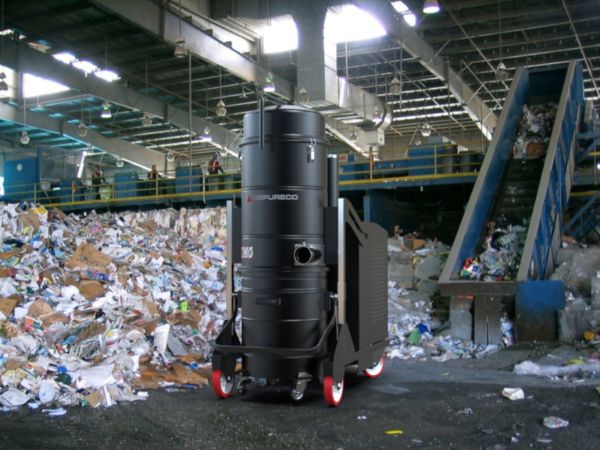
Mobile industrial vacuums can recover grit, glass fines, labels, paper fragments, plastic film, metal pieces and compatible liquid spills around tipping-floor edges, hopper legs and feeder equipment.
Use a mobile wet-and-dry vacuum for localized mixed cleanup. Move to a three-phase or high-power system when material is dense, accumulation is heavy or the pickup path exceeds the practical range of a single-phase unit.
Open piles, intact bulky waste and oversized objects remain loader, sweeper or material-handler applications. The industrial vacuum is used for the fines, fragments and residual material those machines leave behind or cannot reach.
Recommended Systems:
Conveyor carryback and escaped material commonly collect beneath accessible return runs, around head and tail sections, beside transfer chutes and under screening equipment.
A mobile or three-phase industrial debris vacuum works well when pickup locations change. A centralized vacuum system is usually the better fit when crews clean the same conveyor, screen and sorting-platform locations every shift.
High-volume glass fines, grit, pellets and shredded material may require a larger receiver or pre-separation stage to prevent frequent emptying and excessive filter loading.
Clean within guarded areas only after the equipment has been stopped, isolated and released under the facility’s lockout/tagout procedure.


Shredding, crushing and granulating can produce both airborne dust and settled material. These require different collection methods.
Use a high-airflow dust collector at a hood, enclosure or machine connection when the objective is to capture suspended dust as it is generated. Use an industrial vacuum to recover settled fines, fragments and regrind from floors, platforms and accessible equipment surfaces.
Many size-reduction areas require both systems:
Glass dust, labels, film, metal fragments and fines can accumulate beneath separation belts, around sensor cabins, along equipment frames and at discharge chutes.
Use smaller hose and tool configurations for localized cleanup around equipment frames and sensor platforms. Use larger-diameter lines for dense floor accumulations, bunker areas and bulk debris.
Mobile vacuums fit changing maintenance work. Central hose drops fit recurring cleanup points around separation and sorting lines. Follow the equipment manufacturer’s cleaning requirements before working near sensor enclosures or guarded machinery.


Paper dust, film, wire clippings, glass fines and product carryover collect around baler infeed conveyors, tie areas, hydraulic components, bunker edges and loadout transitions.
Central hose drops can serve repeated cleanup points around fixed balers and compactors. Mobile three-phase units support changing access requirements. PUMA and PUMA HD systems can be considered when the application involves heavier material, larger volumes or longer hose runs.
Compatible oil or water recovery should use a system configured for liquid pickup. Do not introduce liquids into a dry central network unless the entire system was designed for wet recovery.

Plastics and glass wash lines can generate water, labels, fines, sediment and sludge. Maintenance and support areas may also require recovery of water, hydraulic oil or other process liquids.
Specify liquid applications according to:
M100 and M100 JC units may be configured for compatible localized wet-and-dry pickup. Larger liquid volumes, chip-loaded fluids or pump-back requirements may be better served by a dedicated sump vacuum.
Shutdown work can involve dense accumulations beneath conveyors, around screen supports, inside accessible chutes and in pits or galleries. System selection should account for more than motor horsepower.
Important factors include:
PUMA and PUMA HD systems support demanding continuous-duty recovery where greater airflow, vacuum and collection capacity are required.
For very large quantities, ATLAS provides a high-capacity, trailer-ready platform with automatic filter cleaning and hydraulic hopper discharge. It should be evaluated as a large-volume material-recovery system—not as a replacement for loaders handling open piles or intact bulky waste.


High-volume, dense or abrasive material can fill the primary receiver quickly and increase filter loading. Pre-separation adds collection capacity and removes material before it reaches the main vacuum or filtration stage.
Cyclonic interceptors can support mobile and high-power recovery applications that collect larger volumes of dust, powders and solids.
Depending on the system, recovered material can be discharged into:
Recover glass and dirt fines, labels, paper fragments, plastic film, food residue and conveyor carryback around screens, sorting stations, optical sorters, bunkers and balers.
Common configurations include central hose drops for repeated pickup points, TX units for mobile continuous-duty cleanup, PUMA systems for heavier accumulations and DF or AF dust collectors for enclosed source-capture applications.
Recover metal fines, mill scale, dirt, glass, rubber fragments, plastic fluff, chips and other residual material around shredders, trommels, separation lines and balers.
Dense or abrasive material may require high-power recovery, larger hose, cyclonic separation and wear-resistant accessories. Conductive or combustible metal dust requires application and hazard review before a system is selected.
Collect pellets, flakes, labels, plastic regrind, crumb rubber, textile fluff and process dust around bale breakers, granulators, dryers, extruders, pellet handling and separation equipment.
Use wet-and-dry systems around compatible wash-line material, continuous-duty vacuums for settled dry material and high-airflow dust collectors for machine-connected source capture. Fine plastic, rubber and carbon-black dust may require combustible-dust review.
Recover glass fines, cullet, aggregate dust, gypsum residue, wood fragments, grit and mixed fines beneath conveyors, screens and separation equipment.
Sharp and abrasive material affects hose, tool, separator and receiver selection. Crusher and screen source capture may require a dust collector, while settled material is recovered with a three-phase or high-power industrial vacuum.
Collect paper dust, cardboard fragments, fibers, lint, labels, film and baling debris around conveyors, screens, sorting lines, bunkers and balers.
Light material often requires greater airflow and adequate receiver capacity. Central vacuum systems reduce repeated hose and machine setup around fixed sorting and baling locations. Combustible fiber or lint requires material-specific review.
Use industrial vacuums in enclosed tipping, transfer, processing and maintenance areas to recover fines and residual debris that loaders and sweepers cannot reach.
RDF lines may require vacuum pickup around shredding, screening, separation and storage equipment. Waste-to-energy maintenance applications involving cold, characterized ash or residue require review of temperature, chemistry, particle size, exposure and discharge.
Lead-bearing dust, conductive powders, graphite, cathode material, electrolyte residue, black mass and damaged lithium batteries are not general debris applications.
These materials can change the required: Equipment classification, Grounding and conductive accessories, Filtration, Containment
Collection method, Discharge system, Fire and explosion protection, Operator procedures
Use a mobile unit for localized cleanup, maintenance tasks and pickup points that change throughout the facility.
M100 and M100 JC provide large mobile collection capacity for dust, debris, chips, shavings and compatible liquids. M100 JC adds JetClean® filter cleaning, a tangential inlet and a larger PTFE filter surface for applications with heavier dust loading.
Best fit:
Filtration, collection accessories and wet-pickup options must be selected for the material. General wet-and-dry units should not be used for combustible, reactive or hazardous dust without the appropriate configuration and application review.
TX three-phase industrial vacuums use side-channel blower technology for continuous-duty recovery of dry dust, chips, swarf, abrasive media, fines and production debris.
The TX platform fits repeated cleanup where a mobile system is still preferred, but the operating time, material load or pickup distance exceeds the practical range of a single-phase vacuum.
Best fit:
Available options can include HEPA secondary filtration, PTFE or antistatic filter media, tangential or cyclonic inlets, grounding and contained collection. Do not assume every TX configuration is suitable for combustible dust, classified locations or liquid pickup.
PUMA and PUMA HD are continuous-duty three-phase systems for heavier dry debris, larger collection volumes and more demanding pickup paths.
Side-channel blowers provide sustained industrial suction, while tangential inlets and internal cyclonic separation help direct incoming material toward the receiver before it reaches the primary filter.
Best fit:
PUMA provides a high-power step above standard three-phase vacuums. PUMA HD extends the platform for larger-scale recovery, greater airflow and heavier production demands.
Filter media, filter cleaning, receiver capacity, pre-separation and discharge should be configured around the actual material. High power alone does not determine whether a system can transport material through the required hose distance.
Centralized vacuum systems connect fixed hose inlets or process pickup points to stationary vacuum, filtration, separation and collection equipment.
Consider a central system when:
PUMA FIX combines stationary suction, filtration, automatic filter cleaning and a collection bin in a compact central-system platform.
HF provides stationary suction, filtration and separation for engineered fixed-piping systems requiring repeated pickup points or longer conveying distances.
CVS is a stationary vacuum-generation platform used as part of a larger system with application-specific filtration, separation, discharge, pipework and controls.
Central-system sizing must account for material transport velocity, pipe diameter, distance, elevation, bends, pressure loss, simultaneous users, inlet control, leakage, filtration and discharge.
Industrial dust collectors capture suspended process dust through extraction hoods, enclosures, machine connections and ducted pickup points.
DF 40 is a mobile high-airflow dust collector for localized source capture and machine-connected extraction.
DF FIX provides stationary high-airflow collection with a removable bin for fixed production equipment and ducted capture points.
AF is a stationary high-airflow collector for larger or multi-point dust-collection systems requiring greater filter area, automatic filter cleaning and configurable bulk discharge.
Best fit:
Dust collectors prioritize airflow volume. They are not substitutes for high-vacuum systems used to recover dense piles, large fragments or settled material through smaller cleaning hoses.
Combustible, conductive or regulated dust requires application review before filtration, grounding, electrical classification, isolation or explosion-protection options are selected.
Ensuring cleanliness and safety at waste disposal centers demands reliable vacuum solutions. Our range includes both mobile and stationary industrial vacuum cleaners, meticulously designed to handle large quantities of debris, dust, and other undesired materials within the workspace. Equipped with high-performance filters, our vacuum systems offer formidable protection, markedly minimizing the risk of contamination and exposure to hazardous substances for operators.
We recommend industrial vacuum cleaners boasting the following characteristics:
Opting for tailored vacuum solutions designed for landfills enables seamless management of significant material volumes, boosts operational effectiveness, minimizes upkeep expenses, and fosters heightened workplace safety.
Reach out to us to explore further our vacuum cleaners for waste disposal centers.
Use an industrial vacuum to recover settled dust, spills and accumulated solids through cleaning hoses and pickup tools. Use a dust collector for airborne fine particulate captured through hoods, enclosures or machine connections at the point of generation. Many waste and recycling lines need both: source capture for suspended dust and high-vacuum cleanup for material that settles around equipment.
The practical distance depends on material density, particle size, hose or pipe diameter, airflow, vacuum level, vertical lift and the number of bends. Provide the complete pickup route so the system can be evaluated against the actual pressure loss and transport requirement.
Add a pre-separator when bulk volume, large particles, abrasive fines or high dust loading would fill the vacuum receiver quickly or overload the primary filter. The pre-separator removes material before it reaches the vacuum, increasing collection capacity, reducing filter loading and simplifying discharge. Size it around the material, airflow, hose diameter and required emptying method.
Match hose diameter and conveying velocity to the largest particle, material density and pickup distance. Minimize sharp bends and sudden diameter changes, use the correct pickup tool and avoid feeding material faster than the system can transport it. For frequent emptying, add a larger receiver, pre-separator or application-specific discharge system instead of increasing hose size without reviewing airflow.
No. HEPA filtration addresses particle capture; it does not by itself control ignition sources or make the complete vacuum system suitable for combustible dust. The material, dust hazard, work area, electrical classification, grounding and bonding, hoses, tools, collection method and complete equipment configuration must be reviewed before use.
A high-power industrial vacuum can replace or supplement shoveling and loader cleanup for some dry, flowable materials, especially where hose access, containment or long-distance recovery is valuable. It is not a universal replacement for mechanical handling. Oversized, dense, wet, stringy or bridged material may require screening, breakup or other equipment. Test the material and confirm volume, pickup distance, lift and discharge requirements before selection.
Provide the material, particle size, density, moisture, hazards, quantity, pickup point, hose or pipe distance, vertical lift, duty cycle, filtration requirement, available utilities and preferred discharge method. Photos, video, safety data and a material sample can improve the recommendation.
