



NFPA 660 Vacuum Requirements for Combustible Dust Cleanup
Combustible dust cleanup is not just another housekeeping task. In facilities that generate or handle combustible dust, cleanup is part of hazard control. The type of dust, the amount being collected, and the area where cleanup is taking place all affect which vacuum can be used safely.
That is where NFPA 660 comes in.
NFPA 660 is now the main standard for combustible dust and particulate solids. For facilities in the United States, it is the standard that helps define how combustible dust hazards should be identified, managed, and controlled. That includes how dust is cleaned up and what role industrial vacuums can play in that process.
When people shop for a vacuum for combustible dust, they often start by looking at horsepower, airflow, or container capacity. Those specs matter, but they are not the first questions to ask. The real starting point is understanding the dust itself, the location where cleanup happens, and whether the vacuum is actually designed for that specific application.
Quick Answer: What Does NFPA 660 Mean for Industrial Vacuum Selection?
NFPA 660 is not a vacuum certification—it is a combustible dust safety framework.
NFPA 660 helps facilities evaluate combustible dust hazards and choose safer housekeeping methods, including when and how industrial vacuums can be used for dust cleanup. The right vacuum depends on the dust being collected, whether the area is ordinary or classified, the amount of material present, and whether the vacuum is being used for residual housekeeping or larger accumulations.
For ordinary, unclassified areas, a properly designed combustible dust vacuum can support routine housekeeping when it is configured for static control, proper filtration, dust containment, and reduced ignition risk. For hazardous or classified locations, the vacuum must be suitable and marked for that specific area classification.
For combustible metal dust, conductive powders, aluminum dust, magnesium dust, reactive materials, or classified areas, vacuum selection should be reviewed as part of the facility’s dust hazard analysis, housekeeping plan, and combustible dust management strategy.
What NFPA 660 Is and Why It Matters
NFPA 660 was created to consolidate combustible dust guidance into a single framework. Instead of bouncing between multiple standards, facilities now have a more centralized reference point for evaluating dust hazards and selecting safer equipment and processes.
The standard is built around a simple idea: if a dust is combustible or explosive, it has to be treated accordingly. That determination cannot be based on assumptions, past habits, or the fact that there has never been an incident before. A facility has to understand what material it is dealing with and what kind of risk that material creates.
That matters because combustible dust is often misunderstood. Many people think of it only in terms of wood flour, food powders, or plastic dust. In reality, combustible dust can also include metal dusts and powders, some of which require even more demanding cleanup.
This is why NFPA 660 matters for vacuum selection. The right machine is not just the one that can pick up the material. It is the one that can do it without becoming part of the hazard.
NFPA 660 vs OSHA, ATEX, Class II Div 2, UL, ETL, and NRTL
Compliance language matters because these terms do not all mean the same thing.
Many buyers search for an “NFPA compliant vacuum,” “OSHA approved vacuum,” “ATEX vacuum,” “Class II Div 2 vacuum,” or “explosion proof vacuum” as if those terms are interchangeable. They are not. NFPA 660 is a combustible dust standard used to guide hazard identification, housekeeping, dust control, and risk reduction. It does not turn a vacuum into a universally “NFPA certified” machine for every dust or facility. OSHA can enforce safe workplace requirements and reference consensus standards, while ATEX, Class II Div 1, Class II Div 2, UL, ETL, CSA, and NRTL markings relate more directly to equipment suitability, electrical classification, testing, and use in specific environments.| Term | What It Means for Vacuum Selection |
|---|---|
| NFPA 660 | Combustible dust safety standard used to guide housekeeping, dust hazard analysis, and dust management practices. |
| OSHA combustible dust | Workplace safety enforcement context; cleanup methods should avoid spreading dust or creating additional hazards. |
| ATEX | European hazardous-area equipment framework often referenced for explosion-risk applications and dust zones. |
| Class II Div 1 / Class II Div 2 | North American hazardous-location classifications for combustible dust environments. |
| UL, ETL, CSA, NRTL | Testing, listing, or certification bodies/marks that may apply to electrical equipment depending on product and application. |
| HEPA | High-efficiency filtration for fine or hazardous dust; useful, but not the same as explosion protection or area-classification suitability. |
Dust Hazard Analysis Before Vacuum Selection
The vacuum should match the DHA, not just the dust on the floor.
A dust hazard analysis, often shortened to DHA, helps determine whether a dust is combustible, where it is present, how it could be dispersed, and what ignition or explosion risks may exist. For combustible dust cleanup, this matters because the same vacuum may be appropriate in one area and completely wrong in another.
A DHA can help clarify whether cleanup is happening in an ordinary location, a hazardous classified location, near process equipment, around combustible metal dust, or in an area where conductive accessories, antistatic filtration, explosion-proof construction, or air-powered operation may be required.
Before selecting an industrial vacuum, facilities should identify the dust type, expected dust load, cleanup frequency, area classification, static-control needs, filtration requirements, and whether the vacuum is being used for routine residual housekeeping or larger material recovery.

HEPA, M-Class, Antistatic, and Grounded Vacuum Components
Filtration is important, but it is only one part of combustible dust cleanup.
High-efficiency filtration can be important when collecting fine, hazardous, or exposure-sensitive dust. HEPA filters, M-Class filters, antistatic filters, conductive hoses, grounded tools, and sealed collection systems can all play a role in a safer vacuum configuration.
However, HEPA filtration alone does not make a vacuum suitable for combustible dust or hazardous locations. A vacuum used around combustible dust also needs to be evaluated for ignition-source control, static dissipation, grounding, accessory compatibility, dust containment, and whether the vacuum is appropriate for the area classification.
For fine or hazardous powders, review our HEPA dust extractors. For classified or explosion-risk areas, compare explosion-proof industrial vacuums. For ordinary-location combustible dust housekeeping, start with our combustible dust vacuum options.

First Question: Ordinary Location or Hazardous Location?
Before looking at vacuum design, filters, or accessories, the first question should always be this:
Is the cleanup taking place in an ordinary location or in a hazardous, classified location?
That distinction changes everything.
An ordinary location is an area that has not been classified as hazardous because the probability of an explosive atmosphere is not expected under normal conditions. A hazardous location, on the other hand, is an area where combustible dust may be present in sufficient concentration to create a fire or explosion risk.
If the area is classified, the vacuum itself must be suitable and properly certified for use in that specific location. This is not something that can be approximated or worked around. A vacuum used in a classified area has to match the requirements of that area.
That is why area classification should come before almost every other buying decision. Too often, people compare vacuums by power or price without first confirming whether the machine can legally and safely operate where it is needed.
For many facilities, most cleanup may occur in ordinary, unclassified areas. Even then, that does not mean any vacuum will do. NFPA 660 still requires the vacuum to be designed to reduce ignition risk and support safer housekeeping.
What NFPA 660 Allows in Unclassified Areas
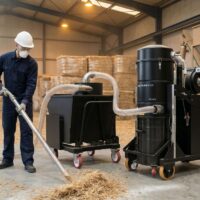
In unclassified areas, portable industrial vacuums can play an important role in housekeeping for combustible dust. The goal is to remove residual dust accumulations before they build up and create a more serious hazard.
That is an important point. In these areas, the vacuum is not just being used for general cleanliness. It is being used as part of a preventive housekeeping strategy.
NFPA 660 also makes it clear that there is a difference between routine housekeeping and handling a large spill or a large accumulation of combustible dust. If there is a substantial amount of material on the floor, that may call for a different cleanup process before a portable vacuum is used for the remaining residue.
This is where application matters. A vacuum that is appropriate for collecting light residual dust from around equipment may not be the right solution for picking up a heavy accumulation of combustible material after a spill or process upset.
The internal design of the vacuum matters as well. For combustible dust cleanup, the machine should be designed so that dust-laden air does not pass through the fan or blower. The airflow should pass through filtration before reaching those components. That design approach helps reduce the chance that the vacuum itself becomes an ignition source.
In practical terms, that means a standard shop vacuum is rarely the right answer for combustible dust cleanup. A vacuum built specifically for industrial housekeeping in combustible dust environments is a very different piece of equipment.
Why Combustible Metal Dust Is Different
One of the most important distinctions in this conversation is the difference between ordinary combustible dust and combustible metal dust.
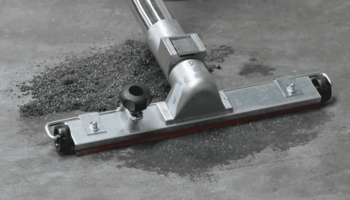
Combustible metal dust should not be treated like general plant dust. Metals such as aluminum, magnesium, and other finely divided conductive dusts can create a much more serious hazard. Because of that, the expectations around vacuum design and use become more demanding.
This is where many facilities get into trouble. They assume that if a vacuum is marketed for combustible dust, it is automatically acceptable for metal dust as well. That is not always the case.
Combustible metal dust cleanup requires a much more deliberate approach. The vacuum needs to be effectively bonded and grounded to prevent the buildup and discharge of static electricity. Hoses and accessories should be conductive or static dissipative. Nozzles and fittings should be chosen with the same level of care, because the accessories are part of the overall safety system.
This is also not an area where the vacuum should be thought of as a primary dust collector. For combustible metal dust, portable vacuums are generally more appropriate for small residual amounts and housekeeping tasks, not for functioning as the main collection system for the process.
That distinction matters. If a facility is generating large amounts of combustible metal dust as part of production, the answer may not be a larger portable vacuum. The answer may be a properly designed central or dedicated collection system, with the portable vacuum used only for final cleanup.
What to Look for in an Industrial Vacuum for Combustible Dust

Start with the work area. Is the vacuum going into an unclassified area, or will it be used in a classified hazardous location? If the area is classified, the vacuum must be certified and marked for that environment. That is the first filter in the buying process.
Next, look at how the machine handles dust internally. The vacuum should be designed so that dust-laden air passes through appropriate filtration before reaching the motor or blower. Dust should not be allowed to pass through the motor section of the vacuum.
Filtration also matters. A well-designed system should use filtration that is appropriate for the material being collected and the risk involved. In many industrial applications, facilities look for a primary antistatic filter and often add a secondary high-efficiency filter stage for additional protection. The exact setup depends on the application, but the principle is the same: contain the dust and keep it out of the wrong parts of the machine.
For combustible dust, and especially combustible metal dust, bonding and grounding are critical. The vacuum, hose, tools, and fittings all need to support static control. It is not enough for only the vacuum body to be designed properly if the accessories introduce another risk.
This is one of the easiest things to overlook and one of the most important things to get right.
Finally, be honest about the job the vacuum is expected to do. Is it being used for periodic housekeeping of residual dust, or is it being asked to function like the main collection system for a dusty process?
Those are two very different roles, and not every portable industrial vacuum should be used for both. In many combustible dust applications, the safest answer is not the most aggressive vacuum. It is the one that fits the actual housekeeping task and the hazard profile of the material.
NFPA Dust Collector vs. Combustible Dust Vacuum
Dust collectors capture process dust; vacuums clean what settles.
Searchers often use terms like NFPA dust collector, NFPA 660 compliant dust collector, and combustible dust vacuum together, but these systems solve different problems.
An industrial dust collector is typically used for source capture or process dust collection where dust is generated. An industrial vacuum is used for settled dust, residual accumulations, floors, ledges, equipment, beams, machinery, work cells, and cleanup points where dust has already collected.
Many facilities need both. Dust collectors help control airborne or process dust, while industrial vacuums support housekeeping by removing settled combustible dust without sweeping it or blowing it back into the air.
Common Mistakes That Create Risk
The most common mistake is assuming all combustible dust behaves the same way. It does not.
Another common mistake is thinking strong suction automatically means safer cleanup. It does not. Vacuum performance is important, but safety depends just as much on design, grounding, filtration, location suitability, and the type of dust being collected.
Facilities also create unnecessary risk when they use the wrong cleanup methods altogether. Dry sweeping or using compressed air can spread dust into the air, which can make the hazard worse rather than better. In combustible dust environments, cleanup methods should reduce the hazard, not redistribute it.
Another mistake is focusing only on the vacuum and ignoring the bigger picture. NFPA 660 is not just about machine selection. It ties vacuum cleanup into hazard analysis, housekeeping practices, and the broader combustible dust management plan for the facility.
A vacuum can be the right tool, but only when it matches the dust, the location, and the purpose.
Final Takeaway
If you need to collect combustible dust, the first question should never be, “What vacuum has the most power?”
The better questions are:
What material are we collecting?
Is this an ordinary location or a hazardous location?
Are we cleaning up residual dust or handling a larger accumulation?
Is the vacuum designed to reduce ignition risk instead of adding to it?
That is the mindset NFPA 660 pushes facilities toward.
For many ordinary locations, a properly designed industrial vacuum can be an effective housekeeping tool for combustible dust cleanup. But when combustible metal dust, conductive dust, or classified areas enter the picture, the requirements become much more specific.
That is where application-first thinking matters most. The right vacuum is not just the one that picks the dust up. It is the one that does the job safely, fits the environment, and supports the facility’s overall combustible dust strategy.
