

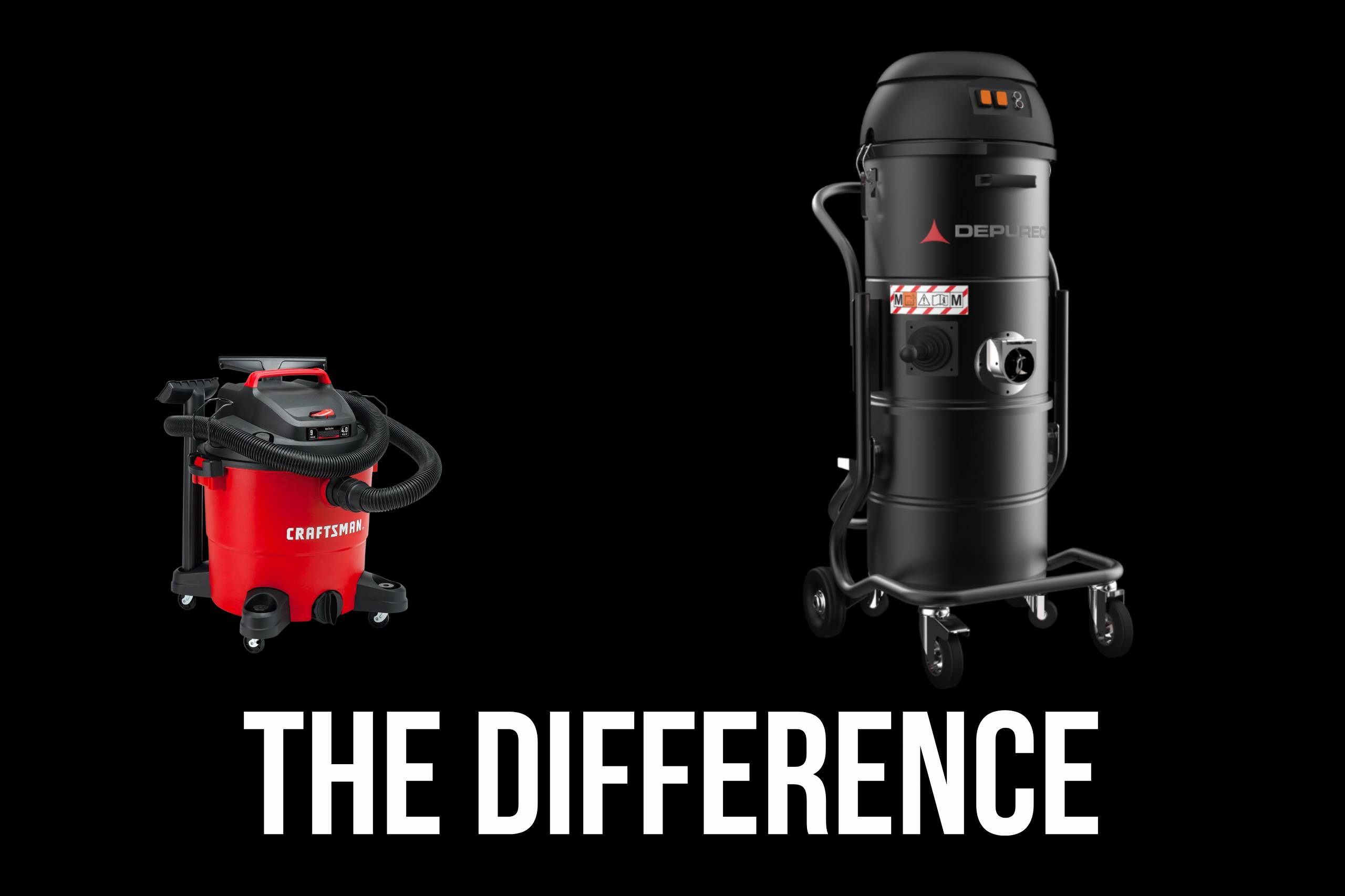
Shop-Vac vs Industrial Vacuum: What’s Right for Your Job?
A shop vac is usually adequate for occasional cleanup of ordinary, nonhazardous debris or small liquid spills. An industrial vacuum is designed for applications where material type, operating time, dust loading, collection volume, hose distance, disposal requirements, or safety conditions exceed what a light-duty wet/dry vacuum can reliably handle.
The difference is not simply tank size or advertised horsepower. The right vacuum must be matched to what is being collected, how often it will operate, how far the material must travel, how the material will be discharged, and whether the dust or debris presents an exposure, fire, explosion, conductivity, or reactivity concern.
This guide explains when a shop vac is sufficient, when an industrial vacuum is the better choice, and which technical factors should drive the decision.
Shop Vac vs Industrial Vacuum: Quick Comparison
| Decision Factor | Shop Vac | Industrial Vacuum |
|---|---|---|
| Typical Use | Intermittent cleanup and small spills | Production, maintenance, process cleanup, and repeated material recovery |
| Operating Time | Short cleaning periods with breaks between uses | Frequent, extended, or continuous-duty applications, depending on the model |
| Material Volume | Low-volume dirt, debris, or liquids | Moderate to high volumes of dust, powder, chips, liquids, sludge, or production waste |
| Motor Design | Commonly compact single-phase motors | Single-phase, three-phase turbine, Roots blower, or compressed-air systems |
| Filter Capacity | Limited filter area that may load quickly with fine dust | Larger filter surfaces selected for heavier dust loading and longer operating periods |
| Filter Cleaning | Basic cleaning or manual filter removal | Manual shaker, reverse airflow, JetClean, pulse cleaning, or automatic cleaning options |
| Filtration | General-purpose cartridge or bag filters | Application-specific filtration, including M-Class, antistatic, PTFE, Nomex, and HEPA options where documented |
| Collection and Discharge | Small tank that is usually emptied manually | Detachable bins, bags, Longopac, valves, pump-out systems, tilting bins, or separators |
| Material Handling | Ordinary nonhazardous dirt, debris, and small liquid spills | Fine powder, metal chips, swarf, oil, coolant, sludge, abrasive waste, and specialized materials |
| Hose Distance | Generally used with short hoses | Can be configured for longer runs, larger hose diameters, restrictions, and vertical lift |
| Integration | Standalone cleanup | Mobile, machine-mounted, fixed, or centralized systems |
| Hazard Suitability | Should not be assumed suitable for combustible, conductive, reactive, or toxic material | Model- and configuration-specific after the material, process, and area are evaluated |
| Overall Cost | Lower initial purchase price | Higher initial investment, with potential savings in labor, downtime, consumables, and equipment life |
The Real Difference Is Not Just Suction Power
It is common to compare vacuums by horsepower, peak horsepower, water lift, or CFM. Those numbers matter, but none of them can determine application fit by itself.
A vacuum that performs well with dry floor debris may struggle with dense metal chips. A unit with strong airflow may lose performance quickly when its filter becomes loaded with fine powder. A vacuum that can collect a small liquid spill may not be designed to separate, recover, and discharge hundreds of gallons of coolant mixed with metal solids.
The better comparison is based on the complete system:
- Motor and duty cycle
- Airflow and vacuum pressure
- Filter surface area
- Filter media
- Filter-cleaning method
- Inlet and hose diameter
- Collection capacity
- Discharge method
- Material characteristics
- Available power or compressed air
- Required documentation and hazard controls
An industrial vacuum should be selected around the process—not selected first and forced into the application later.
Duty Cycle: How Long Does the Vacuum Need to Run?
One of the clearest differences between a shop vac and an industrial vacuum is how the machine is expected to operate.
A shop vac is generally designed for short, intermittent cleaning. It may work well for several minutes at a time while an operator cleans a workbench, collects ordinary floor debris, or removes a small spill.
That becomes a problem when the vacuum is expected to:
- Run repeatedly throughout a shift
- Remain connected to production equipment
- Clean several machines or work areas
- Operate through a long hose
- Recover large volumes of material
- Run for extended periods without cooling breaks
- Support more than one operator or pickup point
Industrial vacuums are available with different motor technologies for different workloads. Compact single-phase units may support mobile maintenance and frequent cleanup. Three-phase side-channel turbine systems are better suited to longer operating periods and demanding production environments. Roots blower systems may be used where high vacuum performance, long piping runs, or centralized collection is required.
The correct duty cycle depends on the actual model. “Industrial” should not be treated as a guarantee that every vacuum can run continuously.
Airflow vs Vacuum Pressure
Airflow and vacuum pressure describe different parts of vacuum performance. Airflow, commonly measured in CFM, is important for carrying lighter material and moving larger volumes of air. It is especially relevant when collecting airborne dust, light debris, or material through a larger hose. Vacuum pressure, often expressed as water lift or inH₂O, becomes increasingly important when collecting dense material, overcoming hose restrictions, pulling through smaller tools, or transporting material over longer distances.
For example, light dust spread across a production floor does not behave like steel chips in the bottom of a CNC machine. A vacuum selected for one may perform poorly with the other, even when its advertised motor power appears similar.
The correct balance depends on:
- Material density
- Particle or chip size
- Hose diameter
- Hose length
- Vertical lift
- Number of bends
- Pickup tool
- Required collection rate
Filter Area and Filter Cleaning Matter More Than Many Buyers Expect
A vacuum may have strong initial suction and still become frustrating to use if the filter is too small for the dust load.
Fine powders can quickly cover the filter surface, restrict airflow, and reduce collection performance. Operators may then spend more time stopping the machine, removing the filter, cleaning it manually, or replacing it.
For repeated fine-dust collection, compare:
- Total filter surface area
- Primary filter classification
- Filter material
- Dust-release characteristics
- Filter-cleaning method
- Secondary filtration options
- Dust disposal method
Industrial vacuums may use star filters, cartridge filters, pocket filters, or other configurations selected around the application. Filter-cleaning options can include manual shakers, reverse airflow, compressed-air cleaning, JetClean systems, or automatic pulse cleaning. HEPA filtration can be an important part of an industrial vacuum configuration, but HEPA alone does not determine whether the complete machine is suitable. The primary filter, seal integrity, dust disposal method, duty cycle, and application must also be considered. A HEPA filter should not be treated as a universal upgrade that converts any shop vac into a properly configured industrial HEPA vacuum.
Related guide:
Collection and Discharge Can Determine Whether a Vacuum Is Practical
Tank capacity receives a lot of attention, but capacity alone does not explain how efficiently material can be handled.
Ask what happens after the material enters the vacuum:
- Does the operator lift and tip the entire machine?
- Can the collection container be detached?
- Can dust be collected directly into a bag?
- Is continuous bagging required?
- Can liquids be pumped or discharged without opening the tank?
- Do chips and liquids need to be separated?
- Will a forklift or tilting bin be used?
- Is material being recovered for reuse?
- Does the operator have to handle the material a second time?
A larger tank is not automatically better. A 30-gallon container that is difficult to empty may create more labor and ergonomic risk than a smaller detachable bin or a properly designed discharge system.
For high-volume material, a cyclone, interceptor, or pre-separator can collect the majority of the material before it reaches the vacuum. This can protect filters, increase usable collection capacity, and reduce the number of times the primary vacuum must be emptied.
When Is a Shop Vac Enough?
A shop vac can be the right choice when all or most of the following are true:
- Cleanup is occasional and short
- Material volume is low
- The material is ordinary and nonhazardous
- The pickup distance is short
- The material does not rapidly clog the filter
- Manual tank emptying is acceptable
- Liquid recovery is limited to small spills
- The vacuum is not connected to production equipment
- A vacuum failure would not interrupt production
- Specialized separation, containment, or discharge is not required
There is no advantage in overspecifying equipment for a simple application. A shop vac is often a practical tool for maintenance rooms, small workshops, service vehicles, and occasional cleanup.
The problem begins when a light-duty vacuum is used as a permanent solution for an application it was not designed to handle.
7
Seven Signs You Need an Industrial Vacuum
1. The filter clogs during every cleanup
Frequent filter loading usually means the filter area, filter media, or cleaning system is not matched to the dust. Replacing filters more often does not solve the underlying equipment mismatch.
1. The filter clogs during every cleanup
Frequent filter loading usually means the filter area, filter media, or cleaning system is not matched to the dust. Replacing filters more often does not solve the underlying equipment mismatch.
1. The filter clogs during every cleanup
Frequent filter loading usually means the filter area, filter media, or cleaning system is not matched to the dust. Replacing filters more often does not solve the underlying equipment mismatch.
2. The vacuum overheats or needs frequent breaks
If the vacuum cannot complete the cleanup without cooling periods, its motor system or duty cycle may be too limited for the application.
1. The filter clogs during every cleanup
Frequent filter loading usually means the filter area, filter media, or cleaning system is not matched to the dust. Replacing filters more often does not solve the underlying equipment mismatch.
3. Operators empty the tank several times per shift
Repeated emptying increases labor and can create secondary dust or spill exposure. A larger detachable container, direct bagging system, pre-separator, or alternative discharge method may be more efficient.
4. Chips, stringy swarf, or dense material block the hose
Metal chips and swarf vary considerably. Fine aluminum chips, dense steel turnings, stringy swarf, grinding sludge, and oily metal fines do not move through a hose in the same way.
Hose diameter, inlet design, airflow, vacuum pressure, chip geometry, and separators all matter.
5. Liquids and solids must be separated or recovered
A general wet/dry vacuum may collect a small mixture of liquid and debris. That is different from recovering coolant from a CNC sump, separating metal chips, filtering the fluid, and discharging or returning the coolant.
6. The material requires additional hazard review
Combustible, conductive, toxic, reactive, or exposure-sensitive material should never be treated as ordinary housekeeping waste.
The material, process, area classification, ignition risks, filtration, grounding, construction, and disposal method must be evaluated before a vacuum is selected.
7. The vacuum is becoming part of the production process
Once a vacuum is connected to machinery, used every shift, shared across several workstations, or relied upon to prevent production downtime, it is no longer just a cleanup tool. It is production equipment and should be specified accordingly.
Choose the Vacuum by Material and Application
Fine Dust and Powder
Fine powder creates a different challenge than general floor debris. It can blind a small filter, pass through inadequate filtration, leak during disposal, or become airborne again when the collection tank is emptied.
Important questions include:
- How fine is the dust?
- How much is collected per shift?
- Is the material free-flowing, sticky, oily, or hygroscopic?
- Is it combustible, conductive, toxic, or sensitizing?
- Is HEPA filtration required?
- How will the dust be discharged without creating a second cloud?
- Will the vacuum remain connected to the machine?
- How frequently must the filter be cleaned?
Applications may include grinding dust, sanding dust, additive-manufacturing powder, food ingredients, chemical powders, pharmaceutical residue, carbon dust, composite dust, and fine production waste.
Metal Chips, Shavings, and Swarf
Metalworking waste can range from light aluminum chips to dense steel turnings, sharp shavings, long stringy swarf, grinding fines, and oily chip mixtures.
A vacuum for metal chips should be evaluated for:
- Chip length and shape
- Material density
- Oil or coolant content
- Hose and inlet diameter
- Abrasion resistance
- Collection volume
- Separator requirements
- Discharge method
- Potential combustibility or reactivity
Stringy swarf can bridge inside hoses and containers. Dense chips may require greater vacuum pressure. Fine metal dust may require a completely different configuration than large machining chips.
The phrase “metal vacuum” is too broad to select equipment safely or effectively. The specific metal and its physical form matter.
Coolant, Oil, Sludge, and Mixed Liquids
A shop vac can remove a small spill. A sump vacuum is designed for a more complete fluid-maintenance process.
Depending on the model and configuration, a sump vacuum may be used to:
- Recover coolant or cutting oil
- Collect chips and sludge
- Separate solids from liquid
- Pump or discharge recovered fluid
- Return usable coolant
- Reduce manual tank cleaning
- Shorten CNC sump cleanout time
- Limit production downtime
The amount of liquid, solids concentration, chip geometry, tank access, discharge distance, and desired fluid recovery method should all be reviewed.
Abrasive or High-Volume Material
Sand, blasting media, glass particles, mineral dust, concrete debris, foundry sand, and other abrasive materials can wear hoses, bends, inlets, filters, and collection components.
High-volume applications may require:
- Heavy-duty construction
- Abrasion-resistant accessories
- Larger inlets and hoses
- Detachable or tilting bins
- Cyclone pre-separation
- Three-phase power
- Continuous bagging
- Forklift handling
- Centralized piping
The goal is not only to collect the material. It is to keep the system productive without excessive filter wear, hose replacement, or manual handling.
Combustible, Conductive, or Reactive Dust
A standard shop vac should not be assumed suitable for combustible or reactive material.
Before selecting a vacuum, identify:
- Exact material
- Particle size and form
- Combustibility data
- Minimum ignition energy, where available
- Conductivity
- Reactivity with water or other materials
- Area classification
- Existing Dust Hazard Analysis information
- Required grounding and bonding
- Acceptable collection and disposal method
An antistatic hose or filter does not turn a standard vacuum into an explosion-protected vacuum. Likewise, a HEPA filter does not make a vacuum suitable for combustible dust.
Explosion-protected and ORD LOC configurations are application-specific. The selected model, electrical components, grounding path, construction, filtration, collection method, and classified area must be reviewed together.
Silica, Lead, and Other Exposure-Sensitive Dust
Fine silica, lead-containing dust, and other exposure-sensitive materials require more than strong suction.
The complete control approach may involve:
- Source capture
- Documented filtration
- HEPA secondary filtration where required
- Sealed collection
- Controlled disposal
- Appropriate accessories
- Worker-protection procedures
- Exposure monitoring
- Facility-specific compliance measures
A vacuum can be one part of an exposure-control plan, but it should not be presented as eliminating all risk by itself.
Industrial Vacuum, Dust Extractor, or Dust Collector?

Industrial Vacuum

Dust Extractor

Dust Collector

Central Vacuum System
A central vacuum system provides vacuum through fixed piping to several pickup points, production machines, or work areas. It can reduce the need to move individual vacuums around a facility.
Dust Extractor
The first question should be:
Are you collecting material after it settles, extracting it directly from a machine, or controlling airborne dust as it is generated?
The answer changes the type of equipment and the airflow calculations required.
Which Type of Industrial Vacuum Fits the Application?

Compact Single-Phase Industrial Vacuums
A compact single-phase industrial vacuum can be a practical step up from a shop vac when the application requires better construction, more filter area, improved filter cleaning, or more efficient collection without requiring three-phase power.
Common uses include mobile maintenance, machine cleanup, fine dust, powders, production debris, and repeated general industrial housekeeping.

High-Power or Three-Phase Industrial Vacuums
A three-phase vacuum is generally considered when the machine must operate for longer periods, move heavier material, support longer hose runs, collect larger volumes, or remain connected to a process. These machines are often used in machining, foundries, heavy industry, bulk-material handling, woodworking, recycling, and continuous production environments.

Wet and Dry Industrial Vacuums
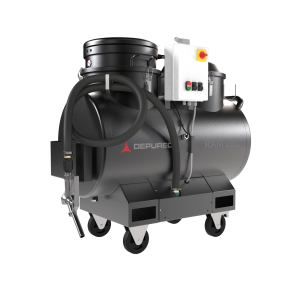
Sump Vacuums

Fine-Dust or HEPA-Configured Vacuum
Explosion-Protected or ORD LOC Vacuums
Fine-dust applications require attention to the complete filtration system, not just the presence of a HEPA filter. Filter area, cleaning method, seals, collection, and disposal must be matched to the dust load and exposure requirements.
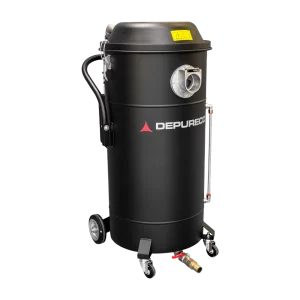
Air-Powered Industrial Vacuum
Fine-dust applications require attention to the complete filtration system, not just the presence of a HEPA filter. Filter area, cleaning method, seals, collection, and disposal must be matched to the dust load and exposure requirements.
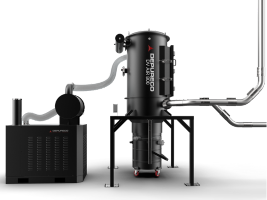
Industrial Central & Stationary Vacuum Systems
A central system may make sense when:
- Several operators clean at the same time
- Multiple production machines require extraction
- Long hose runs are already causing performance problems
- Mobile vacuums create traffic or handling issues
- The facility wants fixed collection points
- Material must be transported to one collection location
- Housekeeping labor is spread across a
large production area
The system should be engineered around simultaneous users, pipe diameter, transport velocity, material characteristics, pressure loss, separator design, filtration, and discharge.
Pre-Separators or Interceptors
A pre-separator can be added when the facility collects large volumes, abrasive material, chips, liquids, or dust that would otherwise overload the primary vacuum. It can increase collection capacity, reduce filter loading, protect the vacuum, and simplify material discharge.
Compare Total Operating Cost—not Just Purchase Price
A shop vac almost always has a lower purchase price. That does not automatically make it the lower-cost solution.
Consider the total cost of the cleanup process:
- Labor per cleanup
- Number of cleanups per week
- Time spent cleaning or replacing filters
- Time spent emptying tanks
- Production downtime
- Number of shop vacs replaced each year
- Bags and filter consumption
- Secondary cleanup caused by dust leakage
- Manual handling of liquid or solids
- Coolant or material that could be recovered
- Service life
- Cost of a blocked process line or unavailable machine
- Cost of using the wrong equipment for a hazard-sensitive material
For a small maintenance task, the shop vac may remain the better value.
For a production application, the larger cost is often not the vacuum. It is the operator time, downtime, repeated handling, and lost material created by an undersized or poorly matched system.
What to Gather Before Requesting an Industrial Vacuum Recommendation
A useful recommendation requires more than asking for the “strongest vacuum.”
Gather the following information:
- Exact material being collected
- Particle, chip, or chunk size
- Dry, wet, oily, or mixed condition
- Approximate material temperature
- Bulk density, if known
- Combustible, conductive, toxic, or reactive properties
- Volume per cleanup or per shift
- Cleaning frequency
- Required operating time
- Hose diameter and total distance
- Horizontal and vertical lift
- Pickup tool or machine connection
- Preferred collection and discharge method
- Available voltage and phase
- Available compressed air, if applicable
- Number of operators or pickup points
- Whether the vacuum will be mobile, fixed, or centralized
- Required filtration or documentation
- Area classification or Dust Hazard Analysis information
- Whether the collected material will be discarded, separated, or reused
The more complete this information is, the less likely the facility is to purchase a vacuum that performs well in a demonstration but poorly in the real application.
Industrial Vacuum Support from Depureco Industrial Vacuums

Depureco Industrial Vacuums support manufacturing and industrial facilities from Kyle, Texas with more than 100+ industrial vacuum models and a wide range of filters, accessories, pre-separators, collection systems, and application-specific configurations.
The recommendation process begins with the material and application. When needed, Depureco Labs can evaluate customer material using representative hoses, accessories, filters, separators, and vacuum configurations before a final system is selected.
Frequently Asked Questions
Is an industrial shop vac the same as an industrial vacuum?
Not necessarily. “Industrial shop vac” is commonly used as a search term for a larger or heavier wet-and-dry vacuum, but the label does not confirm that the machine is designed for industrial duty.
A true industrial vacuum is selected around operating time, motor technology, filter surface area, filter cleaning, material volume, collection method, discharge requirements, hose distance and the characteristics of the material being collected.
A commercial or heavy-duty shop vac may be suitable for intermittent cleanup. It should not automatically be treated as equivalent to a machine designed for production cleanup, process integration, fine powder, metal chips, coolant recovery or extended operation.
Does adding a HEPA filter turn a shop vac into an industrial HEPA vacuum?
No. A HEPA filter is only one component of the complete vacuum and filtration system.
The vacuum must also maintain adequate airflow as dust loads the primary filter, prevent air from bypassing the filtration path, support the required operating time and allow the collected material to be removed without creating uncontrolled secondary exposure.
Primary filter area, filter-cleaning method, seals, collection bags or containers and the documented classification of the HEPA filter all matter. Adding a HEPA filter also does not make a standard vacuum suitable for combustible dust or a classified location.
See the industrial vacuum filter guide: https://depurecousa.com/blog/industrial-vacuum-filter-types/
Why does a shop vac lose suction so quickly when collecting fine powder?
Fine powder can rapidly cover a small filter surface and restrict the airflow passing through it. The motor may still be running normally, but the vacuum’s usable pickup performance declines as the filter becomes loaded.
Repeated fine-dust collection may require more filter surface area, filter media matched to the powder, an effective filter-cleaning system and a collection method that limits dust release during emptying.
A cyclone or pre-separator may also help when the application produces enough material to overload the vacuum’s primary filter or collection container.
Which matters more for metal chips: CFM or vacuum pressure?
Both matter, but their importance changes with the chip and pickup path.
Airflow helps carry material through the hose. Vacuum pressure helps overcome dense material, vertical lift, hose restrictions, small pickup tools and longer transport distances.
Short aluminum chips, dense steel turnings, long stringy swarf and oily grinding fines behave differently. The vacuum must be selected around the metal, chip geometry, bulk density, hose diameter, hose length, bends, vertical lift and collection rate—not one performance number by itself.
Can a wet-and-dry shop vac clean a CNC coolant sump?
A wet-and-dry shop vac may remove a small quantity of liquid, but that does not make it an efficient CNC sump-cleaning system.
A dedicated sump vacuum can be configured to recover larger volumes of coolant or cutting oil, collect chips and sludge, separate solids from liquid and discharge or return recovered fluid. This reduces manual handling and can shorten the amount of time a machine remains unavailable during tank maintenance.
The correct system depends on sump capacity, liquid volume, chip type, solids concentration, tank access, discharge distance and whether the recovered coolant will be reused.
See sump vacuums for coolant and metal chips: https://depurecousa.com/sump-vacuums-for-coolant-and-metal-chips/
Can a standard shop vac collect combustible dust?
A standard shop vac should not be assumed suitable for combustible dust.
The evaluation must consider the exact material, particle form, combustibility, conductivity, reactivity, ignition sensitivity, process conditions, area classification, grounding path, filter configuration, collection method and available Dust Hazard Analysis information.
An antistatic hose, conductive accessory or HEPA filter does not convert an ordinary vacuum into an explosion-protected system. Explosion-protected and ORD LOC configurations must be reviewed as complete systems for the specific material and area.
See explosion-proof industrial vacuums: https://depurecousa.com/explosion-proof-industrial-vacuums/
When does filter surface area matter more than motor horsepower?
Filter surface area becomes especially important when the vacuum repeatedly collects fine dust or large quantities of powder.
A powerful motor cannot maintain useful airflow through a filter that has become blinded. In these applications, filter area, filter media and filter-cleaning performance may have more effect on real-world productivity than a higher advertised horsepower rating.
The correct comparison is how well the vacuum maintains performance throughout the cleanup—not how strongly it pulls with a clean filter at startup.
When should a cyclone or pre-separator be added to an industrial vacuum?
A cyclone, interceptor or pre-separator should be considered when the application involves high material volume, abrasive debris, large chips, liquids mixed with solids or dust that rapidly loads the vacuum’s primary filter.
Collecting material before it reaches the vacuum can:
- Reduce filter loading
- Increase usable collection capacity
- Protect the vacuum from abrasive material
- Reduce emptying frequency
- Simplify material recovery or disposal
The separator must still be matched to the material, airflow, hose diameter and collection process.
See industrial vacuum pre-separators: https://depurecousa.com/industrial-vacuum-cyclone-pre-separators/
How does a long hose affect industrial vacuum performance?
A longer hose increases resistance and pressure loss. Performance is affected further by small hose diameter, sharp bends, vertical lift, rough hose interiors, restrictive pickup tools and dense material.
The vacuum, hose diameter and transport path should be treated as one system. Simply connecting a longer hose to an existing shop vac can result in poor pickup, low transport velocity or repeated blockages.
For long-distance pickup, the supplier should evaluate the material, total equivalent hose or pipe length, vertical rise, number of bends, required collection rate and available vacuum pressure.
When is a three-phase vacuum better than a single-phase vacuum?
A three-phase vacuum is generally the better direction when the application requires longer operating periods, larger material volumes, heavier debris, longer hose runs or permanent connection to production machinery.
Three-phase side-channel turbine systems are commonly selected for demanding or extended-duty applications because they use a different motor and vacuum-generation design than compact single-phase units.
A single-phase industrial vacuum may still be the more practical choice for mobile cleanup, shorter operating periods, moderate collection volumes or areas without convenient three-phase power.
See high-power industrial vacuums: https://depurecousa.com/high-power-industrial-vacuums/
When should a facility consider a central vacuum system instead of mobile vacuums?
A central vacuum system may be appropriate when several work areas require vacuum access, multiple operators clean at the same time, production machines need fixed extraction points or mobile vacuums are repeatedly moved across a large facility.
The system must be engineered around:
- Material characteristics
- Number of simultaneous users
- Pipe diameter and total distance
- Vertical lift and pressure loss
- Required transport velocity
- Separation and filtration
- Collection and discharge location
A central system is not simply a larger vacuum connected to ordinary ductwork.
See centralized vacuum systems: https://depurecousa.com/centralized-vacuum-systems/
Is a commercial shop vac enough for a manufacturing facility?
It can be enough for a limited task, but not necessarily for the facility’s main production-cleanup requirements.
A commercial shop vac may be appropriate when cleanup is intermittent, material volume is low, the debris is ordinary and nonhazardous, hose distance is short and manual tank emptying is acceptable.
An industrial vacuum should be evaluated when filters clog repeatedly, the unit overheats, operators empty it several times per shift, material blocks the hose, liquids and solids must be separated or the vacuum is becoming part of the production process.
How can a facility calculate whether an industrial vacuum is worth the investment?
Compare the complete annual cost of the existing cleanup method with the expected cost after the equipment change.
Include:
- Labor time per cleanup
- Number of cleanups per week
- Production or maintenance downtime
- Time spent cleaning filters and emptying tanks
- Filter, bag and replacement-vacuum costs
- Secondary cleanup caused by leakage or spills
- Manual material handling
- Coolant or material that could be recovered
- Expected equipment service life
For a small intermittent task, a shop vac may remain the lower-cost choice. In a production environment, labor and downtime can cost more than the vacuum itself.
What information is needed before selecting a vacuum for hazardous dust?
Provide the exact material rather than only a general description such as “metal dust” or “plastic powder.”
The review should include:
- Safety Data Sheet
- Particle size and physical form
- Combustibility data
- Conductivity and reactivity
- Minimum ignition energy, when available
- Process and pickup temperature
- Area classification
- Dust Hazard Analysis information
- Material volume and collection frequency
- Required disposal or recovery method
- Required certification or documentation
Without this information, a responsible supplier should not claim that a vacuum is suitable based only on the material’s general name.


