

Light trims, paper scraps, plastic film, fabric offcuts, and other low-density materials do not behave like dust, chips, or heavier debris. They can ride the airflow, collect on the filter, and quickly reduce suction. Depureco trim recovery solutions help separate flying materials before they overload the vacuum system.
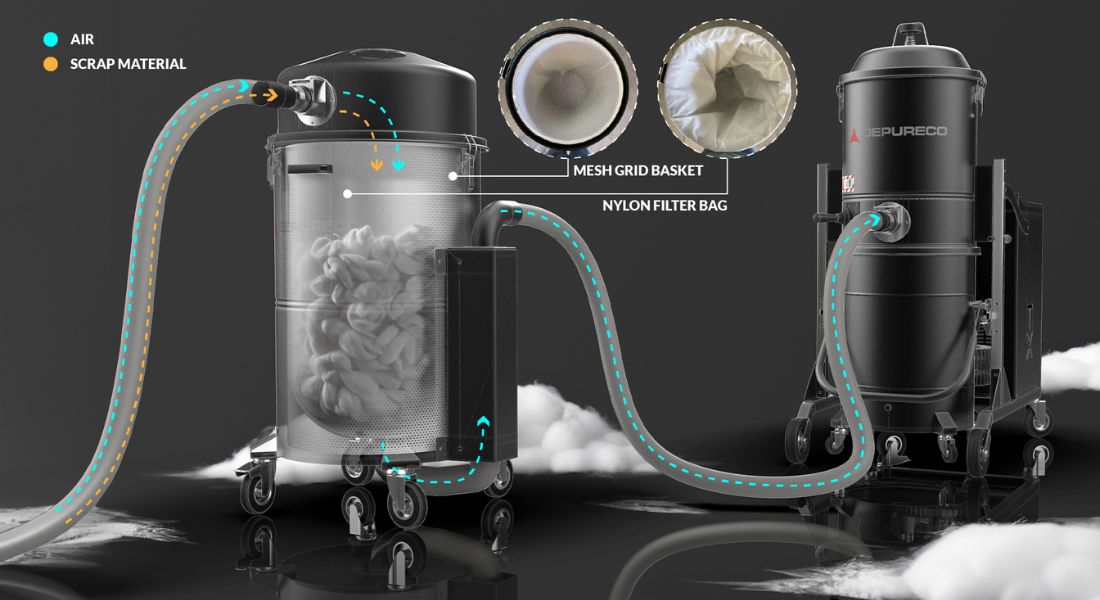

In standard vacuum cleaners, the airflow typically moves from bottom to top. While this design works for heavier debris, it’s problematic for light trims. These lightweight materials, like fabric scraps or plastic film, get carried directly to the filter by the upward airflow. Due to their large surface area and tendency to develop static charges, they easily cling to the filter material instead of falling away. Standard filters aren’t designed to shed these materials effectively, and most vacuums lack pre-separation systems to capture them before reaching the main filter.
As a result, light trims quickly accumulate on the filter surface, creating a barrier that restricts airflow and rapidly decreases suction power. This unique combination of factors is why standard vacuums struggle with light trims, leading to frequent clogging and reduced efficiency.
Our trims interceptor is a separator designed specifically to tackle the challenges of light trims and flying materials. By intercepting these troublesome particles before they reach the main vacuum system, it significantly reduces filter clogging and maintains optimal suction power.
How does it work? The trims interceptor uses a smart pre-separation system to capture light materials from the airstream. As debris enters the unit, it’s directed into a large collection container, where the air velocity decreases, allowing the light trims to settle.
This design effectively traps the majority of light materials, while allowing only the cleanest air to pass through to the main vacuum. This process not only extends filter life but also improves overall system efficiency, reducing downtime and maintenance costs. Integrating the trims interceptor into your existing setup is simple, and the benefits are immediate!


AS and AS 400 are vacuum cleaners designed for handling scraps and large cuttings from production processes in packaging, textiles, and beyond. They feature a high-capacity collection chamber and innovative bottom suction, ensuring vacuumed materials are sent directly into a filter bag. This design excels at collecting light materials like paper, plastic, and packaging trimmings. Powered by a side-channel blower positioned beneath the collection chamber, the AS and AS 400 provide exceptional suction power. An inspection window on the top cover allows operators to monitor material levels without interrupting operation. As part of our food & pharma range, the AS and AS 400 are versatile enough for various industries where cleanliness and efficient waste management are crucial.
Light trims and flying materials create a different problem than normal dust collection.
These questions help explain when to use a vacuum, interceptor, pre-separator, or larger scrap recovery setup.
Use a trim interceptor when the material is light, fluffy, thin, stringy, or prone to flying through the vacuum stream. The interceptor separates lightweight scrap before it reaches the main vacuum filter, helping reduce filter cleaning and maintain more consistent suction.
No. A scrap collection vacuum is used for larger pieces of production waste such as trims, offcuts, plastic film, paper scraps, fabric pieces, and bulky lightweight material. A dust collector is used for airborne dust and fine particulate. Some production areas need both, but they solve different problems.
Common examples include paper trim, plastic film, fabric offcuts, textile scraps, nonwoven material, labels, thin packaging waste, cardboard strips, foam scraps, cotton waste, nylon scraps, and other low-density production waste that can float, bridge, or clog filters.
A centralized system may be better when multiple production lines, machines, or pickup points need scrap recovery at the same time. Centralized systems can help collect material from several areas instead of relying on separate portable vacuums or manual cleanup at each location.
Yes. Trim recovery vacuums, scrap collection vacuums, and pre-separators are commonly used near packaging equipment, flow-pack machines, textile cutting operations, converting lines, paper trim processes, and plastic film production where lightweight scraps are generated continuously or repeatedly.
Start with the material behavior and volume. A vacuum may work for occasional cleanup. A pre-separator or trim interceptor is better when material clogs filters quickly. A larger centralized or engineered trim removal system may be needed when the scrap is continuous, high-volume, or generated from multiple machines.
Source capture pulls fume at the arc, through an extraction arm or directly at the torch, before it gets anywhere near the welder. Ambient filtration cleans the shop air but it is always playing catch-up. The exposure already happened. Every unit on this page is source capture. The question is not whether to capture at the source, it is which method works for your setup
Integration is straightforward. Our solutions are designed for minimal disruption:
We offer free layout consultation to ensure a seamless integration with your current workflow.
