
1.5 HP | 120V 1∼

18,576 in²

900 CFM
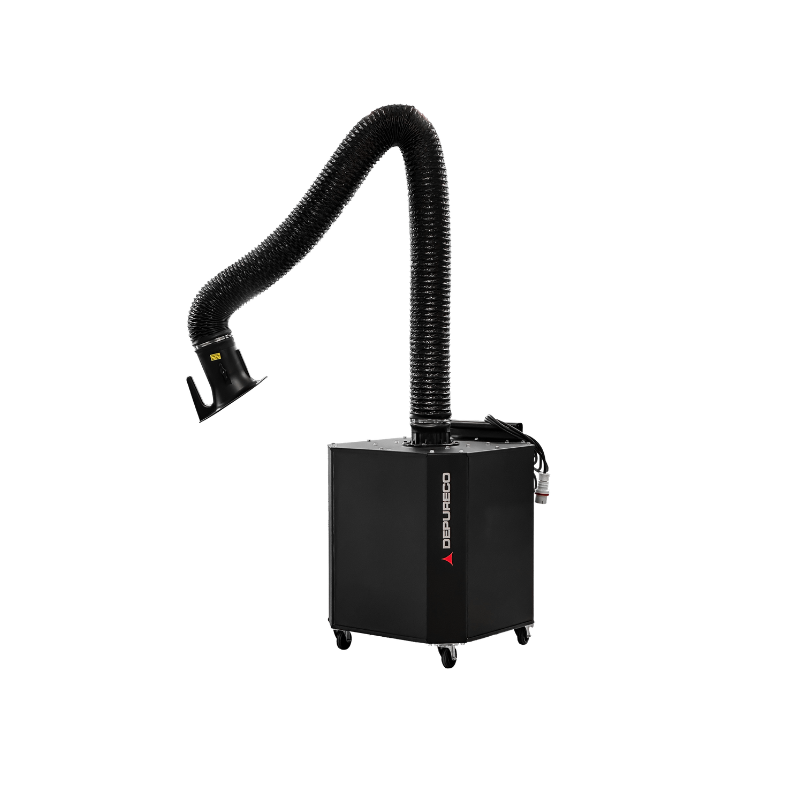
AIR WELD is a portable welding fume extractor built for source capture in welding and fabrication environments. Its 3-meter articulated arm lets the operator position the hood where fumes are generated, while adjustable airflow and a large 18,576 in² filter surface help support cleaner air in the work zone.
Mounted on wheels for easy movement, AIR WELD is a practical fit for welding stations that need mobile fume extraction without installing a fixed system. A built-in filter change counter helps simplify maintenance and makes service timing easier to manage.

A large-surface cartridge filter with 18,576 in² of filter area helps capture welding smoke, fumes, and airborne particulate while maintaining airflow during use. This makes AIR WELD a strong fit for mobile source capture at welding stations, fabrication benches, repair bays, and maintenance welding areas.

The 3-meter articulated extraction arm helps operators position the hood close to the welding plume for better source capture. The arm gives AIR WELD the flexibility needed for weld benches, repair areas, fabrication cells, and other work zones where the extraction point needs to move with the part or operator.
Mounted on wheels, AIR WELD can be moved between work areas when welding stations need flexible fume extraction without a dedicated fixed system at every location.
A built-in filter change counter helps operators track service timing and keep the unit ready for use during welding and fabrication work.
Get answers about using the AIR WELD for portable welding-fume source capture, positioning the articulated extraction arm, welding-station airflow, Class M filtration, activated-carbon options, model selection, and choosing between extraction-arm, on-torch, and fixed welding-fume systems.
The AIR WELD is a portable welding fume extractor designed for localized source capture at welding stations, fabrication benches, repair areas, and industrial maintenance work.
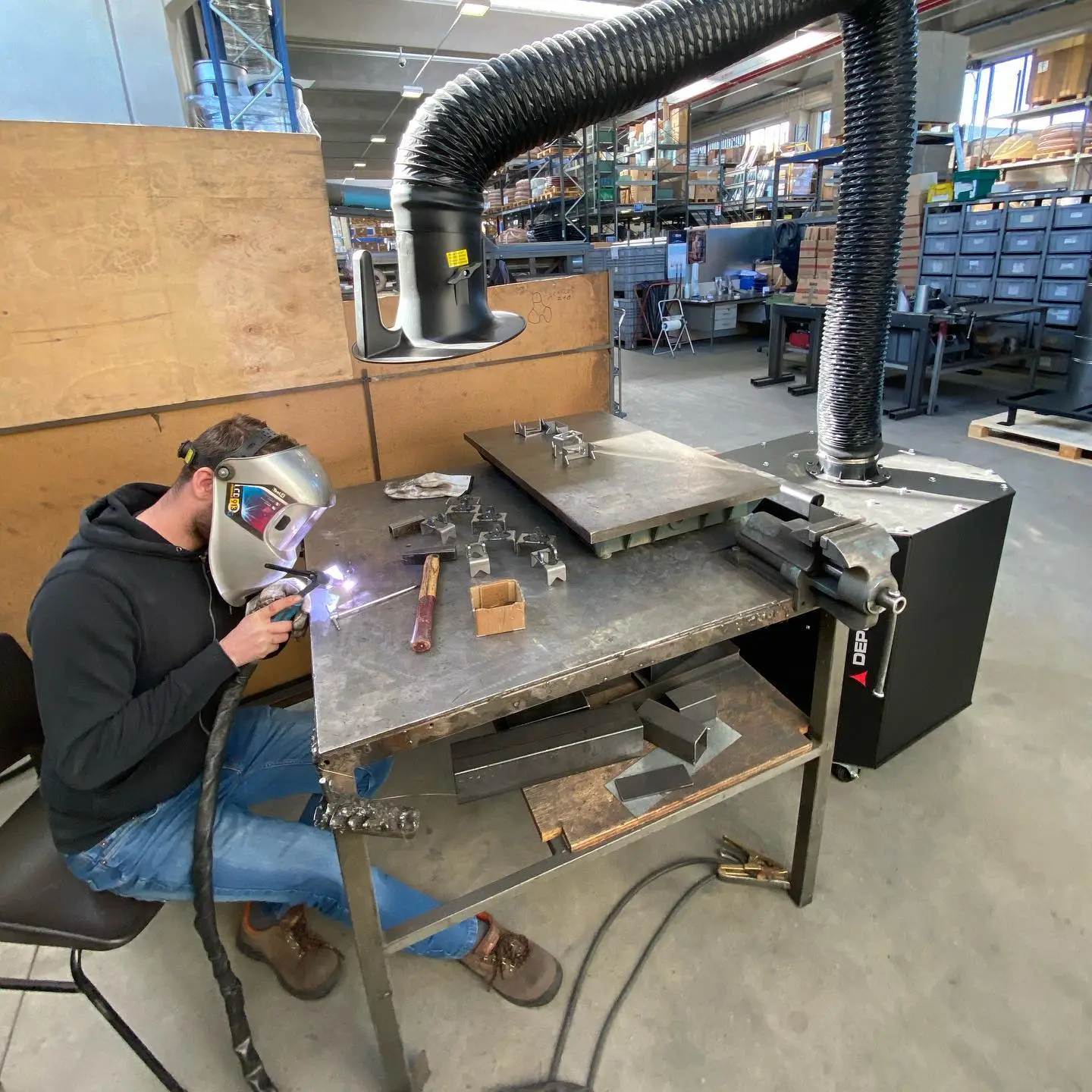
A 118-inch articulated extraction arm allows the operator to position the hood close to the welding plume so airborne fumes can be captured near the point where they are generated rather than relying only on general room ventilation.
The AIR WELD provides up to 900 CFM of airflow through a fan-driven extraction system and is mounted on wheels so it can be moved between workstations when permanent extraction is not required at every welding location.
The current 2026 U.S. price list specifically identifies AIR WELD for welding fumes from TIG welders. Other welding processes should be evaluated according to the fume-generation rate, process, filler material, capture distance, workpiece geometry, and required extraction airflow before equipment is selected.
The AIR WELD extraction hood should be positioned close enough to the welding plume to capture fumes before they spread into the surrounding work area, while remaining far enough from the weld to avoid interfering with the operator, torch, shielding gas, or workpiece.
Its articulated arm allows the hood to be repositioned as the welding location changes. This makes AIR WELD useful for weld benches, repair work, fabrication cells, and other applications where the extraction point changes but remains within reach of the arm.
Capture performance depends on more than the extractor’s maximum airflow. Hood position, distance from the arc, plume direction, cross drafts, workpiece geometry, welding parameters, and the amount of fume being generated all affect how efficiently fumes enter the extraction hood.
The hood should therefore be positioned around the actual welding process rather than simply placed somewhere above the workstation.
The AIR WELD uses a large cartridge filter with approximately 18,576 in² of filter surface.
The current 2026 U.S. configuration uses a cellulose cartridge classified as Class M under EN 60335-2-69. The large filter surface is designed to support airflow while collecting welding smoke and airborne particulate during source-capture operation.
Activated-carbon filtration is also available for applications where odor or certain gaseous contaminants need an additional adsorption stage.
The current price list shows two activated-carbon options: a smaller 2.5 kg filter that is installed inside the main filter and a larger 10 kg configuration that replaces the main filter.
Filter selection should be based on the actual welding process and contaminant. A particulate filter and activated-carbon media perform different functions, so carbon filtration should not be treated as a substitute for particulate filtration or as a universal solution for every welding fume or gas.
Choose the AIR WELD when the welding area is relatively defined and an articulated extraction hood can be positioned close to the welding plume without interfering with the operator.
AIR WELD uses a fan-driven system that provides up to 900 CFM through a movable extraction arm. The hood is repositioned as needed around the weld area.
Choose the XM TORCH when fumes need to be captured directly at the welding torch and the extraction point must continuously move with the operator. XM TORCH uses a higher-vacuum, lower-airflow approach through an on-torch extraction path and is specifically designed for MIG and MAG welding in the current U.S. lineup.
AIR WELD therefore emphasizes high-airflow capture through an articulated hood, while XM TORCH emphasizes localized high-vacuum capture at the torch.
The correct choice depends on welding process, torch compatibility, operator movement, workpiece geometry, fume-generation rate, capture distance, hose or arm positioning, and how frequently the extraction point changes.
The AIR WELD may not be the best choice when the welding point moves so frequently that an articulated hood cannot remain close enough to the plume for reliable source capture. In those applications, an on-torch system such as XM TORCH may be more practical.
A portable AIR WELD may also be the wrong architecture when a facility has many permanent welding stations, large robotic welding cells, or production lines that require fixed ducting or multiple simultaneous extraction points. Those applications may justify an engineered stationary or centralized fume-extraction system.
The AIR WELD should also not be treated as a general-purpose vacuum for collecting grinding chips, metal swarf, piles of metal dust, or other settled production debris. Welding-fume extraction and industrial housekeeping are different applications.
Special attention is required when processes involve combustible or reactive metal dust, unusual coatings, hazardous fumes, or contaminants requiring specialized filtration or exposure controls.
Final selection should consider the welding process, material and coatings being welded, filler metal, fume-generation rate, workstation layout, required capture distance, operator movement, number of welding stations, duty cycle, and applicable exposure-control requirements.