



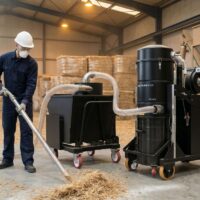
A HEPA vacuum is a vacuum cleaner designed so that collected air passes through a high-efficiency particulate air (HEPA) filter before it is exhausted back into the workspace. In industrial applications, HEPA filtration helps contain very fine and potentially hazardous particulate that should not be released back into the surrounding air after collection.
In a properly configured industrial vacuum, the HEPA filter is typically the final high-efficiency filtration stage behind the primary working filter. The primary filter handles most of the incoming dust load, while the HEPA stage provides final filtration before exhaust air leaves the machine. This staged approach helps protect the HEPA media, maintain airflow, extend filter life, and improve containment of fine dust.
What Is a HEPA Vacuum?
HEPA stands for High-Efficiency Particulate Air. In a vacuum cleaner, a HEPA filter is a high-efficiency filter designed to capture extremely small particulate that should not be allowed back into the air after collection. In industrial applications, HEPA filtration becomes especially important when the material being vacuumed includes fine powders, respirable dust, hazardous particulates, and other contaminants that can create cleanup, compliance, and exposure concerns if they are not properly contained.
Typical examples include:
- Silica dust
- Concrete and masonry dust
- Lead dust
- Asbestos-related dust
- Pharmaceutical powders
- Cosmetic powders
- Food powders such as cocoa or milk powder
- Carbon fiber and glass fiber dust
- Chemical powders
- Fine polishing dust
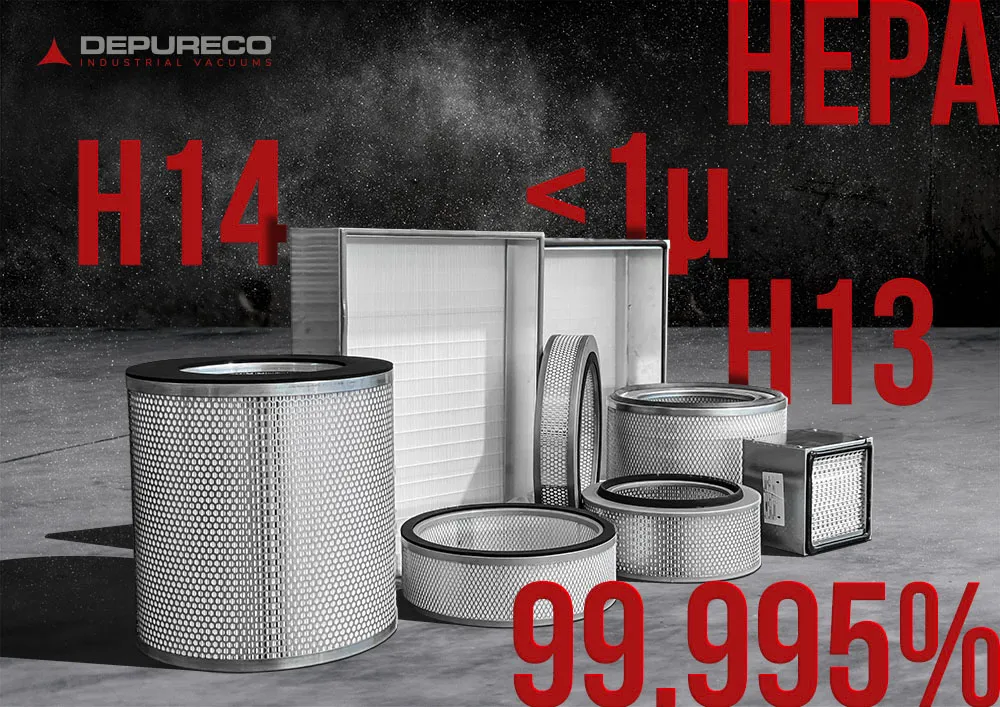
ISO standards categorize filters based on their ability to remove 0.3 µm particles. HEPA certification requires a filter to demonstrate efficiency ranging between 99.97% and 99.995%. There are two types of HEPA filters:
- H13: Efficiency of at least 99.97%
- H14: Efficiency of at least 99.995%
Every Depureco Industrial Vacuum is adaptable to incorporate a HEPA H14-certified filter in addition to its primary filter.
With HEPA H14-certified industrial filters, you can effectively vacuum extremely fine and hazardous dust particles.

What Does a HEPA Filter Do in a Vacuum?
HEPA H14 filters ensure a safe work environment by effectively trapping harmful dust particles. Below are examples illustrating the different materials these filters can capture:
- Cement powders and building material
- Powders in the cosmetic industry
- Polishing powders
- Powders from the pharmaceutical industry
- Asbestos dust
- Food powders such as cocoa and milk powder
- Silica dust
- Powders of composite materials such as carbon fiber and glass fiber
- Chemical powders

How Does a HEPA Vacuum Filter Work?
A HEPA filter does not work like a simple screen that only catches particles larger than the visible openings in the media. Instead, it uses a dense fiber structure that captures particles through multiple filtration mechanisms as air passes through the filter.
The three main mechanical collection mechanisms are:
Impaction
Interception
Diffusion

Why the Most Difficult Particle Size Matters
One of the most misunderstood parts of HEPA filtration is the idea that HEPA performance is only about 0.3 micron particles.
For H13 and H14 filters, the more accurate standards-based reference point is the most penetrating particle size, often shortened to MPPS. This is the particle size range that is the hardest for the filter to capture. For HEPA filters, MPPS is typically around 0.1 to 0.2 microns. If a filter performs to its rated efficiency at that most difficult range, it will often perform even better against many other particle sizes.
That is why H13 and H14 ratings are so important in industrial dust control. They are not just generic “fine filter” labels. They refer to tested high-efficiency performance at the filter’s most challenging particle range.
Feel free to contact a Depureco specialist for further details on the optimal filtration solution tailored to your unique application.
H13 vs H14: What Is the Difference?
H13 Filters
H14 Filters
H14 filters are rated for 99.995% efficiency at MPPS. They are used when the application calls for an even higher level of particulate retention, especially in more demanding hazardous dust environments.
In practical terms, both H13 and H14 are high-efficiency industrial filtration options. The right choice depends on the dust, the process, the vacuum model, the filter loading pattern, and the level of containment the application demands.
If you want to compare complete systems designed around these filtration levels, visit our
In many industrial vacuum systems, the HEPA filter is not intended to take the full incoming dust load on its own. Instead, the vacuum uses a primary filter stage first, followed by the HEPA stage. The primary filter handles the heavier and more direct dust loading. The HEPA filter then acts as the final high-efficiency stage before exhaust air leaves the machine. This setup offers several important benefits: That is why HEPA filtration should be evaluated as part of the full vacuum design, not just as a standalone accessory.Why Industrial Vacuums Use a Primary Filter Plus a HEPA Filter
Which Depureco Vacuums Use H13 or H14 Filters?
Depureco uses both H13 and H14 filter options across selected product lines.
For example, the XM35 JC fine dust industrial vacuum lists both an H13 Absolute conical filter and an H14 Absolute filter as available filter media. That makes it a strong reference point for understanding how the two filter classes fit into real product configurations.
If your application involves hazardous fine dust, silica, lead, or other high-risk particulate, it is worth reviewing a complete
There is no universal answer that fits every facility, because the correct filter level depends on the material, the dust loading, the exposure risk, and the way the vacuum is being used. In general: Examples where higher-efficiency HEPA filtration may matter include:Does Every Industrial Vacuum Need a HEPA Filter?
If you are unsure which filtration level is appropriate, the safest path is to match the filter package to the actual material and process rather than choosing only by percentage.
HEPA Filtration in Industrial Dust Control
The value of HEPA filtration is not just in the lab number. It is in what that filtration helps you do in the field:
- Control fine airborne dust
- Reduce re-entrainment through exhaust air
- Improve workplace cleanliness
- Strengthen containment in hazardous dust applications
- Support safer cleanup procedures
- Build a vacuum configuration that is better matched to the real risk level of the material
This is especially important in industrial environments where the wrong filter setup can shorten filter life, reduce airflow, and compromise dust containment.
For complete systems designed around high-efficiency filtration, see our industrial HEPA dust extractors.
For additional questions and support, please reach out:
