



Fine airborne dust is easier to control when it is captured where it is being generated, not after it has already spread across the machine, floor, and surrounding work area.
The Depureco DF 22 ORD LOC Dust Collector is built for localized source capture around industrial processes that generate fine, dry particulate. With high airflow, antistatic primary filtration, a grounded design, and multiple inlet configurations, the DF 22 can be connected directly to production equipment or paired with a properly positioned extraction point for applications such as sanding, grinding, polishing, routing, trimming, and other dust-producing processes.
In the video below, you can see the DF 22 working at the source. In this Product Spotlight, we’ll go beyond the demonstration to show where the DF 22 fits best, which materials and applications require additional review, and what to consider when configuring the collector for your process.
See the DF 22 in Action
Watch the Depureco DF 22 demonstrate localized source capture for fine process dust. We’ll use the rest of this guide to explain where the collector fits, how it can be configured, and what should be confirmed before selecting it for your application.
Want to review the machine while you watch?
View DF 22 ORD LOCWhat the DF 22 Does Differently
The DF 22 is designed around source capture, collecting fine particulate close to the point where it is generated instead of relying only on cleanup after the dust has spread through the surrounding work area.
This makes it especially useful around processes such as sanding, grinding, polishing, routing, trimming, and machine operations where lightweight dust can become airborne as it is produced.
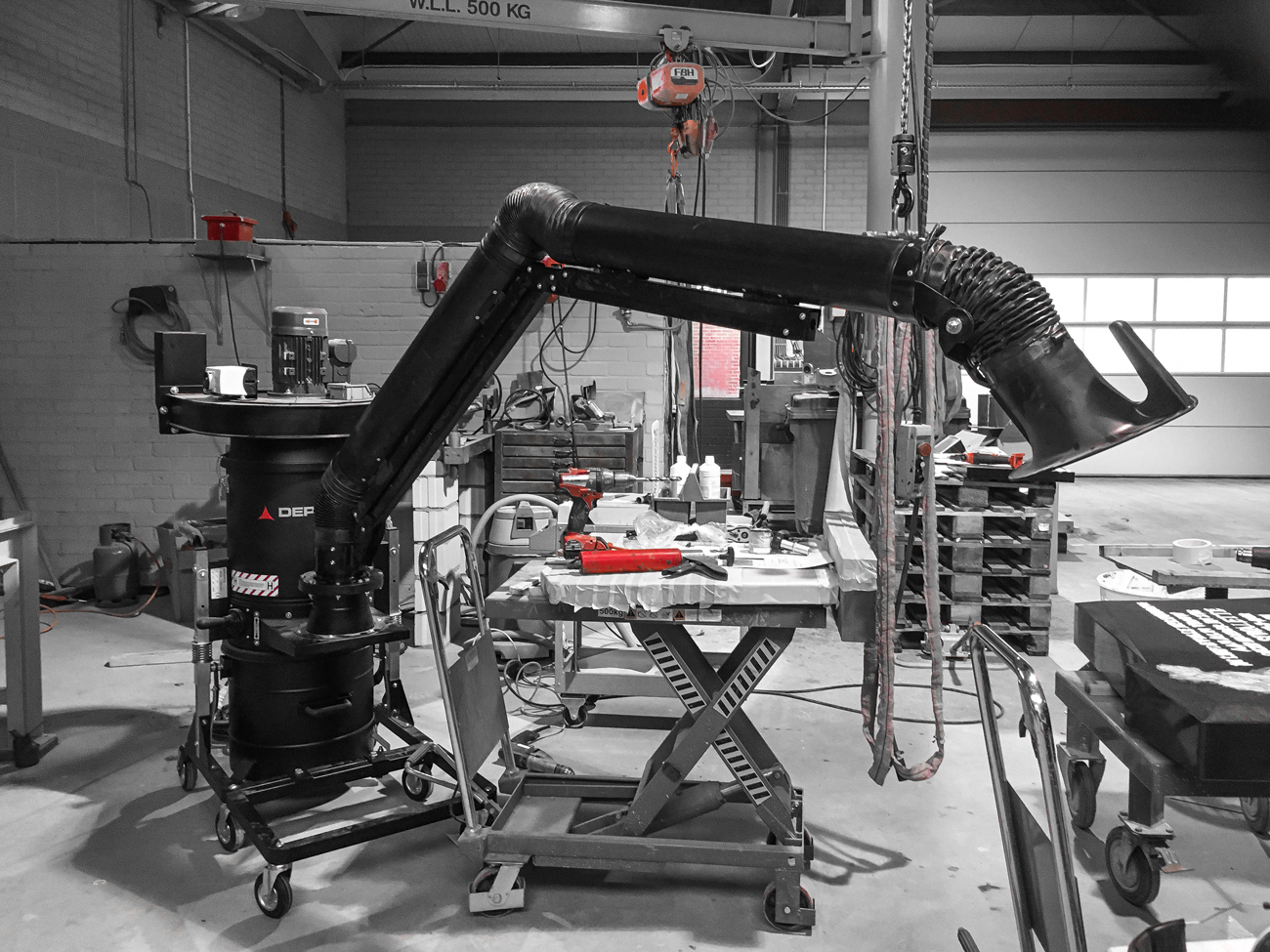
A properly configured dust collector can be connected directly to enclosed production equipment or positioned near the process with a hood or extraction arm. The goal is to intercept the dust before it has a chance to migrate, settle on machinery, or add to routine housekeeping.
If the main problem is dust becoming airborne during the process, start by evaluating a source-capture dust collector. If the material has already settled on floors, equipment, or inside the machine, an industrial vacuum may be the better cleanup tool.
Capture It at the Source
Sanding, grinding, polishing, routing, trimming and other processes can release lightweight particulate into the air. This is where a source-capture dust collector such as the DF 22 may be the appropriate starting point.
Recover It with an Industrial Vacuum
Material already sitting on floors, machinery, ledges or inside production equipment is generally a housekeeping or recovery application and may be better suited to an industrial vacuum.
Where the DF 22 Fits Best
The DF 22 is most useful where a production process creates fine, dry particulate that can be captured close to where it is generated.
Strong applications can include sanding, polishing, routing, trimming, deburring, and other machine processes that release lightweight dust into the surrounding work area. Depending on the material and process, the collector can be connected directly to production equipment or used with a properly positioned extraction hood or arm.
Common candidates include plastic and PVC dust, wood and composite dust, sanding fines, polishing residue, and other dry process dusts.
Not every fine dust application should automatically be routed to the DF 22, however. Combustible, conductive, reactive, toxic, hot, or otherwise hazardous materials require additional review of the material properties, process, collection point, and facility classification before equipment is selected.
Best for: localized source capture of fine, dry industrial process dust.
Confirm before specifying: exact material, dust behavior, volume, process temperature, presence of sparks, collection method, and whether the pickup point is in an ordinary or classified location.
Start with the DF 22
- Sanding and polishing dust
- Plastic and PVC machining dust
- Routing and trimming fines
- Wood and composite process dust*
- Machine-connected fine dust extraction
- Dry, lightweight process particulate
Confirm the Material First
- Combustible dust
- Metallic or conductive dust
- Flour, sugar and starch
- Chemical powders
- Pharmaceutical powders
- Dust with unusual toxicity or reactivity
Use Another Equipment Path
- Liquids, coolant, oil or sludge
- Bulk metal chips or swarf
- Welding fumes
- Lead-dust housekeeping
- Concrete or silica floor preparation
- Hot material or active spark pickup
DF 22 at a Glance: What the Specs Mean
A source-capture dust collector is only useful if it can move enough air through the pickup point while maintaining practical filtration and collection capacity for the process.
The DF 22 delivers up to 824 CFM of airflow from a 3.45 HP electric fan, giving it the airflow needed for localized extraction at machines, workstations, hoods, and properly configured capture points. Actual capture performance still depends on factors such as hood placement, inlet size, duct or hose length, bends, and how far the pickup point is positioned from the dust source.
Its M-Class antistatic polyester primary filter provides 3,800 in² of filtration surface, while a manual filter-cleaning system helps remove accumulated dust from the filter during routine operation. A 26-gallon collection bin provides capacity for recovered particulate without turning the collector into an oversized centralized system.
Multiple inlet configurations—4, 4¾, and 6 inches – also give the DF 22 flexibility when matching the collector to different machine connections and source-capture layouts.
Airflow alone does not determine whether a dust collector is correctly sized. The dust source, pickup geometry, material characteristics, ducting, operating hours, and required filtration all need to be considered together.
High-volume airflow for localized source capture around dust-generating processes.
Electric fan designed to support continuous industrial dust-extraction applications.
Primary filtration area for collecting fine particulate during operation.
Antistatic polyester primary filtration for appropriate fine-dust applications.
Integrated manual filter-cleaning system helps manage dust buildup on the filter.
Removable collection capacity for recovered dry process dust and particulate.
Multiple inlet sizes help match the collector to different machines and capture layouts.
Grounded construction and antistatic filtration support application-specific static-control planning.
Build the DF 22 Around the Dust Source
Getting good source capture is not simply a matter of connecting a hose to a dust collector. The pickup point needs to be designed around where the dust is created, how it moves, and how close the collection point can be positioned to the process.
Depending on the application, the DF 22 may be connected directly to enclosed production equipment or paired with an extraction hood or articulated arm positioned near an open dust source. The closer the pickup is to where the particulate is generated, the less airflow is typically wasted trying to capture dust after it has already dispersed.
Hose or duct diameter, total run length, bends, inlet selection, and the type of hood or machine connection all affect system performance. Applications involving combustible or static-sensitive dust may also require conductive or antistatic accessories as part of the complete configuration.
Depureco offers industrial vacuum and dust-collection accessories including hoses, reducers, tools, and extraction components that can help configure the DF 22 around the actual production process.
Start with the dust source first, then size and configure the pickup, ducting, filtration, and collector around it, not the other way around.
Start at the Dust Source
Position the pickup as close as practical to where the dust is generated before it spreads into the surrounding work area.
Match the Hood or Machine
Use direct machine connections, enclosed pickups, hoods, or extraction arms based on the process and how the dust moves.
Size the Hose or Ducting
Diameter, run length, bends, reducers, and inlet selection all affect airflow and source-capture performance.
Match the Dust
Confirm filtration, static-control requirements, collection method, operating conditions, and the material hazard profile.
Need help configuring the pickup? Depureco offers hoses, reducers, filtration components, and other industrial vacuum accessories for application-specific setups.
Explore Industrial Vacuum AccessoriesORD LOC: Confirm the Application Before You Specify the DF 22
The ORD LOC designation matters when evaluating where and how the DF 22 will be used. It indicates an ordinary-location configuration—not a blanket approval for every combustible-dust process or classified hazardous location.
A material can be combustible even when the collection point is in an ordinary location, so equipment selection still needs to consider the complete application. The exact dust, particle characteristics, process, ignition sources, static behavior, dust loading, collection method, and facility classification can all affect the final recommendation.
Confirm before specifying the DF 22:
What exact material is being collected?
Is the dust combustible, conductive, reactive, or toxic?
Is the collection point in an ordinary or classified location?
Does the process create sparks, hot particles, or elevated temperatures?
How much dust is generated and how quickly?
Is the pickup directly connected to a machine, enclosed hood, or open extraction arm?
What hose or duct diameter and distance are required?
How many hours per shift will the collector operate?
Are additional filtration or static-control measures required?
Compliance-aware note: the DF 22 should be selected as part of the complete dust-control strategy. A dust collector, filter, grounding feature, or accessory by itself does not establish facility-wide OSHA, NFPA, or combustible-dust compliance. Final suitability depends on the material, application, location classification, facility requirements, and complete system configuration.
Confirm the Dust, Process and Location
- Exact material or dust
- Combustible or non-combustible
- Conductive, reactive or toxic properties
- Ordinary or classified location
- Sparks, heat or hot particulate
- Dust generation rate and volume
- Pickup type and capture distance
- Hose or duct diameter and length
- Operating hours and duty cycle
- Filtration and static-control requirements
What is the DF 22 ORD LOC dust collector used for?
The DF 22 is designed for localized source capture of fine, dry particulate generated by industrial processes. Potential applications include sanding, polishing, routing, trimming, machine extraction, and other processes where dust can be captured close to where it is generated. Final suitability depends on the material and operating environment.
What is the difference between a dust collector and an industrial vacuum?
A dust collector is generally used to capture airborne particulate at or near the process that creates it. An industrial vacuum is typically better suited to recovering material that has already settled on floors, machinery, ledges, or inside equipment.
Can the DF 22 collect combustible dust?
Potentially, but combustible dust alone does not establish that the DF 22 is appropriate for an application. The exact material, dust characteristics, ignition risks, collection method, and area classification must be reviewed before equipment is selected.
What does ORD LOC mean on the DF 22?
ORD LOC refers to an ordinary-location configuration. It should not be treated as equivalent to equipment selected for a classified hazardous location. Classified applications require review for the appropriate equipment path.
What should I send Depureco before selecting a DF 22?
Send the material being collected, the process generating the dust, SDS or dust-test data if available, photos or video of the source, approximate pickup distance, hose or duct requirements, available power, operating hours, and any known area classification.
See the DF 22 Work, Then Match It Your Process
The DF 22 ORD LOC is built around a straightforward idea: capture fine process dust as close as practical to where it is being generated.
But the collector is only one part of a successful source-capture setup. The material, pickup location, hood or machine connection, airflow requirements, ducting, filtration, operating conditions, and facility classification all influence the final configuration.
If you are considering the DF 22 for sanding, grinding, polishing, plastics, woodworking, machine extraction, or another fine-dust application, Depureco USA can help review the process before you specify the equipment.
Send us the material, dust source, process information, photos or video, and any available SDS or dust-test data. We can help determine whether the DF 22 is the right starting point—or whether another dust collection or industrial vacuum solution better fits the application.
Ready to Review Your Dust Application?
See the full DF 22 ORD LOC specifications or explore Depureco's broader source-capture solutions. Final equipment selection should be based on the material, process, pickup configuration, operating conditions, and facility requirements.
