



A loaded filter restricts airflow and reduces an industrial vacuum’s pickup performance. Keeping it clean helps the vacuum work efficiently and supports the service life of the filter and machine.
Depureco offers several filter-cleaning methods, from manual shakers to automatic compressed-air systems. The right choice depends on the material, dust volume, filter type, and operating cycle.
Regular cleaning, combined with correct filtration and maintenance, helps:
- Maintain airflow as dust builds up.
- Support filter life through consistent care.
- Protect internal components from collected material.
- Support dust containment within a properly configured vacuum.
Follow the cleaning schedule and filter-condition indicators in your machine’s manual. Cleaning removes buildup; worn or damaged filters still need replacement according to the machine’s maintenance instructions.
Manual Filter Cleaning
Manual systems offer a straightforward, economical way to remove material from the filter during routine industrial cleanup
Manual Filter Shaker

A lever connected to the filter moves or compresses it, releasing accumulated dust and solids into the collection container. Depending on the model, the control may be mounted on the side or top of the vacuum, with different lever orientations for comfortable operations
This method suits dry dust, chips, and compatible damp materials. Stop suction as directed in the machine manual before operating the shaker.
JetClean® Filter Cleaning

JetClean® uses the pressure difference between the inside and outside of the vacuum to release dust from the cartridge filter. The motor stays running, while closing the inlet gate briefly pauses material pickup.
Designed for fine, dry dust, JetClean completes cleaning in seconds and helps reduce interruptions. Follow your model’s operating instructions.
-
01
Close the Gate
Block the suction inlet with the sliding gate.
-
02
Operate the Flap
Quickly open and release the cleaning flap at least three times.
-
03
Resume Pickup
Reopen the gate to restore airflow through the inlet.
Powered and Automatic Filter Cleaning
Powered systems reduce manual shaking, while automatic systems manage cleaning cycles through the vacuum’s controls. Activation and cleaning timing vary by model and configuration.
VIBRO Cleaning System

VIBRO uses vibration to release fine dust from a cartridge filter on compatible compact vacuums. It helps maintain airflow during demanding dust-collection work without requiring the operator to shake the filter by hand.
SE Electric Filter Shaker

An electric motor repeatedly shakes the filter, dislodging trapped dust and solids so they fall into the collection container. SE is suited to coarse dust, granules, and debris.
PSC Pneumatic Filter Shaker

A compressed-air driven piston compresses the filter vertically to release trapped material. PSC suits chips, granules, and compatible damp materials. Activation may be operator-controlled or automated, depending on the configuration.
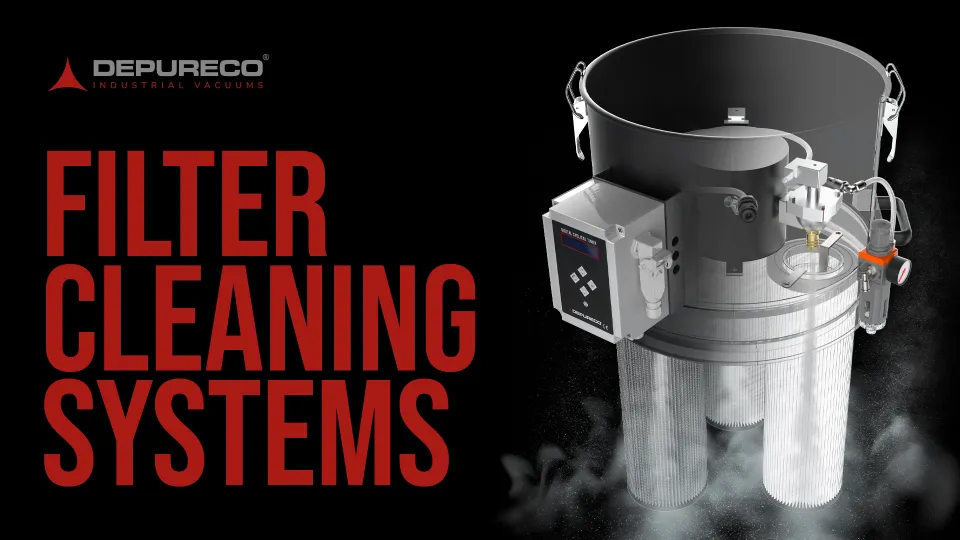
SP Automatic Reverse-Pulse Cleaning

SP uses short compressed-air pulses to dislodge dust from cartridge filters automatically while vacuuming continues. It is particularly useful for large quantities of fine dust that quickly load the filter.
A cyclic controller cleans the cartridges at adjustable intervals. The cycle can be tailored to the type and amount of dust being collected.
The system described here uses approximately 87 psi (6 bar) air pulses. Confirm the required compressed-air supply and settings for the specific machine.
Compare the Cleaning Methods
Availability, material suitability, and cycle controls depend on the vacuum and filter configuration.
| System | Cleaning Action | Typical Material |
|---|---|---|
| Manual Shaker | Lever moves the filter | Dry dust, chips, compatible damp materials |
| JetClean® | Pressure-difference cleaning | Fine, dry dust |
| VIBRO | Cartridge vibration | Fine dust on compact vacuums |
| SE | Electric shaking | Coarse dust, granules, debris |
| PSC | Pneumatic piston | Chips, granules, compatible damp materials |
| SP | Automatic reverse air pulses | Large quantities of fine dust |
Industrial Vacuum Filter Cleaning FAQs
How often should I clean my industrial vacuum filter?
Follow the machine’s maintenance schedule and filter-condition indicators. If pickup weakens, check for hose or accessory blockages and clean the filter as instructed. The interval depends on the application and operating conditions.
How do manual, powered, and automatic systems differ?
Manual systems need operator action. Powered shakers use electric or pneumatic mechanisms; automatic systems control their own cleaning cycles. SE and PSC activation and timing depend on the vacuum configuration.
Can the vacuum keep collecting material while the filter cleans?
SP can clean automatically during vacuuming. JetClean® keeps the motor running, but its closed inlet gate temporarily pauses material pickup. Other systems have model-specific stopping requirements. Follow the machine’s operating instructions.
Does filter cleaning eliminate the need for replacement?
No. Cleaning removes accumulated material but cannot repair damaged media. Replace damaged filters, and follow the machine’s manual if clogging persists after cleaning. Use the correct replacement filter for the vacuum and application.
Which filter-cleaning system is suitable for fine dust?
JetClean® suits fine, dry dust; VIBRO uses cartridge vibration on compatible compact models. SP is useful for larger quantities of fine dust that quickly load filters. Match the method to the vacuum, filter, and workload.
Need Help Choosing a Filter Cleaning System?
Tell us what you collect, how much dust you generate, and how long the vacuum runs. We can help match the cleaning method, filtration, and vacuum configuration to your application.
