


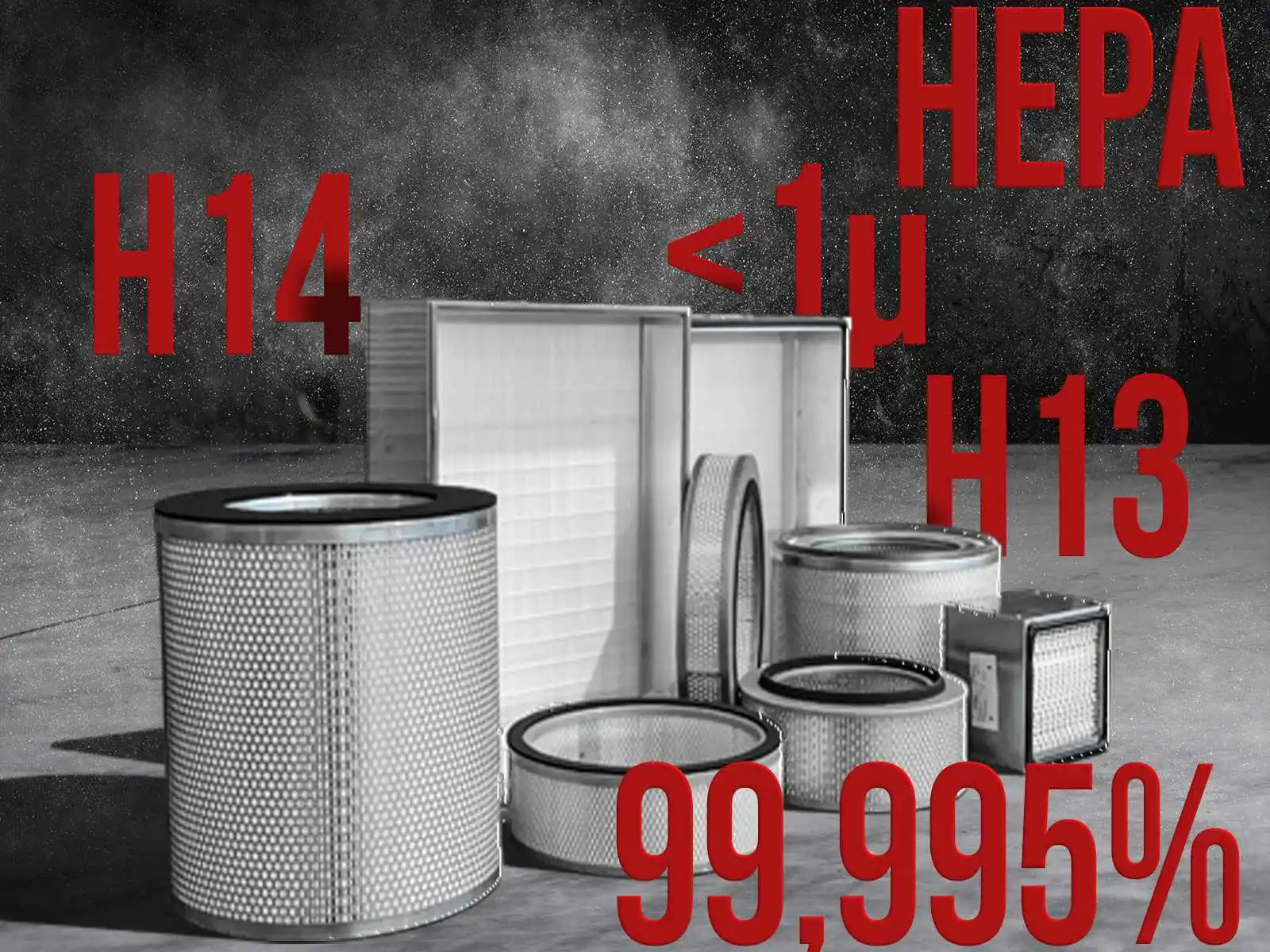
HEPA H13 an H14 are both high-efficiency final filter classes, but they are not identical. H14 captures more of the particle size that is most difficult for a HEPA filter to retain, while H13 can be the right choice when very high filtration is required without specific H14 requirement.
For an industrial vacuum, however, choosing between H13 and H14 is not as simple as selecting the larger number. The dust, exposure risk, primary filter, airflow, filter loading, work area, and maintenance method all matter. This guide explains what the two ratings mean, where each excels, and how to decide which filtration path fits the application.
H13 vs. H14 at a Glance
Under EN 1822, H13 and H14 are both HEPA classes. H13 must achieve at least 99.95% integral efficiency at the most penetrating size, or MPPS (Most Penetrating Particle Size). H14 raises that minimum to 99.995%.
The difference looks small when written as a percentage, but it is significant when expressed as penetration: H13 allows up to 0.05% penetration at the class limit, while H14 allows up to 0.005%. In other words, H14 permits ten times less penetration at MPPS.
H13
≥ 99.95%
Maximum integral penetration at MPPS: 0.05%.
H14
≥ 99.995%
Maximum integral penetration at MPPS: 0.005%.
EN 1822 integral efficiency at MPPS. Complete vacuum performance also depends on sealing, filter installation, loading and system design.
Scroll sideways to compare both HEPA classes.
| Comparison | H13 | H14 |
|---|---|---|
| EN 1822 integral efficiency at MPPS | ≥ 99.95% | ≥ 99.995% |
| Maximum integral penetration | ≤ 0.05% | ≤ 0.005% |
| ISO 29463 equivalent | ISO 35 H | ISO 45 H |
| Typical role | High-efficiency final filtration where H13 meets the application requirement | Higher-efficiency final filtration where tighter particulate retention is specified or beneficial |
| Main advantage | Very high fine-particle retention without automatically specifying the tighter H14 class | Ten times lower class-limit penetration at MPPS than H13 |
What Do H13 and H14 Ratings actually Measure?
EN 1822 evaluates high-efficiency filters at their most penetrating particle size. MPPS is the particle-size range where a filter is least efficient, typically around 0.1 to 0.2 microns for HEPA media. If the filter meets its required efficiency at that difficult point, capture is generally higher for many particles that are either larger or smaller.
This is also why U.S. HEPA language can look different. OSHA and the U.S. EPA commonly describe HEPA as at least 99.97% efficient at 0.3 micrometers. EN 1822 H13 and H14 use MPPS-based classification, so the percentages should not be compared as though they came from the same test point.
If a project, regulation, or customer specification states a particular HEPA requirement, confirm the filter documentation and complete vacuum configuration against that requirement rather than relying on the H13 or H14 label.
When an H13 HEPA Filter Is a Strong Fit
H13 is a high-efficiency final filtration option for applications that need very strong particulate retention but do not specifically call for H14. It is commonly considered when fine or respirable particulate must be controlled downstream of the vacuum’s primary working filter.
H13 can be a strong fit when:
- The process requires HEPA-level final filtration and H13 satisfies the written requirement.
- The material is a fine industrial dust or powder that should not be returned to the work area through the exhaust.
- The vacuum already has an appropriate primary filter and cleaning system to manage the incoming dust load.
- The facility wants high-efficiency final filtration without automatically specifying a tighter class than the application requires.
The important point is that H13 should be selected as part of the full filtration system. The vacuum still needs the correct primary filter, enough filter surface area, suitable collection, and a maintenance plan for the actual dust.
Where H14 HEPA Filtration Excels
H14 is the tighter of the two HEPA classes. Its maximum integral penetration at MPPS is one-tenth the H13 limit, making it the stronger choice when an application calls for a higher-efficiency final particulate barrier.
H14 is worth evaluating when:
- A customer specification, process requirement, or internal standard explicitly calls for H14.
- The material is hazardous, toxic, or exposure-sensitive and the risk assessment supports tighter final filtration.
- The process involves fine pharmaceutical, chemical, composite, ceramic pigment, silica, lead, or similar particulate where a higher-containment filtration path is being reviewed.
- The vacuum is part of a controlled production or cleanup process where minimizing downstream particulate release is especially important.
H14 is not automatically required for every fine-dust application. The better question is whether the tighter filtration class solves a defined exposure, process, or specification requirement.
Why H14 Is Not Automatically the Better Vacuum Filter
A higher HEPA efficiency does not automatically mean a better-performing vacuum. Filter resistance and usable airflow depend on the media, pleat geometry, filter surface area, face velocity, dust loading, and the way the vacuum is sized around the filter.
That means the H13 or H14 label alone cannot tell you how much suction the complete machine will maintain. Manufacturers can use different filter areas and geometries to reach the required efficiency while managing resistance.
Dust loading matters just as much. If a large quantity of powder reaches the HEPA stage because the primary filter is too small, poorly matched, or difficult to clean, resistance can increase quickly and shorten final-filter life. In many cases, improving the primary filter, adding surface area, using a better cleaning method, or adding pre-separation does more for day-to-day performance than simply moving from H13 to H14.
Why Industrial Vacuums Use a Primary Filter Plus HEPA
In many Depureco industrial vacuum configurations, the HEPA filter is a downstream or final filtration stage rather than the filter that handles the entire incoming dust burden.
The primary working filter receives most of the material first. Its job is to provide enough surface area, dust-release behavior, and cleaning capability for the application. The H13 or H14 stage then provides the final high-efficiency particulate barrier before air leaves the machine.
This two-stage approach helps protect the HEPA media, extend service life, keep resistance more manageable, and maintain more consistent vacuum performance. For heavy powder loading, a cyclone or pre-separator may provide an additional stage before the primary filter.
Material enters from the floor, tool, machine or process.
Handles most of the incoming dust burden and protects the downstream final filter.
Provides the high-efficiency particulate barrier before filtered air exits the machine.
HEPA Does Not Solve Every Dust Hazard
HEPA class tells you about particulate filtration. It does not, by itself, tell you whether an industrial vacuum is suitable for combustible dust, conductive dust, a classified hazardous location, or another specialized application.
That distinction matters because several filtration labels solve different problems. M-Class filtration is commonly used as a primary working stage in industrial vacuums. Antistatic media addresses electrostatic behavior at the filter. H13 and H14 describe high-efficiency particulate retention. Combustible-dust suitability depends on the complete machine, grounding and bonding path, accessories, ignition-source controls, material, and work area.
An H14 filter cannot turn a standard vacuum into an explosion-proof or combustible-dust-rated system. Always evaluate the full equipment configuration when the material presents additional hazards.
Describes high-efficiency particulate retention at the final filter stage.
A different classification commonly used for the primary working filter in industrial vacuum designs.
Addresses electrostatic behavior at the filter-media level; it is not a complete conductive or grounded system by itself.
Depends on the complete vacuum, accessories, grounding, material and work-area classification - not HEPA grade alone.
How to Choose Between H13 and H14
Start with the requirement, not the percentage. If a process or customer specification explicitly requires H14, the decision is straightforward: use a vacuum configuration that supports a properly installed H14 final filter.
If the requirement is simply HEPA or high-efficiency final filtration, determine what the material actually demands. Review the dust hazard, loading rate, expected runtime, primary filter, cleaning system, collection method, and any exposure-control or facility requirements. H13 may be fully appropriate in one application, while another may justify H14.
Also confirm model compatibility. Filter surface area, geometry, seals, replacement procedure, and downstream placement can vary by vacuum. The best selection is the filter class that meets the real requirement while allowing the complete vacuum to operate effectively over its duty cycle.
A practical selection path
If H14 is specifically required by the process, specification or internal standard, select an H14-compatible system.
Confirm particle type, hazard, loading rate and whether the material is combustible, conductive, sticky or abrasive.
Match the primary filter, surface area, cleaning method and pre-separation to the incoming dust burden.
Check model compatibility, seals, accessories, collection method, maintenance and location requirements.
H13 and H14 Options Across Depureco Vacuums
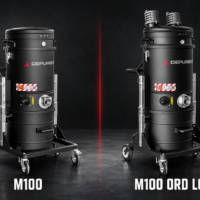
Depureco uses both H13 and H14 filtration options across selected industrial vacuum models. For example, the XM35 JC, M100, and M100 JC LP product families list both H13 and H14 final-filter options, while other models may list a specific H14 configuration.
That does not mean the filters are interchangeable between every machine. Different models use different filter shapes, surface areas, mounting arrangements, and primary-filter architectures. Always confirm the exact vacuum model and filter configuration before ordering or specifying a replacement.
For a broader explanation of how HEPA fits with M-Class, PTFE, antistatic, and other filtration options, see Depureco USA’s Industrial Vacuum Filter Types & Selection Guide and What Is a HEPA Vacuum? How HEPA Filtration Works.
HEPA H13 vs. H14 FAQs
Is H14 ten times better than H13?
H14 allows ten times less penetration at the EN 1822 class limit: 0.005% versus 0.05% for H13 at MPPS. That does not mean the entire vacuum is ten times better. Overall performance also depends on sealing, primary filtration, filter area, dust loading and the rest of the system.
Is H13 still a true HEPA filter?
Yes. Under EN 1822, both H13 and H14 are HEPA classes. H13 has a minimum integral efficiency of 99.95% at MPPS, while H14 increases that minimum to 99.995%.
Does OSHA require H14 for silica dust?
OSHA's silica standard defines a HEPA filter as at least 99.97% efficient at removing 0.3 micrometer monodispersed particles. It does not name H14 as a universal requirement. The correct vacuum and filter configuration still depends on the specific task and applicable control requirements.
Does an H14 filter always reduce vacuum airflow more than H13?
Not automatically. Filter resistance depends on media, pleat design, surface area, face velocity, loading and system sizing. The HEPA label alone does not tell you the final airflow or suction performance of the vacuum.
Does H13 or H14 make a vacuum safe for combustible dust?
No. HEPA class describes particulate filtration. Combustible-dust suitability requires review of the complete machine, material, static-control path, conductive accessories, grounding or bonding, ignition-source controls and the classification of the work area.
Need Help Choosing Between H13 and H14?
Send Depureco USA the material you are collecting, the process or cleanup task, expected dust volume, vacuum model, duty cycle, and any written HEPA or filtration requirement. We can help determine whether H13, H14, or a different filtration setup is the better fit for the complete application.
What to send our team
What dust or powder are you collecting, and what hazards are known?
Is this floor cleanup, tool extraction, machine-side recovery or continuous collection?
Do you have a HEPA, H13, H14, customer, regulatory or internal specification?
Share the vacuum model, hose length, runtime and approximate dust volume.
We can help confirm whether H13, H14 or a different filtration setup fits the application.
Discuss My Application