




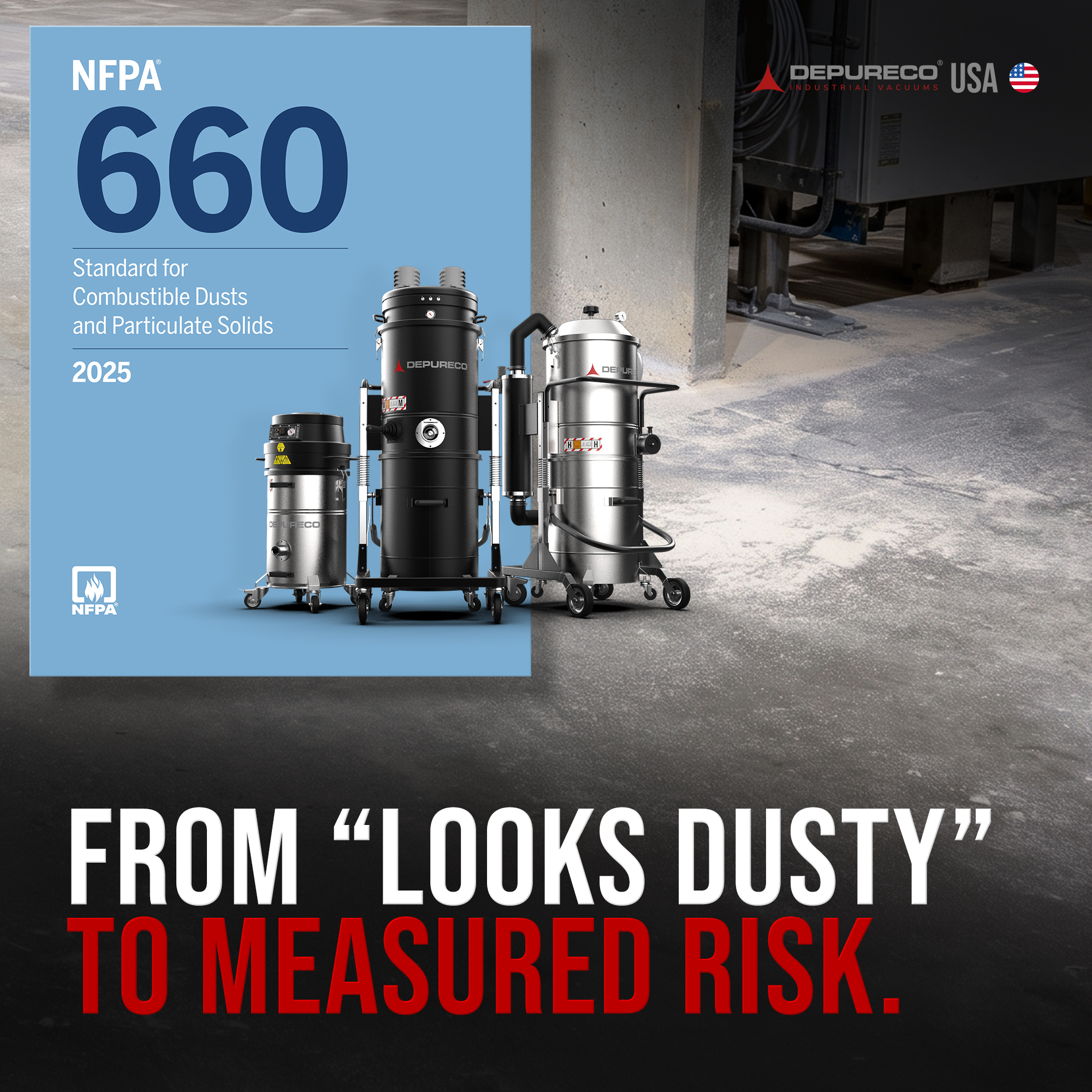
Most combustible dust conversations start with the same advice: keep it clean. The harder question is what “clean” actually means on your floor.
That is where an NFPA 660 combustible dust housekeeping review becomes useful. The dust itself matters. So do the amount that settles, where it accumulates, how often your team removes it, whether the area has a documented electrical classification, and what equipment the crew uses for cleanup.
Those decisions should not happen in separate meetings. EHS may start with the hazard. Maintenance may start with cleaning frequency. Engineering may start with the material and area. Operations may care most about recurring downtime. Procurement may begin with price and specifications.
Before anyone compares vacuum horsepower, all five groups need the same basic facts.
The right question is not “How powerful is the vacuum?” It is “What material are we collecting, where is it accumulating, how much is there, how often does it return, and what conditions apply to that area?”
This review walks through that decision path. First, measure and document the accumulation. Next, look at the material and the process creating it. Then review housekeeping frequency and area documentation. Finally, match the cleanup method, vacuum configuration, hose, tools, filtration, collection system, and equipment marking to the actual application.
For a separate equipment-focused review, see our NFPA 660 vacuum requirements for combustible dust cleanup.
Quick Reference: From Dust on the Surface to a Cleanup Decision
One floor measurement can start the review, but it should not make the entire decision by itself.
Use this table as a decision framework, not as a substitute for a facility-specific DHA, electrical area-classification review, applicable requirements, or equipment documentation.
A thin layer can still matter. A large visible pile does not automatically tell you which vacuum to buy. And an area does not become Class II Division 1 or Division 2 simply because a table says the dust reached a certain thickness.
Measure the condition, understand the material, review the process, check the area documentation, and then select the cleanup system.
Why "A Little Dust" Is a Measurement, Not a Guess
The dust you can barely see may still need a measurable cleanup threshold.

A common plant-floor problem is that everyone recognizes “a lot of dust,” but nobody can explain exactly when cleanup should start.
One person sees a harmless film. Another sees an EHS issue. Maintenance plans to get it on Friday. Production wants to wait for the next shutdown.
A measurable housekeeping trigger gives the team something better than opinion.
OSHA’s current combustible-dust inspection guidance tells inspectors to look beyond the floor. Likely accumulation areas include structural members, conduit and pipe racks, cable trays, floors, areas above suspended ceilings, and surfaces on or around process equipment, dust collectors, and ductwork. OSHA also directs inspectors to document the extent and depth of accumulations and to take representative measurements when evaluating housekeeping hazards.
That distinction matters because the dustiest square footage in a plant may not be the aisle everyone walks through.
The floor is only one part of the inspection
Look at:
- beams and open-web structural members
- horizontal pipe and conduit
cable trays - tops of electrical or mechanical enclosures
- ductwork
- equipment frames
- mixers and mills
- conveyor transfer points
- bag-dump stations
- packaging and filling equipment
- dust collector exteriors
- areas above suspended ceilings
- hard-to-reach ledges where fine material settles over time
A commonly cited combustible-dust reference point is approximately 1/32 inch, often discussed with a surface-area component and nominal bulk-density assumptions. That reference can help teams understand why a layer that looks minor may deserve attention.
However, it is not a universal “safe until this exact number” rule.
The material matters. The area matters. The extent matters. The process matters. The applicable NFPA 660 material-specific requirements matter. Your current DHA and other facility documentation matter.
Why bulk density changes the visual picture
A lighter, fluffier dust can spread a given mass across a deeper visible layer. A denser powder can place more mass into a thinner layer.
The examples below illustrate the scaling logic. They are reference examples, not universal allowable limits.
These figures illustrate layer-depth scaling logic. Do not use the table as a substitute for the requirements that apply to your material, process, facility, DHA, or jurisdiction.
The practical takeaway is simple: do not write a housekeeping procedure that says only “clean when dust becomes visible.”
Define what the team checks. Define where it checks. Define the trigger. Define who acts. Then verify that the trigger still fits the material and process.
For OSHA’s current overview of combustible dust hazards and affected materials, see the OSHA combustible dust resource.
The Material Changes the Housekeeping Review
Flour, wood dust, aluminum powder, and graphite should not send a buyer down the same equipment-selection path.
“Combustible dust” describes a hazard category. It does not describe one material.
OSHA identifies combustible-dust examples that include food ingredients such as sugar, starch and flour; grain; plastics; wood; pharmaceuticals; rubber; coal; and metals such as aluminum, iron, magnesium and zinc. OSHA also identifies processes and industries that range from agriculture and food production to chemical manufacturing, furniture, recycling, metalworking, additive manufacturing and 3D printing.
That is why the first question in a vacuum review should not be:
Which explosion-proof vacuum has the most horsepower?
It should be:
What exactly are we collecting?
Material and process examples
These examples show why material identity and production process should come before vacuum model selection. Actual housekeeping, equipment, classification, filtration, and handling requirements depend on the material, process, facility, DHA, and applicable requirements.
If the Same Ledge Is Dusty Every Shift, Look Upstream
Housekeeping removes accumulation. It does not fix every process that creates it.
A recurring dust problem can expose a process problem.
Suppose maintenance vacuums the same area every morning and finds the same accumulation by the end of the shift. The crew may need a better vacuum, but the plant should also ask why that material keeps escaping.
OSHA’s current combustible-dust NEP specifically tells inspectors to examine equipment and transport systems for dust leakage or escape and visible dust-cloud formation.
That gives plant teams a useful rule:
When accumulation returns quickly, investigate both the cleanup method and the source.
A faster vacuum may reduce labor. It may not solve an open transfer point, leaking conveyor, poor enclosure, or inadequate source capture.
Common release points include:
- bag dumping
- sack emptying
- mixing and blending
- milling
- grinding
- sanding
- cutting
- screening
- sieving
- filling
- packaging
- pneumatic conveying
- bucket elevators
- belt conveyors
- transfer chutes
- additive manufacturing powder handling
- hopper charging
- bulk-bag unloading
- leaking duct joints
- poorly sealed equipment
- dust collector leakage
- filter-change procedures
- material discharge points
How Dust Accumulation Can Trigger a Classification Review
Measure the dust, but do not use layer depth as a shortcut for assigning a Division or Zone.
Dust accumulation and area classification belong in the same conversation, but one does not automatically convert into the other through a simple thickness table.
For U.S. facilities using the Class/Division system, OSHA’s hazardous-location framework defines Class II locations around combustible-dust conditions and distinguishes Division 1 from Division 2 based on how the dust may be present, suspended, accumulated, or affected by normal and abnormal operation.
That is different from saying:
1/32 inch equals Division 1.
or:
If you can no longer see the floor color, the area equals Division 2.
Do not use those shortcuts.
What the team should review instead
- The actual dust or material
- The process creating or handling it
- Whether dust can become suspended
- Normal operating conditions
- Abnormal operation or equipment malfunction
- Accumulation on and around equipment
- Conductive dust considerations
- The facility’s electrical area-classification drawings or documents
- The current DHA
- The classification system and jurisdiction that actually apply
Ordinary or unclassified areas still need a real review
“Unclassified” does not mean “the dust does not matter.”
OSHA’s current NEP describes conditions for portable vacuum cleaners collecting combustible particulate solids in unclassified areas. The guidance addresses:
- appropriate materials of construction
- conductive or static-dissipative hoses
- bonding and grounding of conductive components, including wands and attachments
- the path of dust-laden air
- motor location relative to the dust-laden air stream
Classified areas require area-specific suitability
For a documented hazardous location, verify equipment against the actual classification that applies.
That may involve:
- Class
- Division
- Group
- Equipment marking
- Temperature considerations
- Material characteristics
- Other jurisdiction-specific requirements
A generic “explosion-proof” marketing description should not replace the facility’s documented area requirements.
For current U.S. regulatory language, review OSHA 1910.307 on hazardous classified locations and the associated OSHA electrical definitions.
Class/Division and Zone Language Are Not Automatic One-to-One Substitutes
Do not translate a Class II Division 2 application into Zone 22 from a marketing table alone.
Buyers often see Class/Division and Zone terminology side by side on product literature. That can make the systems look interchangeable.
They are not automatically the same thing.
A facility should use the classification framework documented for its site and jurisdiction. Then verify the equipment marking against that framework.
The practical rule is:
Start with the facility documentation. Do not start with the product brochure.
This matters even more when equipment moves between plants, production areas, countries, or projects that use different regulatory and classification systems.
The Housekeeping Program Has to Be Written Down, Not Remembered
A useful program tells the team where to look, when to act, how to clean, and who owns the response.
A working combustible dust housekeeping program needs more than an informal agreement to clean when the area looks bad. It should define where accumulation occurs, how the team checks it, what triggers a response, which cleanup methods fit the material and area, and who owns the work.
That matters because the floor is only one part of the problem. Dust can accumulate on structural members, pipe racks, cable trays, equipment frames, ductwork, enclosures, ledges, dust collector exteriors, and other surfaces that operators may rarely see during normal production.
Vacuum cleaning is often a practical way to remove settled material without simply pushing it elsewhere. However, the method still depends on the dust, process, quantity, area, and application. Compressed-air and other high-energy cleaning methods deserve separate controls because they can put settled material back into suspension.
A working housekeeping program should be able to show:
- A documented inspection and cleaning frequency tied to the actual material, accumulation pattern, and facility conditions
- Coverage of elevated and hard-to-see surfaces, not only floors and aisles
- Defined cleanup methods for the materials and areas involved
- Additional controls where compressed-air or other high-energy cleaning methods are used
- Clear responsibility for each production area, line, room, or housekeeping zone
- A current dust hazard analysis and other relevant facility documentation
- A process for reviewing changes in materials, equipment, production volume, layout, or operating conditions
- Inspection or housekeeping records that show the team actually follows the program
- A response plan when dust returns faster than the existing schedule can control it
Do You Need a Housekeeping Vacuum
or a Dust Collector?
A dust collector handles dust while the process creates it. A vacuum handles material after it lands. Many facilities need both.
This distinction saves buyers from trying to solve the wrong problem with the wrong equipment.
A production team may say, “We have a dust problem,” but that can describe several very different situations.
Dust may be:
- becoming airborne during grinding or sanding
- escaping from a bag-dump station
- leaking from a transfer point
- settling on floors after production
- collecting on equipment frames and ledges
- building up across several floors
- spilling during maintenance or changeover
- escaping during filter service or material discharge
Those problems do not all point to the same equipment.
Do You Need a Housekeeping Vacuum
or a Dust Collector?
- settled dust on floors
- dust on machinery
- material on beams or ledges
- residue around production equipment
- spills and localized releases
- cleanup between batches
- maintenance cleanup
- recovery from bins or localized areas
- recurring plant housekeeping
Review a dust collector or source-capture system when the process actively creates airborne dust during:
- grinding
- sanding
- cutting
- mixing
- bag dumping
- screening
- filling
- powder transfer
- milling
- other repeatable dust-generating production steps
A portable industrial vacuum should not become the plant’s substitute for needed process capture.
At the same time, a dust collector does not eliminate every housekeeping need. Material can still escape during maintenance, transfer, spills, filter changes, abnormal operation, or imperfect enclosure.
That is why many facilities need both:
- Source capture where the process creates airborne dust
- Industrial vacuuming for settled material, spills, and maintenance cleanup
For active process dust, review industrial dust collectors for source capture.
For settled combustible dust and plant housekeeping, compare combustible dust vacuum options.
When repeated cleanup points suggest a different system
A portable vacuum may also stop making sense when:
- the same areas require cleaning every shift
- operators drag units long distances
- the facility spans several floors
- overhead cleaning is routine
- hose setup takes longer than the actual cleanup
- multiple fixed pickup points would reduce labor
In those cases, review whether a centralized vacuum system fits the facility better than another portable unit.
Before You Compare Vacuums, Collect These Facts
A good equipment recommendation starts with the application, not the model number.
1. Exact Material
Use the real material whenever possible. The material identity can change the entire equipment review.
- Flour
- Sugar
- Starch
- Wood Dust
- Aluminum
- Magnesium
- Graphite
- Carbon Black
- Plastic Resin
- Pharmaceutical Powder
- Food Ingredient
- Additive Manufacturing Powder
- Another Process-Specific Material
2. Available Material & Facility Documentation
Gather what already exists. Where relevant and available, material data may include parameters such as Kst, Pmax, MIE, MEC, or other test results. The information needed depends on the actual application.
- SDS
- DHA findings
- Available dust-test data
- Internal EHS requirements
- Insurance Recommendations
- Engineering Standards
- Electrical Area-Classification Drawings
- Equipment Restrictions
3. Particle Form
Particle form affects airflow, filtration, hose diameter, pickup tools, collection, and discharge.
- Very Fine Dust
- Powder
- Granules
- Chips
- Fibers
- Mixed Debris
- Dust Plus Larger Pieces
4. Material Condition
A dry fine powder and an oily mixed residue are not the same vacuum application.
- Dry
- Damp
- Oily
- Hot
- Sticky
- Abrasive
- Hygroscopic
- Contamination-Sensitive
5. Quantity
Estimate what the system must actually handle. A thin housekeeping layer and a deep process spill may require completely different approaches.
- Pounds Per Shift
- Container Fill Rate
- Approximate Cubic Volume
- Spill Quantity
- Frequency of Large Releases
6. Cleanup Frequency
Frequency affects duty cycle, collection capacity, filter loading, labor, and whether portable equipment still makes sense.
- Continously
- Every Shift
- Daily
- Weekly
- During Changeovers
- Only During Shutdown
7. Cleanup Location
Document where pickup happens. Include expected hose distance and vertical lift where possible.
- Floor
- Machinery
- Overhead
- Production Line
- Pit
- Inside Equipment
- Several Floors
- Confined Process Area
- Outdoor Process Area
8. Area Classification
Do not guess from the amount of dust visible on the floor.
- Ordinary or Unclassified
- Class II Division 1
- Class II Division 2
- Governed by another Documented Classification System
- Not yet formally evaluated
9. Current Cleaning Method
What does the crew use today? The current method often reveals the real pain point.
- Broom
- Compressed Air
- Shop Vacuum
- Portable Industrial Vacuum
- Manual Collection
- Outside Contractor
10. What Is Actually Failing?
Be specific. This is the information that moves a buyer from “show me a vacuum” to “show me the right solution.”
- Too Much Labor
- Dust Returns too Quickly
- Filters Clog
- Shop Vacuums Fail
- Hoses are too Short
- Operators Cannot Reach Overhead
- Containers Fill too Quickly
- Emptying Creates Another Dust Cloud
- Current Equipment Does Not Fit The Area
- Production Downtime Is Too High
- The Plant Needs Better Documentation
- The Material is Valuable and Needs Recovery
- Cross-Contamination is a Concern
Matching the Vacuum to the Application, Not the Catalog Page
Horsepower is one specification. It is not a dust-control strategy.
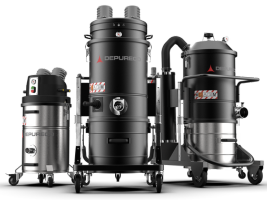
Once the facility establishes the layer depth and area classification, vacuum selection is no longer a matter of preference. NFPA 660 is direct on this point: the facility must use a vacuum listed for that hazardous, classified location for that specific environment. A manufacturer may market a vacuum broadly as “explosion-proof” or “combustible dust safe,” but this is not automatically equivalent to a unit listed for Division 1/Zone 20-21, Division 2/Zone 22, or the specific dust group involved.
There’s also a detail that’s easy to miss if you’re only skimming for headline changes: NFPA 660 makes the documentation and test-standard question more specific for portable vacuum cleaners used with combustible metals. That’s a meaningful shift for any facility running aluminum, magnesium, or other reactive metal dust, because it means “rated for combustible dust” and “tested for combustible metal dust” are no longer interchangeable claims; they’re two different sets of requirements.
For ordinary-location housekeeping, Depureco’s combustible dust vacuum cleaners are built around antistatic filtration and grounded construction from the inlet through the collection container. For classified locations, our explosion-proof industrial vacuums are matched to the specific division or zone in question rather than sold as a one-size-fits-all hazardous-area solution. And when dust load, cleanup frequency, or facility size has outgrown what a portable unit can reasonably handle, our centralized vacuum systems move the collection point entirely away from individual operators.
A Five Minute Housekeeping Self-Check
Before the next vacuum purchase, it's worth running through these five questions:
- A documented inspection and cleaning frequency tied to the actual material, accumulation pattern, and facility conditions
- Coverage that extends to elevated and hard-to-see surfaces — beams, ledges, equipment tops, ductwork, pipe racks, cable trays, and other identified accumulation points, not just the floor
- Defined cleanup methods for the materials and areas involved, including any additional controls required for compressed-air or other high-energy cleaning methods
- Clear responsibility for each production area, line, room, or housekeeping zone
- A current dust hazard analysis and other relevant facility documentation, with a process for reviewing changes in materials, equipment, production volume, layout, or operating conditions
- Inspection and housekeeping records that show the team actually follows the program and responds when accumulation returns faster than expected
A confident answer to all five is a good sign. A shrug on more than one is a sign the housekeeping program needs attention before the equipment list does.
Final Takeaway

Combustible dust housekeeping works best when the plant connects four things:
- the material
- the accumulation and process conditions
- the documented area and housekeeping program
- the equipment configuration
A measured layer can tell the team that an accumulation deserves attention. It should not become a shortcut for assigning a hazardous-area classification.
Area-classification documentation can tell the team what environment it is working in. It does not tell maintenance how much material a vacuum must move per shift.
An equipment listing or marking can support selection for a defined application. It does not make the entire facility compliant by itself.
And a powerful vacuum can still be the wrong solution if the real problem is:
- uncontrolled source generation
- several floors of repeated cleanup
- heavy bulk material
- poor discharge containment
- insufficient filtration
- the wrong hose diameter
- excessive pickup distance
- a hose-and-tool configuration that does not fit the material
- a production process that keeps releasing dust faster than housekeeping can remove it
The best buying decision starts when the team can explain the material, the process, the accumulation, the area, and the work that needs to happen after the machine arrives.
Use those facts to decide whether the problem calls for:
- a portable combustible dust vacuum
- an area-specific explosion-proof industrial vacuum
- conductive or static-dissipative accessories
- a centralized vacuum system
- a dust collector or source-capture system
- pre-separation
- another engineered material-handling approach
Then compare products.
FAQ: NFPA 660, OSHA Dust Control, Housekeeping & Vacuum Selection
Does NFPA 660 set one dust accumulation limit for every material?
No. Do not treat one commonly cited layer-depth reference as a universal limit for every dust, process or facility. The applicable review depends on the material, process conditions, relevant NFPA 660 requirements, the current DHA and other facility-specific factors.
Does reaching a certain dust layer automatically make an area Class II Division 1 or Division 2?
No. Do not assign electrical area classification from a simple dust-thickness conversion table. Review the material, normal and abnormal operating conditions, suspension potential, accumulation, conductive-dust considerations and the facility’s documented area-classification information.
Is Class II Division 2 the same thing as ATEX Zone 22?
No. They come from different classification frameworks and should not be treated as automatically interchangeable. Use the system documented for the facility and verify the equipment against the marking and requirements that actually apply.
Is a conductive vacuum hose enough for combustible dust cleanup?
No. Review the complete path. Hose, couplings, wands, attachments, conductive components, bonding, grounding, vacuum construction and the rest of the application all matter. One conductive hose does not automatically make an otherwise unsuitable system appropriate.
Does an unclassified area mean an ordinary shop vacuum is acceptable?
Not automatically. OSHA’s current combustible-dust NEP discusses specific considerations for portable vacuum cleaners collecting combustible particulate solids in unclassified areas, including materials of construction, conductive or static-dissipative hoses, bonding and grounding of conductive components, the dust-laden air path and motor location.
Should we use a vacuum or a dust collector?
Start with where the dust is. If the process creates airborne dust at a repeatable source, review source capture or dust collection. If the material has settled and needs removal from floors, machinery, ledges or other surfaces, review industrial vacuuming. Many plants need both.
What information should I provide when requesting a combustible dust vacuum recommendation?
Provide the exact material, available SDS and dust-test data, particle form, condition, quantity, cleanup frequency, pickup locations, hose distance, area classification, current cleaning method and the main problem you are trying to solve.
Can a vacuum make our facility NFPA 660 compliant?
No single vacuum makes an entire facility compliant. Equipment selection is one part of a broader system that can include the DHA, process design, housekeeping, inspection, ignition-source control, electrical classification, dust collection, maintenance, training and other facility-specific requirements.
What should we do if dust returns immediately after cleanup?
Investigate the source as well as the cleanup method. Repeated accumulation can point to leaking equipment, transfer points, poor enclosure, inadequate process capture, conveying losses or another upstream problem. A higher-capacity vacuum may reduce labor, but it may not fix the source.
When should we consider a centralized vacuum system?
Consider a central system when the same areas require frequent cleaning, operators move portable vacuums long distances, the facility spans several floors, overhead cleaning is routine, or multiple fixed pickup points would reduce setup and labor.
