




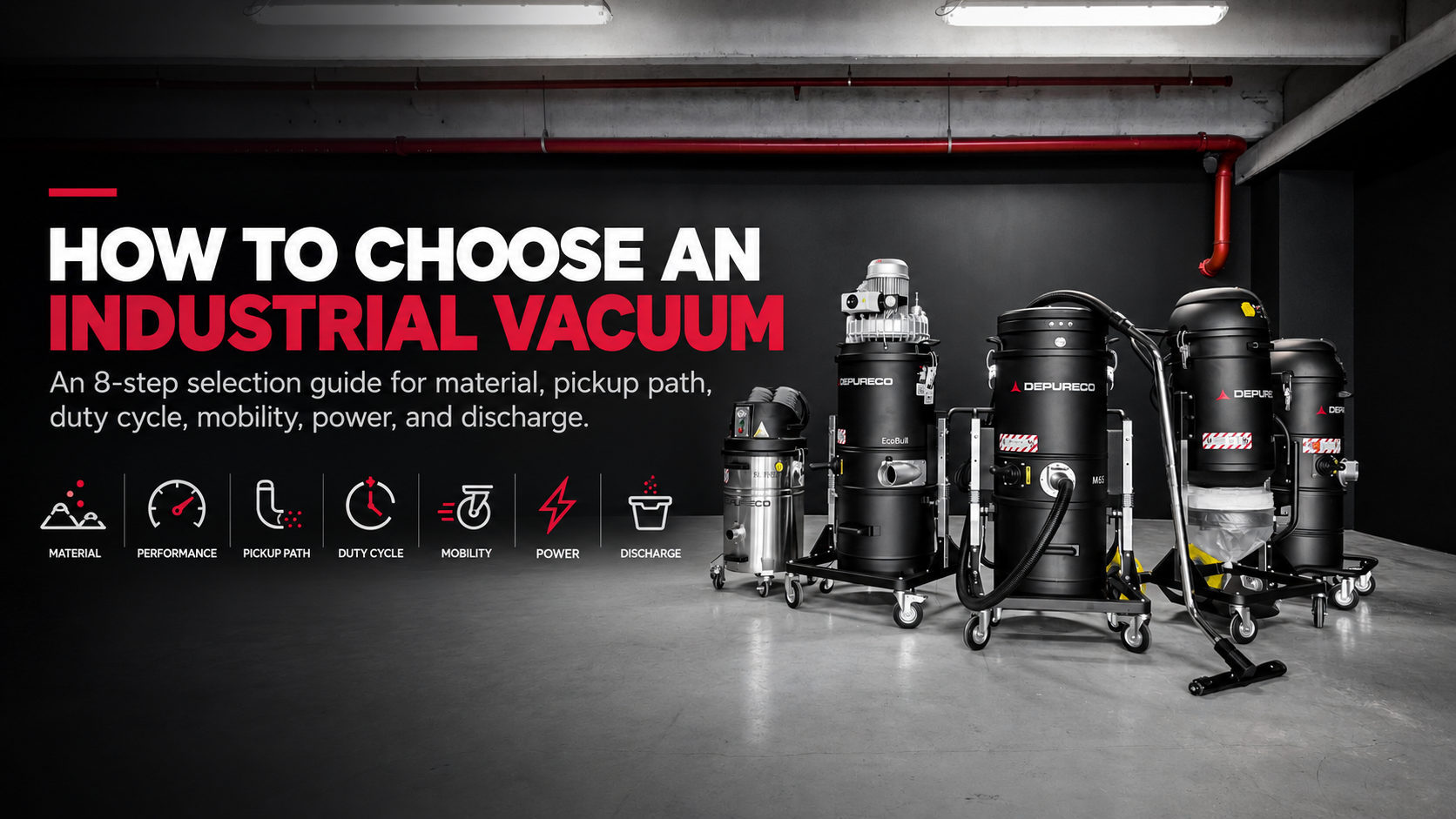
An industrial vacuum should be selected around the application, not a model number or a single performance figure. Two facilities can collect similar-looking material and still need very different equipment because the pickup distance, dust behavior, operating time, disposal method, or work area is different.
A useful selection process starts with a few practical questions: What are you collecting? How does the material behave? How far must it travel? How often will the vacuum run? How many people need suction at once? Does the vacuum need to move? What utilities are available? And what happens to the material after it is collected?
This guide walks through those questions so you can narrow the right type of industrial vacuum before comparing individual models.
Dry, wet, oily, sticky, hot, hazardous, combustible, chips or sludge?
Fine or coarse, light or dense, free-flowing or stringy?
How far, how high, through what hose size, bends and tools?
Occasional cleanup, scheduled daily use or continuous-duty recovery?
One operator, several locations, or simultaneous users?
Move the vacuum to the work, or bring fixed suction points to the operators?
Single-phase, three-phase, compressed air or another available utility?
How will collected material be emptied, bagged, pumped, recycled or returned to process?
Before You Choose: Is the Material Settled or Airborne?
Start by defining the job itself. An industrial vacuum is usually the right path when material has settled on floors, machinery, inside tanks, in containers, or around a production area and needs to be recovered through a hose.
If the main problem is dust becoming airborne during grinding, sanding, mixing, dumping, or another process, a dust collector or source-capture system may be the better starting point. Many facilities use both: source capture for airborne dust and an industrial vacuum for settled cleanup.
What Material Are You Collecting?

Material is the first filter in the selection process because it affects almost every other decision.
Dry dust and powders usually put the most emphasis on filter media, filter surface area, and filter cleaning. Damp or sticky material may require media that releases dust more easily. Wet debris and ordinary liquids require a vacuum configured for liquid recovery, while CNC coolant, straight oil, metal chips, and sludge may be better handled by a dedicated sump vacuum that separates solids from liquid and supports gravity or pump-out discharge.
Swarf and metal chips add another variable: shape. Short broken chips behave differently from long stringy turnings that can bridge, tangle, or block a hose.
Hot, corrosive, toxic, combustible, or reactive materials require an application-specific review. High-temperature collection can require specialty hose, tools, and filtration or an upstream cooling solution. Combustible or classified-location applications require the complete vacuum, grounding path, and accessories to be evaluated for the actual material and work areas.
How Fine, Heavy, or Difficult Is the Material
Particle size matters, but it is only part of the picture. Fine dust can stay airborne, load filters quickly, and require higher-efficiency filtration or contained collection. Dense chips, grit, or sludge create a different challenge because the vacuum must overcome more resistance to start and maintain material movement
This is where airflow and vacuum pressure need to be considered together. Airflow helps carry lightweight material and supports wider pickup openings. Vacuum pressure helps overcome resistance from dense material, long hose routes, narrow tools, and vertical lift.
Do not compare industrial vacuums using only maximum CFM, maximum vacuum, or horsepower. Actual pickup performance also depends on hose diameter, hose length, bends, reducers, tool geometry, filter loading, particle shape, and the rate at which material enters the hose.
Higher air volume is often important for fine lightweight dust, wide floor tools, larger openings and light production scrap.
Available vacuum becomes increasingly important with dense material, narrow tools, long hose routes, vertical lift and restrictive pickup conditions.
Do not size an industrial vacuum from maximum CFM or maximum vacuum alone. The useful performance is what remains at the actual pickup point.
Where is the Material?
The pickup path changes the performance requirement. Recovering material next to the vacuum is not the same as moving it through 50 feet of hose or lifting it out of a deep pit, mezzanine, or machine tank.
Document the longest realistic hose or pipe run, not the easiest one. Include vertical rise, bends, reducers, valves, separators, and the pickup tool. A long route with dense material may require a different pressure-flow balance than short-range floor cleanup.
The work area also matters from a safety standpoint. The source infographic distinguishes ATEX and non-ATEX areas. For a U.S. application, the equivalent selection question is whether the cleanup occurs in an ordinary or unclassified area or in a hazardous classified location. If combustible dust, flammable material, or a classified area is involved, confirm the area classification and equipment suitability before choosing the vacuum.
Distance, elevation, and area type are all identified as selection factors in the original guide.
How Often Will the Vacuum Run?
Occasional cleanup, daily housekeeping, and continuous-duty recovery place very different demands on the suction unit and filtration system.
For intermittent maintenance, mobility and convenience may matter most. As use becomes more frequent, filter cleaning, collection capacity, and emptying time have a larger effect on productivity. For long loaded runtimes or continuous operation, a three-phase side-channel blower, automatic filter cleaning, larger receiver, or fixed system may be more appropriate than a compact intermittent duty vacuum.
Also estimate how much material is collected per event or shift. A machine that has enough suction but fills every few minutes can still be the wrong solution.
The original guide divides use into occasional, once-a-day, and continuous operation.
How Is the Material Accumulated?
A thin layer across a floor favors a wide floor tool and good airflow. A pile introduces more material at once and can create slugs that temporarily fill the hose. Material inside a container may require a wand or pickup lance. A tank or sump can add depth, liquid, sludge, and a need to separate solids from fluid.
The pickup method should therefore be part of the specification. Tell Depureco whether the material is spread across a surface, accumulated in piles, stored in bins, or collected inside tanks.
These four material presentations, stratified, piles, containers, and tanks, come directly from the source selection chart.
Portable cleanup and maintenance tasks can often favor compact, easy-to-move equipment.
Filter cleaning, collection capacity and emptying time become more important as use repeats every shift.
Long loaded runtimes may call for side-channel blowers, automatic filter cleaning, larger receivers or fixed systems.
Two or more outlets used one at a time are different from two or more simultaneous operators. Simultaneous use increases total airflow demand and can change the vacuum unit, pipe sizing and system architecture.
How Many Suction Points Do You Need?

One pickup point is straightforward. Multiple pickup points require a second question: will they be used at the same time?
Several outlets used one at a time do not create the same airflow demand as several operators vacuuming simultaneously. Simultaneous use can change the required suction unit, pipe diameter, and control strategy.
If pickup locations change throughout the plant, a mobile vacuum may be the simplest answer. If cleanup happens repeatedly at fixed stations, across several floors, or at multiple production cells, a centralized vacuum system may reduce hose handling and make suction available where operators already work.
The source guide differentiates between one point, multiple non-simultaneous points, and multiple simultaneous points before asking whether the vacuum should be wheeled or fixed.
What Power Source Is Available?
The available utility helps narrow the equipment platform.
Single-phase industrial vacuums are convenient for mobile cleanup where standard facility power is available. Three-phase side-channel blower systems are commonly used for higher-power and continuous-duty applications. Compressed-air vacuums use Venturi suction and can be useful where plant air is the preferred utility, but the facility must be able to supply the required airflow and pressure continuously at the connection point.
The original selection guide also includes battery power. Where battery-operated equipment is available for the application, verify runtime, recharge workflow, and material compatibility instead of treating cordless operation as the only selection factor.
Power source should be matches to the operating pattern, not chosen in isolation.
The four source categories are single-phase, three-phase, compressed air, and battery.
Convenient for mobile cleanup where standard facility power is available and the required duty cycle fits the motor platform.
Common for higher-power, sustained industrial duty and larger fixed or mobile recovery systems.
Useful where plant air is the preferred utility, but the facility must be able to supply the required flow and pressure continuously.
Where available, portability can improve access, but runtime, recharge workflow and application compatibility must still be checked.
How Will You Empty or Reuse the Material?
Collection is only half of the job. Think about what the operator has to do after the material reaches the vacuum.
A detachable bin works well for general solids that can be emptied in batches. Longopac or other contained bagging can reduce handling of fine or exposure-sensitive dust. Big Bags van make sense for higher-volume bulk material. Liquids may be drained by gravity or discharged with a pump. Engineered systems can use intermittent or continuous automatic discharge when production cannot stop for repeated manual emptying
For coolant or process material that will be reused, also consider separation and filtration before it returns to the machine or next process step.
The best collection method is the one that matches the material, disposal route, operator exposure concerns, and required production uptime.
Plan the exit before you size the collection bin.
Best when material must be carried away, contained or disposed of in controlled batches.
Useful for liquids, sumps and applications where collected material needs to move into another tank or container.
Worth evaluating when high material volume or process continuity makes frequent manual emptying impractical.
The right discharge method can reduce operator handling, shorten downtime and make a correctly sized vacuum much easier to live with.
Putting the Selection Together
A good industrial vacuum recommendation is a system decision. The suction unit, filter, filter-cleaning method, hose, accessories, receiver, and discharge method all have to work together.
Before requesting a recommendation, collect the material name and SDS when available, wet or dry condition, particle size and shape, approximate volume, hose distance, vertical lift, pickup tool, duty cycle, simultaneous users, available utilities, and disposal or reclaim method. Add any HEPA, food, pharmaceutical, combustible-dust, or classified-location requirements.
That information usually narrows the field much faster than starting with horsepower, tank size, or product name.
Before asking for a recommendation, collect these details
- Exact material and SDS if available
- Dry, damp, wet, oily, hot or sticky condition
- Particle size, shape and approximate density
- Estimated amount collected per event or shift
- Hose diameter, total distance and vertical lift
- Pickup tool, machine connection or tank depth
- Occasional, daily or continuous-duty runtime
- Number of simultaneous operators or suction points
- Available voltage or compressed-air capacity
- How the material must be emptied, transferred or disposed of
- Any HEPA, food, pharma or containment requirement
- Any combustible, reactive or classified-location concern
Industrial Vacuum Selection FAQs
What information should I know before choosing an industrial vacuum?
Start with the material, its condition and volume, hose distance and vertical lift, pickup tool, duty cycle, number of users, available power and the way the material must be discharged. Also identify any filtration, combustible-dust, hazardous-material or classified-location requirements.
What matters more: airflow or vacuum pressure?
Both matter. Airflow helps carry lightweight material and supports wider pickup openings. Vacuum pressure helps overcome resistance from dense material, long hoses, narrow tools and vertical lift. The correct balance depends on the complete pickup path.
When should I consider a central vacuum system instead of a mobile vacuum?
Consider a central system when cleanup happens repeatedly at fixed locations, several operators need access, hose runs are long, or multiple suction points must be available throughout the facility. Simultaneous users must be included in the system sizing.
Can one industrial vacuum handle dry dust, liquids and metal chips?
Some wet-and-dry configurations can handle more than one material type, but the details matter. Fine dust, large chips, coolant, sludge, straight oil and combustible material can require different filters, separators, collection tanks, float protection, accessories or dedicated vacuum families.
Does a larger motor automatically mean a better industrial vacuum?
No. Motor power is only one part of the system. Actual pickup performance depends on airflow, vacuum pressure, hose size and length, vertical lift, material behavior, filter loading, tools, collection capacity and duty cycle.
How do I know if my dust needs a combustible-dust or classified-location vacuum?
Do not decide from the material name alone. Review the material hazard information, process conditions and the facility's area classification. If combustible, conductive, reactive or hazardous dust is involved, the complete vacuum configuration and accessories should be reviewed for that specific application.
Need Help Choosing the Right Industrial Vacuum?
Tell Depureco USA what you collect, where it is located, how much material you recover, how often the vacuum will run, how far the pickup path extends, and what needs to happen to the material after collection. We can help turn those application details into the right vacuum, filtration, accessories, and discharge configuration.
Start with the application, not the model number
Tell us what you collect and whether it is dry, wet, oily, sticky, hot or hazardous.
Share hose size, distance, lift, pickup tool and where the material accumulates.
Tell us how much material, how often, and how many operators need suction at once.
Explain how the collected material needs to be emptied, bagged, pumped or reused.
Depureco USA can help turn those details into the right vacuum configuration.
Discuss My Application