



Fine aluminum chips are easy to miss during CNC machining. Larger chips may leave the machine through the conveyor, while particles remain suspended in the coolant or settle in the sump, pipes, and channels. Over time, that buildup can reduce usable tank capacity and make routine maintenance more difficult.
TaMek, a Norwegian manufacturer of aluminum components, produces approximately 40-50 metric tons of aluminum chips each year-about 44-55 U.S. tons. In some of its CNC machines, accumulated deposits occupied as much as 70% of the coolant tank volume.
The company needed a faster way to remove coolant and machining residue together, reach material left behind by the chip-removal system, separate aluminum chips from the liquid, and recover coolant that remained suitable for use. TaMek selected the Depureco RAM OIL T 500, a high-capacity sump vacuum designed around those combined tasks.
The documented case reports the yearly chip volume, deposit buildup, 500-liter collection capacity, and ability to service eight of ten CNC tanks without emptying the unit mid-task.
Why Fine Aluminum Chips Become a CNC Sump-Cleaning Problem

Chip conveyors are effective at moving larger machining chips out of a CNC, but the finest particles do not always follow the same path. They can remain in the circulating fluid, settle after the machine stops, and collect in tank bottoms, corners, channels, and other difficult-to-reach areas.
This creates a different maintenance problem from simply emptying a tank. The operator has to remove the liquid, expose the bottom of the sump, recover the settled solids, and decide what should happen to the coolant after collection.
At TaMek, the problem had become large enough that deposits occupied up to 70% of the available tank volume in some machines. The company needed a system with enough capacity to handle a complete cleanout without repeatedly stopping to empty a smaller unit.
The TaMek Application in Numbers
TaMek’s case is useful because the application was documented with real operating figures. The numbers below show both the scale of aluminum-chip production and why collection capacity mattered during sump maintenance.
These results are specific to TaMek. The right capacity and filtration arrangement for another shop will depend on sump size, chip load, coolant condition, and the maintenance route between machines.
Case data reported by TaMek and Nor-Swiss. Results depend on sump size, chip load, fluid condition and the supplied vacuum configuration.
Why TaMek Chose the RAM OIL 500 T

TaMek’s previous equipment required too many emptying cycles during CNC tank cleaning. The company also wanted to separate aluminum chips from the collected coolant so the two material streams could be handled independently.
The RAM OIL 500 T met those needs with a large liquid tank, a dedicated solids-separation hopper, liquid filtration, and powered discharge. The reported installation included:
- Approximately 132 gallons of liquid capacity
- A tilting hopper for chip separation
- 150-micron liquid filtration
- An external pump for transferring recovered liquid
- A side-channel blower suited to sustained industrial operation
The large tank was especially important. TaMek reported that the coolant tanks on eight of its ten CNC machines could be serviced without emptying the vacuum during that individual cleanout.
For U.S. facilities, electrical service, pump configuration, accessories, and the exact RAM OIL model should be confirmed with Depureco USA before specification.
The source describes the need for fewer emptying cycles, recovery of usable fluid, and selection of the mobile 500-liter RAM OIL 500 T.
How the Coolant Recovery Process Works

The RAM OIL 500 T collects coolant and aluminum chips together through one suction hose. Lowering the liquid level also gives the operator better access to the bottom of the sump, making it easier to remove deposits left behind by the CNC’s normal chip-removal system.
The 150-micron stage should be understood as bulk liquid filtration, not complete coolant conditioning. Before recovered coolant returns to a machine, the shop should still evaluate concentration, chemistry, tramp oil, microbial condition, and any finer contamination that could affect the process.
The documented workflow consists of vacuuming the mixed sump contents, separating solids from liquid, and returning filtered coolant only when the fluid remains suitable for reuse.
Coolant, aluminum chips, fines and compatible settled residue enter through the same suction hose.
The hopper retains larger chips while the liquid passes through the filtration stage into the collection tank.
The external pump sends filtered liquid to a suitable container or back toward the CNC only when the fluid remains acceptable for reuse.
A 150-micron stage removes bulk suspended contamination; it does not by itself correct concentration, tramp oil, bacteria, chemistry or every fine particle.
Filtering Coolant While CNC Machines Continues Running
TaMek also uses the system as supplemental coolant-filtration tool while CNC machines are operating. In this mode, the vacuum removes some suspended residue from the fluid without requiring a complete tank clean every time.
That operating mode gives the maintenance team another way to manage contamination around the production schedule. It does not replace periodic sump cleaning or normal coolant testing, but it can help remove some solids between full cleanouts.
The source describes this as an additional operating mode alongside periodic tank cleaning, not a replacement for complete maintenance.
Handling Separated Aluminum Chips and Supporting Briquetting
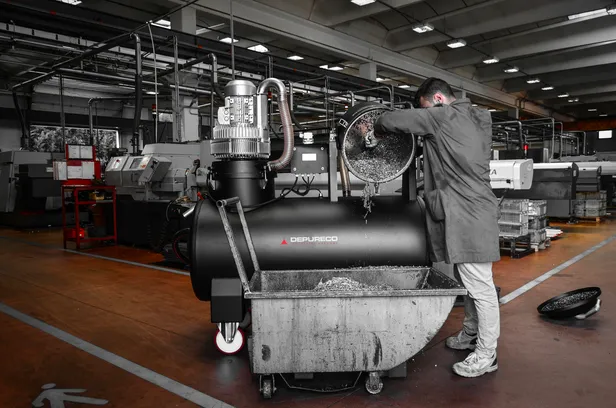

Once chips are separated from the coolant, they still need to leave the vacuum safely and efficiently. The RAM OIL T 500 uses a tilting hopper that allows the operator to discharge the collected solids into a suitable bin without manually lifting a full internal container.
TaMek also operates a separate briquetting system that compacts aluminum chips and recovers some of the coolant retained in the material. The Depureco vacuum is used to clean the area around that equipment, supporting the broader chip-handling workflow.
The source material does not establish that the RAM OIL T 500 directly transfers chips into the briquetting press. Any direct vacuum-transfer process would require a separate review of chip geometry, moisture, conveying distance, receiver design, and the briquetter’s feed requirements.
The distinction between filtration during CNC operation and cleanup around the separate briquetting equipment is documented in the original case study.
Results for Maintenance and Production

The TaMek installation produced several practical improvements in the way coolant, chips, and CNC sump maintenance were handled.
The source does not report a specific dollar savings or exact reduction in maintenance time, so those results should not be generalized. The documented benefit is a simpler, more flexible workflow for recovering coolant, removing chips, and cleaning CNC tanks.
The reported results center on fewer emptying cycles, recovery of coolant that remains suitable for use, production-side filtration, and improved removal of deposits.
What changed for TaMek
The larger tank better matched the volume of the CNC sumps being serviced.
Lowering the liquid level made settled chips and deposits easier to reach.
Bulk solids could be handled independently from the recovered liquid.
The unit could also remove some residues while CNC machines continued operating.
What U.S. Machine Shops Should Evaluate
A case study can show what worked, but equipment still has to be matched to the local application. Review the largest sump, coolant type, chip load, filtration target, discharge path, electrical service, and material hazards before choosing a machine.
Wet bulk aluminum chips should not be treated as equivalent to hot material or dry fine aluminum dust. An ordinary sump vacuum should not be selected for hot chips, flammable liquids, or dry combustible metal fines without a specific application and hazard review.
Size capacity around the biggest tank and the number of machines in the maintenance route.
Short chips, stringy swarf, fines and heavy sludge behave differently in hoses and separators.
Define whether the goal is bulk separation, reuse support, disposal or additional coolant treatment.
Confirm whether liquid must return to the machine, transfer to a drum or move to another treatment step.
Verify U.S. voltage, phase, runtime and the exact supplied RAM OIL configuration.
Wet bulk aluminum chips are not the same hazard as hot material or dry reactive aluminum fines.
CNC Coolant Recovery FAQs
What does a CNC coolant recovery vacuum do?
A CNC coolant recovery vacuum removes machining fluid together with compatible chips, swarf, fines and settled residue from a machine sump. A separation stage retains larger solids while recovered liquid moves into the collection tank for discharge, evaluation, treatment or reuse.
Can a sump vacuum collect coolant and aluminum chips together?
Yes, when the machine is designed for mixed liquid-and-solid recovery. The RAM OIL T 500 collects coolant and wet aluminum chips through one hose, then separates the bulk solids from the liquid inside the vacuum. Hot material, flammable liquids and dry reactive metal fines require a separate application review.
Can filtered coolant be returned directly to the CNC machine?
Only when the recovered fluid remains suitable for the machining process. Filtration can remove bulk particulate, but the shop should still verify concentration, chemistry, tramp oil, microbial condition and any remaining fine contamination before returning coolant to service.
What does 150-micron coolant filtration remove?
A 150-micron liquid filter helps reduce suspended chips and particles larger than its nominal opening. It is useful for bulk separation during sump cleaning, but it should not be treated as complete coolant conditioning or fine polishing for every machining process.
How did the 132-gallon capacity help TaMek?
The larger tank reduced the need to stop and empty the vacuum during an individual cleanout. TaMek reported that the coolant tanks on eight of its ten CNC machines could be serviced without emptying the unit mid-task.
Does the RAM OIL T 500 feed TaMek's chip briquetting press?
The source material does not establish direct vacuum transfer into the briquetting press. It states that TaMek operates a separate aluminum-chip briquetting system and also uses the Depureco vacuum to clean the area around that equipment. Direct transfer would require a separate process and equipment review.
Need Help Configuring a CNC Sump-Cleaning Workflow?
Send Depureco USA the largest sump size, coolant type, chip alloy and shape, estimated solids load, number of machines, available power, hose distance, and discharge destination. Include any coolant-reuse, filtration, or chip-handling objective.
What to send our application team
Share the largest tank size and how many machines are in the maintenance route.
Describe the coolant, chip alloy, chip shape, fines and any settled sludge.
Include available voltage, hose length, lift and the liquid-discharge destination.
Tell us whether recovered coolant will be staged, treated, disposed of or evaluated for reuse.
Depureco USA can help configure a sump-cleaning and coolant-recovery workflow around your machines.
Discuss My CNC Application