



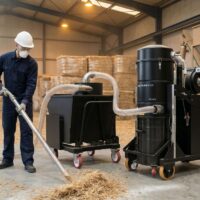
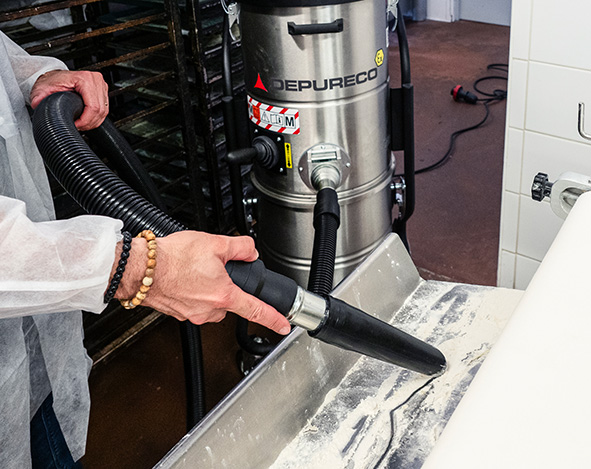
A practical combustible dust compliance checklist should look beyond the vacuum itself. The material being collected, the cleanup area’s classification, static-control measures, filtration and containment needs, and actual operating conditions can all affect which equipment is appropriate.
Before selecting a vacuum, your facility should review five critical safety checks. These provide a practical starting point for compliance-aware equipment selection and help maintenance, EHS, and engineering teams identify the right cleanup path without assuming that one vacuum or feature makes an entire facility compliant.
The 5 Critical Safety Checks
The right combustible dust vacuum strategy starts with the application, not the machine. Before comparing vacuum models, review these five areas with your EHS, maintenance, or engineering team.
1. Identify the Dust
Confirm exactly what material is being collected and whether your facility has relevant SDS information, dust testing, or Dust Hazard Analysis data. Particle size, moisture, conductivity, combustibility, and reactivity can all affect equipment selection.
2. Confirm the Cleanup Area
Determine whether the vacuum will operate in an ordinary or unclassified area or within a formally classified hazardous location. Equipment appropriate for ordinary-location housekeeping should not automatically be assumed suitable for a classified area.
3. Review Static Control
Look beyond the vacuum body. Hoses, tools, filters, collection components, bonding, grounding, and electrical continuity may all be part of the static-control strategy.
4. Match Filtration and Containment
Filtration should match the material and exposure concerns. HEPA filtration may be important for very fine or hazardous particulate, but filtration efficiency alone does not address combustible dust ignition hazards.
5. Define the Complete Application
Consider how much material will be collected, how often the vacuum will run, pickup distance, available power or compressed air, number of operators, disposal requirements, and any unusual conditions such as reactive or hot material.
Simple rule: Do not select a combustible dust vacuum from a product label alone. Final suitability depends on the material, location, application, and complete system configuration.
Know the Dust
Identify the material and review available hazard data before selecting equipment.
Confirm: material, SDS, dust testing or DHA data.Know the Location
Determine whether cleanup occurs in an ordinary area or a classified hazardous location.
Confirm: documented facility area classification.Check Static Control
Review the complete conductive path, including hoses, tools, bonding and grounding.
Confirm: complete system configuration.Check Filtration
Match filtration and containment to the particle size and exposure requirements.
Confirm: filter and disposal requirements.Check the Application
Match the vacuum or system to workload, runtime, utilities and operating conditions.
Confirm: volume, frequency, users and pickup distance.Match the Application to the Right Vacuum Path
Once the five safety checks are documented, the next step is narrowing the equipment path. The goal is not to choose a vacuum based on one feature, but to match the complete configuration to the dust, location, and cleanup requirements.
Ordinary or Unclassified Area
For combustible-dust housekeeping in an ordinary or unclassified area, an appropriately configured ORD LOC combustible dust vacuum may be the right starting point. Final suitability still depends on the material, static-control requirements, filtration, and complete application.
Classified Hazardous Location
If the cleanup area is formally classified, the vacuum must be evaluated against that documented hazardous-location classification. Do not assume that an ordinary-location vacuum, ATEX configuration, or generic “explosion-proof” label automatically matches the facility requirement.
Large or Multi-Point Facility
When multiple operators, production areas, or fixed pickup points need routine cleanup, an engineered centralized vacuum system may provide a better facility-wide strategy than moving individual vacuums between areas.
Unknown or Unusual Material
If the dust is reactive, conductive, unusually fine, hot, chemically complex, or not well characterized, confirm the material and application before selecting equipment.
Recommended path: Start with the hazard and application requirements, then select the vacuum category and configuration that fits them.
Ordinary / Unclassified Area
Start with an appropriately configured combustible dust vacuum and confirm the material, filtration, static-control, and housekeeping requirements.
Classified Hazardous Location
Review equipment specifically intended for the documented location classification through the explosion-proof industrial vacuum path.
Large or Multi-Point Facility
Facilities with multiple cleanup points or operators may benefit from an engineered centralized vacuum system instead of relying only on mobile equipment.
Unknown or Unusual Material
If the material is reactive, conductive, hot, chemically complex, or poorly characterized, confirm the application before selecting equipment.
Combustible Vacuums FAQs
Not necessarily. Equipment selection depends on the material, the facility's documented area classification, and the complete application. Cleanup in an ordinary or unclassified area follows a different equipment path than work inside a classified hazardous location.
No. HEPA filtration addresses fine-particle capture, but it does not by itself address ignition or static-related hazards. Conductive components, bonding, grounding, equipment configuration, and the cleanup environment may also need to be evaluated.
Start with the material or SDS, available dust testing or DHA information, the cleanup-area classification, estimated material volume, cleanup frequency, available power or compressed air, filtration needs, and collection or disposal requirements. The more complete the application information, the easier it is to narrow the appropriate equipment path.
Build Your Vacuum Strategy Around the Application
Combustible dust cleanup starts with understanding the material, location, and operating conditions. Once those details are documented, Depureco can help narrow down the appropriate vacuum category, filtration, accessories, and system configuration for your facility.
For the most useful application review, have the following information available:
- Material or SDS
- Dust testing or DHA information, if available
- Cleanup-area classification
- Estimated material volume and cleanup frequency
- Available electrical power or compressed air
- Filtration and containment requirements
- Collection and disposal method
Final suitability should be confirmed for the specific material, application, facility requirements, and complete vacuum configuration before ordering.
Need Help Confirming the Right Vacuum Path?
Send us your material, cleanup requirements, available hazard information, and facility conditions. Depureco can help review the application and narrow the appropriate equipment and configuration.
