

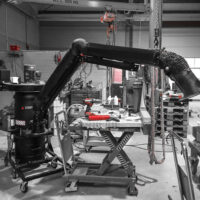


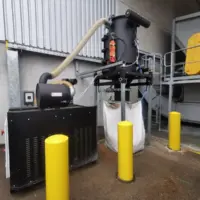

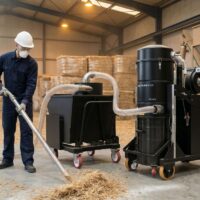

Metal chips and swarf may come from the same machining process, but they do not always create the same cleanup problem. Short broken chips, long curled turnings, oily shavings, and coolant-loaded swarf can behave very differently once they enter a vacuum hose and collection tank.
That is where a typical shop vacuum can start struggling. The problem is not always a lack of suction. Chip shape, material weight, volume, liquid content, and duty cycle all affect whether a vacuum is actually suited for a CNC machine shop.
Knowing what your machines are producing makes it much easier to determine whether you need a dedicated metal chip vacuum, a wet-capable industrial vacuum, or a CNC sump vacuum designed to recover coolant, oil, chips, and swarf.
Metal Chips vs. Swarf: What Actually Changes?
In machine shops, the terms metal chips and swarf are often used interchangeably. The more useful distinction for vacuum selection is not the name of the debris, but how it behaves.
Short, broken chips generally move through a hose more easily than long, curled or stringy turnings. Long swarf can bunch together, bridge across openings, wrap around other material, and create restrictions inside the collection path.
Moisture changes the application again. A pile of mostly dry chips is fundamentally different from chips saturated with coolant or cutting oil. Once significant liquid, sludge, or settled fines are involved, the job becomes less about collecting dry solids and more about recovering and separating solids from liquid.
Simple rule:
The right vacuum depends on four things:
- Chip shape: short and broken or long and stringy
- Material volume: occasional cleanup or continuous heavy loading
- Wet vs. dry: dry chips or coolant-loaded debris
- What happens next: disposal, separation, coolant recovery, or reuse
That is why two CNC machines in the same facility may require very different vacuum configurations even when both are producing “metal chips.”
| What You Are Collecting | How It Behaves | Common Vacuum Challenge | Likely Solution Path |
|---|---|---|---|
| Short, Dry Metal Chips | Coarse, sharp, dense, and relatively free-flowing | Heavy material loading, abrasion, and frequent emptying | Metal chip vacuum |
| Long or Stringy Swarf | Curls, tangles, nests, and bridges across openings | Hose or inlet restrictions and difficult discharge | Chip and swarf-specific industrial vacuum |
| Coolant-Wet Chips | Mixed solid and liquid material | Liquid accumulation and separation requirements | Wet-capable chip vacuum or sump system |
| Coolant, Chips & Sludge | Liquid-dominant mixture with settled solids and fines | Rapid tank filling, sludge removal, and fluid handling | CNC sump or oil and swarf recovery vacuum |
Why a Typical Shop Vacuum Struggles
A shop vacuum may work well for occasional floor cleanup, but CNC machining can expose weaknesses that have little to do with advertised suction power.
1. Metal chips are heavy and abrasive
Steel, aluminum, brass, and other machining chips are considerably denser and more abrasive than ordinary dust or light debris. Larger quantities can quickly fill a small collection tank and place more wear on hoses, inlets, and collection components.
2. Long swarf can clog the collection path
Long curls and stringy turnings can catch on bends, bunch together, and bridge across hose or inlet openings. Once that happens, airflow can drop even though the vacuum motor itself is still running normally.
3. Coolant changes the job
When chips are saturated with coolant or cutting oil, the vacuum is no longer handling dry solids alone. Significant liquid may require overflow protection, greater liquid capacity, chip separation, controlled discharge, or a dedicated sump-recovery system.
4. Machine shops need more than occasional cleanup
Repeated CNC cleanup can require longer run times, greater collection capacity, and more durable components than a light-duty vacuum was designed to handle.
Common mistake: Trying to solve these problems by simply buying a vacuum with a higher advertised horsepower or suction rating. The better approach is to match the vacuum configuration to the material, chip shape, liquid content, volume, and required duty cycle.
Heavy, Abrasive Material
Metal chips are dense and abrasive. Large quantities can quickly fill smaller tanks and increase wear on hoses, inlets, and collection components.
Long Swarf Can Bridge
Long curls and stringy turnings can tangle, bunch together, and restrict the collection path before material ever reaches the tank.
Coolant Changes the Application
Wet chips introduce liquid handling, overflow protection, separation, discharge, and potentially coolant-recovery requirements.
Higher Duty Requirements
Repeated CNC cleanup may require longer run times, greater capacity, and more durable construction than light-duty cleanup equipment provides.
Match the Vacuum to What Your CNC Machine Produces
Once you know how the material behaves, the equipment path becomes much clearer. The goal is not to find one vacuum that handles every possible CNC cleanup job. It is to match the vacuum to the dominant material and recovery task.
Mostly Dry Chips and Swarf
If the application is dominated by dry metal chips, shavings, or turnings, start with a dedicated metal chip vacuum. These systems are better suited for the weight, volume, and abrasive nature of machining debris than a typical light-duty shop vacuum.
Recommended path: Metal chip and swarf recovery.
Mostly Coolant, Oil, Chips, and Sludge
If liquid makes up a significant portion of what you are recovering, the application changes. A CNC sump vacuum is designed around liquid recovery, chip separation, sump cleaning, and fluid handling rather than dry debris collection alone.
For applications specifically involving cutting oil and swarf, Depureco also offers dedicated oil and swarf recovery vacuums.
Recommended path: Sump or oil-and-swarf recovery.
Fine Metallic Dust
Fine metal dust should not automatically be treated as another chip-recovery application. Grinding, sanding, polishing, or machining processes that generate fine metallic particulate can introduce different filtration, containment, static-control, and combustible-dust considerations.
Compliance-aware note: Final equipment selection for fine metal dust should be based on the material, particle characteristics, process, hazard profile, and facility requirements. Do not assume a standard chip or sump vacuum is appropriate without confirming the application.
Metal Chips & Swarf
Best starting point for mostly dry metal chips, shavings, turnings, and coarse CNC machining debris.
View Metal Chip VacuumsCoolant, Oil & Sludge
Best starting point when sump cleaning, coolant recovery, chip separation, or liquid handling is the primary job.
View CNC Sump VacuumsFine Metallic Dust
Fine metal dust can require different filtration, containment, and hazard considerations than coarse chips or swarf.
FAQs
The terms are often used interchangeably in machine shops. In practice, swarf can refer broadly to machining waste including chips, shavings, turnings, and other metal debris.
For vacuum selection, the more important question is how the material behaves: short or stringy, wet or dry, light or heavy, and how much is being collected.
A shop vacuum may handle small amounts of occasional debris, but repeated CNC cleanup can introduce heavier material loads, sharp chips, long turnings, coolant, and longer operating cycles.
For regular machine-shop cleanup, a dedicated metal chip vacuum is generally the better starting point.
If you are primarily collecting dry chips, shavings, and swarf, start with a metal chip vacuum.
If you are primarily recovering coolant, cutting oil, sludge, and chips together, a CNC sump vacuum is usually the more appropriate path because the application requires liquid handling and solid-liquid separation.
Confirm before ordering: Final equipment selection should consider material, chip geometry, wet/dry condition, liquid volume, collection method, duty cycle, and any applicable hazard profile.
Stop Fighting the Wrong Vacuum
If metal chips, long swarf, coolant, or sludge repeatedly clog your vacuum or slow CNC cleanup, the problem may be the equipment configuration rather than the suction level.
Depureco can help match the vacuum to your material, chip shape, wet/dry condition, collection volume, and cleanup process so you are not trying to force one machine into the wrong application.
Whether you are recovering mostly dry chips or cleaning coolant-filled CNC sumps, the right starting point is understanding what your machines are actually producing.
Not Sure Which Vacuum Fits Your CNC Debris?
Tell us what material you are machining, what the chips or swarf look like, whether coolant or cutting oil is present, and how much material you need to recover. We can help identify the right machine-shop vacuum path for your application.
Request a Vacuum Recommendation