SP – 3C – 14,000
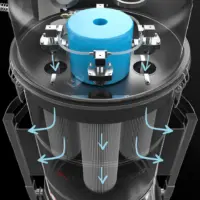
Automatic reverse jet cleaning system. Antistatic M class filter (EN-60335-2-69), 3x Polyester filter cartridges, 14,000 in² filter surface.


6.2–8.5 HP

52,700 in²

FROM 15.7 to 25.9 inH2O
The AF high-airflow stationary dust collector is built for centralized dust collection systems that need large filter surface, high air volume, and multi-point dust capture from production processes. It is designed for dry dust, fine particulate, powders, granular material, and process dust collected from multiple pickup points, hoods, machines, or duct-connected collection points.
The AF range includes AF 40 and AF 55 configurations. Both models use 480 V / 60 Hz three-phase fan power with an 8-inch inlet, IP55 / Class F motor protection, and maximum airflow from 1,295 to 1,589 CFM. This makes AF a stronger fit for centralized dust collection layouts than smaller mobile collectors when the system must support larger air volume or multiple collection points.
Filtration is handled by four large antistatic polyester M-Class cartridge filters with 52,700 in² of total primary filter surface. The SP automatic reverse-jet cleaning system helps remove dust from the cartridge surface during operation, while the conic cyclone supports material separation before dust reaches the filters.
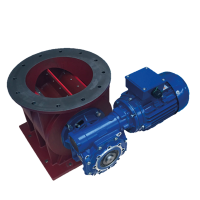
AF can be configured with optional discharge systems for different collection and emptying workflows, including pneumatic discharge valves, rotary valve discharge, Big-Bag discharge, level detection, PTFE filtration, and optional H14 absolute filtration. Final selection should account for the dust type, airflow requirement, duct layout, pickup points, filter loading, disposal method, and any combustible-dust or classified-location requirements.

AF 40 and AF 55 use 480 V / 60 Hz three-phase fan configurations delivering 1,295–1,589 CFM for centralized dust collection systems and multi-point source capture.

Four large antistatic polyester M-Class cartridge filters provide 52,700 in² of primary filter surface for dry dust, fine particulate, powders, and process dust.

The SP automatic reverse-jet cleaning system helps remove dust from the cartridge surface and control filter loading during dry-dust service.

A conic cyclone supports material separation before the filters. Optional discharge systems can be configured for Big-Bag workflows, rotary valve discharge, pneumatic valves, or other process requirements.
Automatic reverse jet cleaning system. Antistatic M class filter (EN-60335-2-69), 3x Polyester filter cartridges, 14,000 in² filter surface.
Get answers about using the AF for stationary multi-point dust collection, machine-connected source capture, dry powders and process particulate, cyclonic pre-separation, automatic reverse-jet filter cleaning, localized discharge, AF model selection, and choosing between stationary and mobile dust-collection systems.
The AF is a high-airflow stationary dust collector designed for fixed industrial processes that require continuous source capture from machines, hoods, enclosures, or multiple duct-connected pickup points.
Unlike a mobile dust collector that is moved between individual machines, the AF is intended to remain integrated into the production layout. Its three-phase fan system supports larger air volumes and centralized or semi-centralized dust-collection arrangements where several collection points may feed the same filtration and discharge unit.
The current AF range includes AF 40, AF 55, and AF 75 models with maximum airflow from 1,295 to 2,472 CFM.
Typical applications include cutting, trimming, sanding, machining, woodworking, plastics and composites processing, powder handling, packaging, and other production processes that continuously generate dry airborne particulate.
The AF is particularly useful when a facility needs large filter surface, automatic filter cleaning, cyclonic separation, and a configurable discharge system instead of relying on a small removable collection bin.
The AF is intended for dry process dust, fine particulate, powders, granular material, and other suitable airborne production material captured through a fixed extraction system.
Typical applications can include woodworking dust, cutting and trimming particulate, sanding dust, plastic and composite dust, machining fines, packaging dust, powders, and other dry material generated repeatedly at production equipment.
Because the AF is designed for duct-connected source capture, it can collect from several machines, hoods, enclosures, or extraction points when the overall system is properly sized.
Material suitability still depends on the process. Particle size, dust concentration, bulk density, abrasiveness, temperature, moisture, conductivity, combustibility, duct velocity, and required capture airflow can all change the system design.
The fact that a material can physically move through the duct does not automatically mean the standard AF configuration is appropriate for every dust or process hazard.
The AF combines several stages to support continuous stationary dust collection.
Incoming material enters through an 8-inch tangential inlet. The tangential path and conic cyclone help separate heavier particulate from the airflow before the remaining fine dust reaches the primary filters.
The AF uses a large cartridge filtration system with approximately 52,700 in² of total Class M filter surface. An SP automatic reverse-jet cleaning system uses compressed-air pulses to remove accumulated dust from the cartridges and help control filter loading during operation.
Separated material then moves toward the lower discharge section rather than relying on a small removable bin as the only collection method.
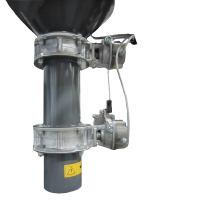
The AF can be configured with different localized discharge devices, including manual or pneumatic butterfly valves, rotary valves, and other discharge arrangements. This allows the collection workflow to be matched to the material volume and how the facility intends to transfer or dispose of recovered dust.
Choose the AF model according to the airflow and static-pressure requirements of the complete dust-collection system.
The AF 40 provides up to 1,295 CFM with 13.4 inH₂O of continuous vacuum and 10.6 inH₂O of available static depression.
The AF 55 increases performance to 1,589 CFM with 20.4 inH₂O of continuous vacuum and 18.9 inH₂O of available static depression.
The AF 75 provides the highest performance in the current range at up to 2,472 CFM, 39.7 inH₂O of continuous vacuum, and 21.2 inH₂O of available static depression.
All three models use the same 8-inch tangential cyclone inlet and 52,700 in² filtration platform.
The correct model should therefore be chosen from the required airflow at the pickup points, total duct length, duct diameter, elbows and branches, hood losses, number of simultaneous collection points, dust-generation rate, and total system resistance—not horsepower alone.
Choose the AF when the application requires a fixed high-airflow system with large filter capacity, cyclonic pre-separation, automatic filter cleaning, and a configurable discharge method for material collected from one or more permanent process points.
A DF 40 is generally the better fit when high-airflow source capture needs to remain mobile and move between machines or production areas.
A DF FIX SP is a strong stationary option when the application can use a detachable collection bin and does not require the AF’s larger filter area or localized discharge architecture.
The AF becomes more attractive as the application moves toward continuous machine-connected extraction, multiple pickup points, greater filter loading, and workflows where collected material must discharge through a valve, rotary airlock, Big-Bag arrangement, or another downstream collection system.
Very large plant-wide networks, numerous simultaneous users, or complex process integration may require a fully engineered centralized system rather than selecting an AF model from airflow alone.
The standard AF should also not automatically be assumed suitable for combustible dust or a hazardous classified location. Dust hazards, required isolation, grounding, explosion protection, electrical classification, and discharge design must be reviewed separately when applicable.