



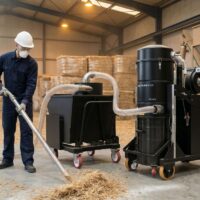
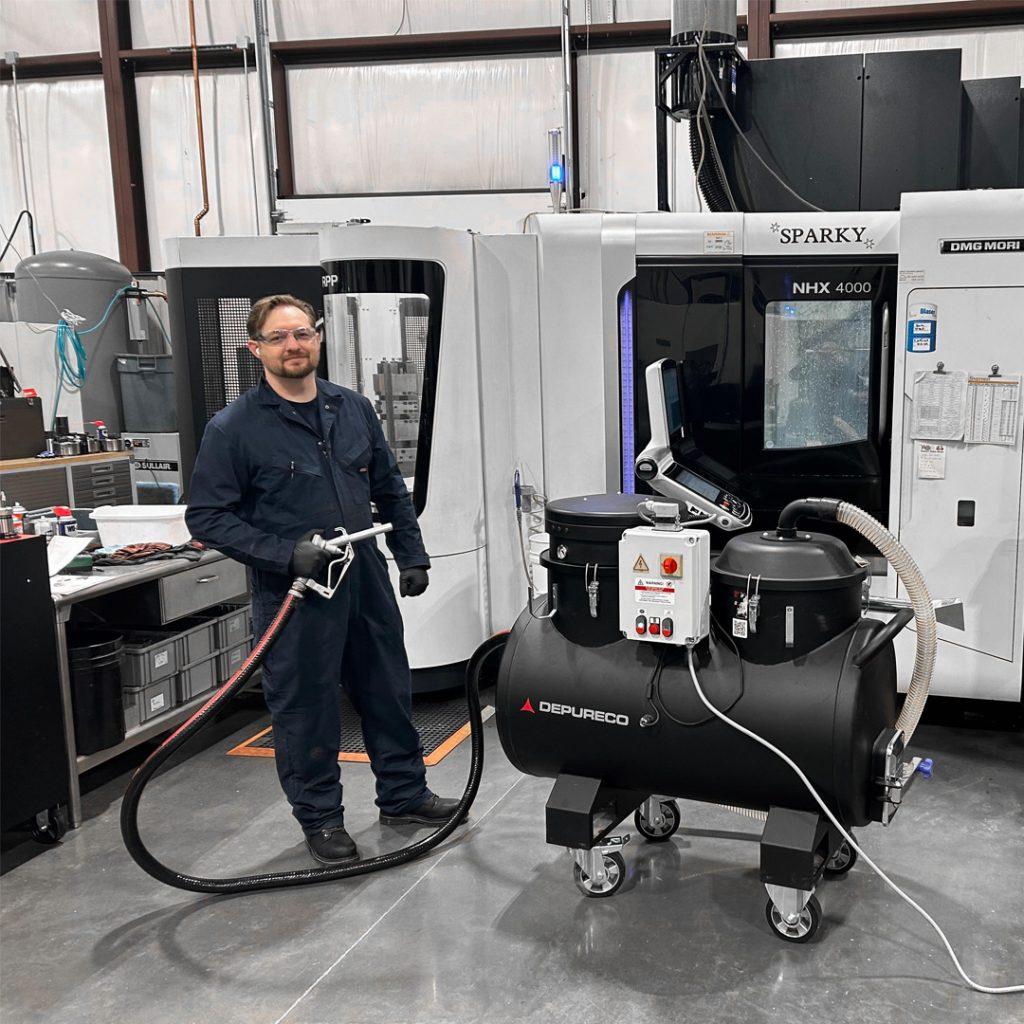
A CNC shop can create several completely different cleanup problems from the same machining process. Dry chips and swarf collect inside machines and around work cells. Coolant, cutting oil, fines, and sludge settle inside sumps. Maintenance teams also deal with spills, oily residue, and mixed debris across the shop floor.
Those jobs do not always belong to the same vacuum category.
The simplest rule is to start with what is going into the hose and what you need to do with it afterward.
- Mostly dry metal chips, shavings, or swarf: Start with a chip vacuum built around solid-material recovery.
- Coolant or cutting oil mixed with chips and sludge: A sump vacuum is generally the better path because the job involves liquid recovery, solid/liquid separation, and CNC tank cleanout.
- Spills and changing wet/dry housekeeping: An industrial wet/dry vacuum provides more flexibility for general machine-side and facility cleanup.
- Fine or airborne machining dust: Stop before choosing among these three. Fine, hazardous, conductive, or potentially combustible particulate can require a different filtration, dust-extraction, or hazard-specific vacuum configuration.
The goal is not to find one vacuum that is universally “best” for a CNC shop. It is to match the equipment to the material, cleanup objective, volume, and operating conditions.
For many machine shops, that can mean using more than one type of industrial vacuum.
Already know which cleanup problem you are trying to solve?
Quick Answer: Which CNC Vacuum Type Do You Need?
Start with the material that makes up most of the cleanup job.
A CNC shop handling mostly dry chips has a different requirement than a maintenance team draining a coolant-filled sump. Likewise, a vacuum used for occasional spills and general housekeeping does not necessarily need the same separation and discharge features as a dedicated sump-cleaning system.
Use these three paths as the starting point. Final equipment selection should still account for material type, chip geometry, liquid volume, sludge, duty cycle, and the method for discharging the collected material.
Mostly Dry Solids
Chip Vacuum
Start here when the primary job is collecting dry metal chips, shavings, turnings, or swarf from CNC machines and surrounding work areas.
- Dry chips and shavings
- Short or curled metal turnings
- Machine trays and chip buildup
- Bulk solid-material recovery
Mostly Liquid + Solids
Sump Vacuum
Start here when coolant or cutting oil makes up a major part of the job and chips, fines, or sludge also need to be removed from the CNC sump.
- Coolant or cutting oil
- Wet chips and swarf
- Settled sludge and fines
- Tank cleanout and liquid recovery
General Mixed Cleanup
Industrial Wet/Dry Vacuum
Start here when the vacuum needs to move between general dry debris, small liquid spills, oily residue, and routine machine-side housekeeping.
- Small spills and leaks
- Mixed wet and dry debris
- Machine-side housekeeping
- General facility maintenance
Start With What Is Actually Going Into the Hose
The fact that a vacuum will be used near a CNC machine does not tell you enough to select the right equipment. The more useful question is: what material will the vacuum collect most of the time?
A machining operation can create coarse chips, long swarf, coolant, cutting oil, settled sludge, fine metal particles, and general floor debris. Each behaves differently once it enters a hose, separator, collection tank, or filter.
Solids-First Applications
When most of the material is dry chips, shavings, or turnings, the system needs to prioritize solid-material pickup and collection.
Chip size and shape matter. Short aluminum or steel chips behave differently from long, curled swarf that can bridge, tangle, or restrict a pickup path. The amount of residual coolant on the chips can also affect the equipment choice.
This is where a dedicated chip-vacuum path generally makes the most sense.
Liquid-First Applications
A coolant-filled sump changes the problem.
Instead of simply collecting solids, the vacuum may need to recover a large volume of coolant or cutting oil while also removing chips, fines, and settled sludge from the tank.
That creates additional requirements such as solid/liquid separation, adequate liquid capacity, practical discharge, and—in some configurations—the ability to transfer recovered fluid.
For repeated CNC sump maintenance, those functions are what separate a sump vacuum from a general-purpose wet/dry vacuum.
Housekeeping-First Applications
Not every wet CNC cleanup is a sump-cleaning application.
A maintenance team may need to collect a small coolant spill, vacuum oily residue around a machine base, remove dry debris from the floor, and then move to another part of the facility.
When versatility matters more than coolant separation or tank-cleanout capability, an industrial wet/dry vacuum can be the more practical choice.
Material State Can Change the Recommendation
Two shops machining the same alloy may still need different vacuum systems.
One may generate mostly dry chips that fall into a collection tray. Another may run the same material with flood coolant and routinely clean a large sump containing liquid, chips, and metal sludge.
The material name is important, but so are:
- whether the debris is dry, wet, or oil-coated
- chip size and geometry
- liquid volume
- the amount and density of sludge
- how often the cleanup occurs
- whether recovered liquid needs to be transferred or reused
- hose distance and pickup requirements
- the expected duty cycle
These factors should drive the equipment decision before comparing motor power, tank size, or individual vacuum models.
Simple Rule
Choose the vacuum around the material that dominates the cleanup job: dry solids, liquid-heavy sump contents, or general mixed housekeeping.
When to Use a Chip Vacuum
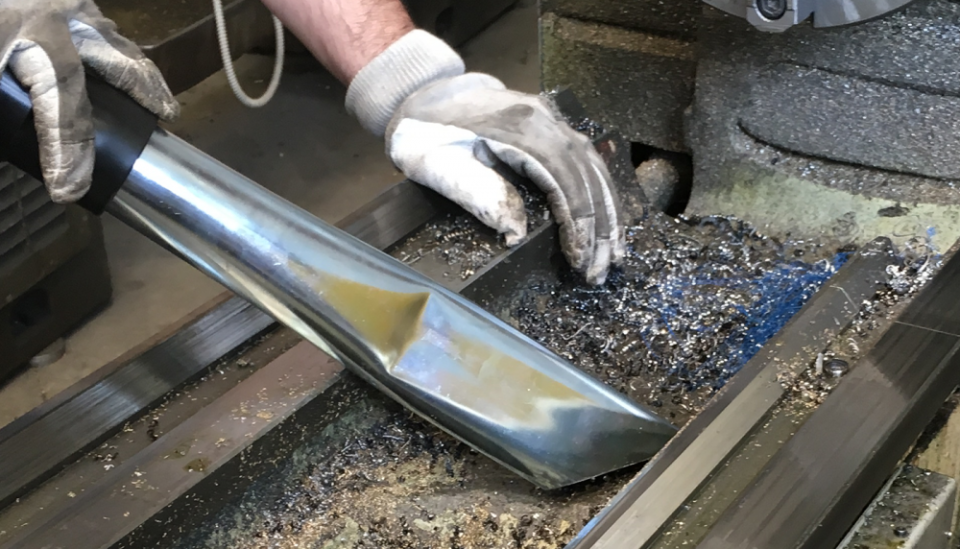
A chip vacuum is the better starting point when the cleanup job is dominated by dry or lightly oil-coated metal chips, shavings, and swarf rather than a large volume of coolant or cutting oil.
Typical applications include collecting chips from CNC machine interiors, chip trays, work cells, floors, and material-handling points where the primary objective is moving solid machining debris efficiently.
Best for Dry and Mostly Dry Machining Debris
Chip vacuums are most relevant when the material load consists primarily of:
- steel, stainless steel, aluminum, or other metal chips
- machining shavings and turnings
- short or curled swarf
- chips collected around machine tools
- dry process scrap and coarse production debris
- lightly oil-coated chips where liquid recovery is not the main objective
The key distinction is that the job is solids-first.
If a vacuum is spending most of its operating time moving chips rather than draining liquid from a CNC tank, a chip-focused system can provide a more appropriate material-handling path than equipment designed primarily for liquid recovery.
Chip Shape Matters
“Metal chips” can describe very different materials.
Short broken chips usually move through a vacuum system more easily than long, continuous turnings. Stringy swarf can twist together, form bird nests, bridge across openings, or restrict hoses and separators.
A shop producing long lathe turnings may therefore need a different pickup arrangement than a milling operation producing small, broken chips.
Before selecting equipment, consider:
- typical chip length
- whether chips are short, curled, or stringy
- hose and inlet diameter
- how much residual coolant is carried with the chips
- how quickly chips accumulate
- how the collected material will be emptied or transferred
When a Chip Vacuum Is Not the Best Starting Point
A chip vacuum should not automatically be selected simply because metal chips are present.
If the chips are submerged in a large coolant tank, mixed with significant liquid, or buried in settled sump sludge, the job has shifted from dry chip collection toward liquid-and-solid recovery.
That is where a sump vacuum usually becomes the more appropriate path.
Likewise, very fine metal particulate or machining dust should not automatically be treated like coarse chips. Fine, hazardous, conductive, or potentially combustible particulate can require a separate filtration and hazard review.
Recommended Path
For CNC operations where dry chips, shavings, and swarf are the primary material, start with Depureco USA’s metal chip vacuum solutions.
Final equipment selection should still be confirmed around chip geometry, material volume, residual liquid, pickup distance, discharge method, and expected duty cycle.
Good Starting Fit
- Dry CNC chips and shavings
- Short or curled metal turnings
- Machine trays and work-cell cleanup
- Bulk solid-material recovery
- Light residual oil where liquid recovery is secondary
Consider Another Path
- Coolant-heavy CNC sumps
- Large liquid volumes
- Dense settled sludge or slurry
- Applications requiring liquid return or transfer
- Fine or potentially hazardous metal dust
When to Use a Sump Vacuum
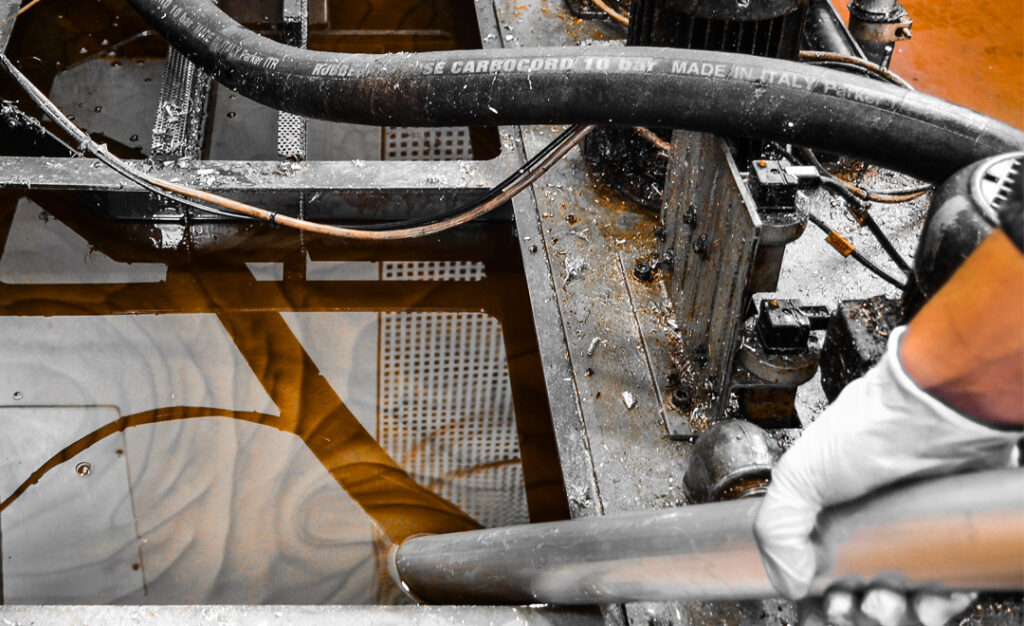
A sump vacuum is the better starting point when the cleanup job is dominated by coolant, cutting oil, or another machining fluid mixed with chips, fines, or settled sludge.
This is different from simply picking up a spill. CNC sump cleaning often involves removing a large volume of liquid, separating solids from that liquid, reaching contamination that has settled at the bottom of the tank, and then discharging or transferring the recovered material practically.
Best for Coolant-Heavy CNC Maintenance
Sump vacuums are most useful for applications such as:
- draining CNC coolant tanks
- recovering cutting oil
- removing wet chips and swarf
- collecting settled fines and sludge
- cleaning the bottom of machine sumps
- separating bulk solids from recovered liquid
- transferring or discharging recovered fluid, depending on the vacuum configuration
The defining characteristic is that the job is liquid-first.
If the maintenance task starts with a sump containing dozens of gallons of coolant and ends with chips and sludge that also need to be removed, a sump vacuum is generally a more purpose-built solution than a general wet/dry vacuum.
Separation Matters
One of the main differences between a sump vacuum and a general wet vacuum is what happens after the material is collected.
In many machining applications, it is useful to keep bulk chips and swarf separate from the recovered liquid. That can make disposal easier, simplify tank cleanout, and support downstream coolant-management procedures.
Some sump-vacuum configurations also provide dedicated liquid filtration or pump-assisted discharge.
The exact filtration, separation, and discharge method varies by model, so those features should be confirmed before ordering.
Sludge Changes the Application
The bottom of a CNC sump can contain much more than coolant and visible chips.
Fine metal particles, settled contamination, oily residue, and dense sludge can accumulate in areas that are difficult to clean manually. These materials can be heavier and more difficult to move than ordinary liquid spills.
For sludge-heavy applications, the vacuum should be selected around:
- sump depth
- liquid volume
- sludge density
- particle size
- hose length
- required suction lift
- discharge method
- cleaning frequency
A vacuum that works well for routine coolant recovery may not automatically be the best choice for a deep tank filled with dense grinding sludge.
Coolant Recovery Does Not Automatically Mean Coolant Reuse
Recovering coolant and separating bulk solids can be useful, but a vacuum alone does not determine whether the fluid is ready to return to production.
Coolant condition can also depend on concentration, tramp oil, bacteria, fine contamination, chemistry, and the machining process.
If coolant reuse is part of the goal, confirm the shop’s fluid-management requirements in addition to selecting the vacuum.
When a Sump Vacuum Is More Than You Need
A dedicated sump vacuum may not be necessary when the application consists mainly of occasional spills, small amounts of liquid, or routine wet/dry housekeeping around the facility.
In those situations, an industrial wet/dry vacuum may provide a simpler and more flexible solution.
Recommended Path
For CNC applications involving coolant, cutting oil, wet chips, swarf, and sump sludge, start with Depureco USA’s CNC sump vacuum solutions.
Final selection should be confirmed around tank capacity, fluid type, solids loading, sludge, discharge requirements, cleaning frequency, and whether recovered liquid will be transferred or reused.
Good Starting Fit
- Coolant-heavy CNC sumps
- Cutting oil mixed with chips
- Wet swarf and settled fines
- Sludge and tank-bottom contamination
- Applications needing liquid recovery or transfer
Consider Another Path
- Mostly dry chips and shavings
- General floor housekeeping
- Small incidental liquid spills
- Fine airborne machining dust
- Applications where liquid separation is unnecessary
When to Use an Industrial Wet/Dry Vacuum

An industrial wet/dry vacuum is usually the better fit when the cleanup job changes throughout the day and the primary goal is general machine-side or facility housekeeping rather than dedicated chip transfer or CNC sump cleaning.
A maintenance team may use the same vacuum to collect dry debris near one machine, recover a small coolant spill near another, clean oily residue from the floor, and handle routine wet or dry maintenance tasks elsewhere in the facility.
That versatility is the main advantage.
Best for General Mixed Cleanup
Industrial wet/dry vacuums can be a practical choice for:
- small coolant or cutting-fluid spills
- oily residue around machine bases
- mixed wet and dry floor debris
- routine machine-side cleanup
- maintenance departments serving multiple areas
- occasional chips mixed with small amounts of liquid
- general plant housekeeping
Unlike a dedicated sump vacuum, the primary purpose is not usually to empty and clean a large coolant tank or separate significant volumes of machining fluid from chips and sludge.
Where Wet/Dry Versatility Helps
Many CNC shops have cleanup tasks that do not justify a specialized machine for every incident.
For example, a coolant hose leak may leave several gallons of liquid around a machining center. Chips may accumulate underneath equipment. Maintenance personnel may also need to clean loading areas, aisles, workbenches, or other production spaces.
A wet/dry vacuum can move between those jobs without requiring the shop to treat every liquid pickup as a sump-recovery process.
This makes the category especially useful when portability and flexibility matter more than fluid separation or coolant-transfer capability.
A Wet/Dry Vacuum Is Not Automatically a Sump Vacuum
One common mistake is assuming that any vacuum capable of collecting liquid is also designed for repeated CNC sump cleanout.
The two applications can involve very different material volumes and maintenance objectives.
A CNC sump may contain:
- a large volume of coolant or cutting oil
- submerged chips and swarf
- dense settled sludge
- metal fines
- tramp contamination
- material that needs to be separated before discharge
If those conditions describe the regular job, a sump vacuum is generally the more appropriate starting point.
A wet/dry vacuum may still be capable of collecting some of the same materials, but capability alone does not mean it is the most efficient configuration for the workflow.
When a Wet/Dry Vacuum May Be More Practical
A dedicated sump system can be unnecessary if liquid pickup is only occasional.
A wet/dry vacuum may be the better choice when:
- spills are relatively small
- liquid recovery is not the dominant task
- the vacuum serves multiple departments or machines
- coolant reuse or pump-back is not required
- material changes frequently
- portability is more valuable than specialized separation
The decision should be based on the job the vacuum performs most often rather than the most difficult cleanup it might encounter once or twice a year.
Recommended Path
For machine shops that need flexible equipment for spills, mixed debris, and routine industrial housekeeping, start with Depureco USA’s industrial wet/dry vacuum solutions.
Final selection should be confirmed around the expected liquid volume, solids loading, material type, filtration needs, collection capacity, available power, and operating frequency.
Good Starting Fit
- Small coolant or oil spills
- Mixed wet and dry debris
- Routine machine-side cleanup
- General facility housekeeping
- Maintenance teams serving multiple areas
Consider Another Path
- Routine full CNC sump cleanout
- Large coolant or cutting-oil volumes
- Heavy settled sludge
- Applications requiring chip/liquid separation
- Coolant transfer or recovery workflows
Where Each Vacuum Stops Making Sense
The three vacuum categories overlap in some CNC cleanup tasks, but that does not make them interchangeable.
A vacuum may technically pick up a material while still being poorly matched to the volume, separation requirements, discharge method, or frequency of the job. The better question is not only “Can it collect this?” but “Is this what the system is designed to do repeatedly?”
Using a Chip Vacuum for a Coolant-Heavy Sump
A chip vacuum is a strong option when solid machining debris dominates the application. That changes when the pickup point becomes a tank filled primarily with coolant or cutting oil.
A liquid-heavy sump can require:
- substantial liquid capacity
- separation of chips from recovered fluid
- removal of settled sludge and fines
- practical liquid discharge or transfer
- repeated tank-cleaning cycles
If those requirements dominate the job, move toward a sump-vacuum configuration rather than trying to make a solids-focused system perform a liquid-recovery workflow.
Using a Wet/Dry Vacuum as the Shop’s Regular Sump Cleaner
Industrial wet/dry vacuums can handle many of the same materials found around CNC equipment. They are useful precisely because they can move between wet and dry housekeeping tasks.
The limitation appears when occasional liquid pickup becomes routine full-sump maintenance.
Repeatedly draining large tanks, separating wet chips, removing bottom sludge, and handling recovered coolant can justify equipment designed specifically around sump cleaning.
A wet/dry vacuum may be capable of collecting the material, but capability and workflow efficiency are not always the same thing.
Using a Sump Vacuum for Mostly Dry Chip Collection
The opposite mismatch can happen when a shop selects liquid-recovery equipment for an application that is almost entirely dry.
If the main problem is piles of dry chips, shavings, and turnings around CNC machines, the liquid-separation features of a sump vacuum may offer little benefit.
A chip-focused system may provide a more direct material-handling path, particularly when chip volume and solids recovery are the main concerns.
Treating Fine Metal Dust Like Coarse Chips
This is where the three-way comparison has an important boundary.
Coarse machining chips and fine metal particulate are not automatically the same vacuuming application. Fine dust can behave differently in filters, become airborne more easily, and may introduce exposure, conductivity, or combustible-dust considerations depending on the material and process.
If the application involves fine metal dust, graphite, composite dust, or another potentially hazardous particulate, do not select equipment solely from this chip-versus-sump-versus-wet/dry comparison.
The material and hazard profile should be reviewed separately before equipment is selected.
Expecting One Vacuum to Solve Every CNC Cleanup Problem
Some shops genuinely have more than one vacuum application.
A facility may need to:
- recover dry chips from machining cells
- clean coolant-filled sumps during maintenance
- handle spills and mixed floor debris
- control fine dust from a separate dry-machining process
Trying to force every one of those jobs through a single vacuum can create unnecessary compromises.
In those situations, the better solution may be to standardize around two or more vacuum categories, each selected for the work it performs most often.
Mismatch 01
Chip Vacuum for a Liquid-Heavy Sump
When coolant volume, sludge removal, separation, and liquid discharge dominate the job, move toward a sump-vacuum configuration.
Mismatch 02
Wet/Dry Vacuum for Routine Sump Service
General wet pickup does not automatically provide the separation, capacity, or discharge workflow needed for repeated CNC tank cleanout.
Mismatch 03
Sump Vacuum for Mostly Dry Chips
If the application is dominated by dry chips and swarf, a dedicated solids-recovery path may be simpler and better matched to the job.
Why Chip Shape Matters
Not all metal chips move through a vacuum system the same way.
A CNC mill producing short, broken aluminum chips creates a very different collection problem than a lathe producing long steel turnings. Even when the alloy is the same, chip geometry can affect hose flow, pickup efficiency, separator performance, and how easily collected material can be discharged.
Short Chips and Shavings
Short, broken chips are generally easier to move through hoses and collection paths because they are less likely to bridge across openings or wrap around internal components.
Typical examples include:
- small milling chips
- short drilling chips
- broken aluminum shavings
- compact steel or stainless chips
For these applications, material volume and residual coolant may influence equipment selection more than chip length.
Curled and Stringy Swarf
Long or curled swarf requires more attention.
Continuous turnings can twist together, form bird nests, and bridge across hose inlets, baskets, or separators. Long swarf can also become harder to discharge once a collection container begins to fill.
For applications producing stringy material, confirm:
- typical chip length
- hose diameter
- pickup-tool opening
- separator or basket design
- expected chip volume
- how the collected swarf will be emptied
A vacuum that performs well with short chips should not automatically be assumed to handle long continuous turnings equally well.
Wet Chips Behave Differently
Residual coolant or cutting oil can change how chips move and collect.
Lightly coated chips may still behave primarily like solids. Once the material becomes saturated or submerged in significant liquid, however, the application begins moving toward sump recovery rather than dry chip collection.
That distinction is especially important when operators describe the material simply as “swarf.” The same term may refer to dry turnings on a machine tray or wet chips sitting at the bottom of a coolant tank.
Fines and Sludge Are Another Material Class
Very small particles can settle into coolant and form dense sludge at the bottom of a sump.
This material does not behave like coarse chips and may place greater demands on suction lift, filtration, wear resistance, and discharge.
The more the material resembles slurry, metal mud, or settled fines instead of recognizable chips, the more important it becomes to evaluate the application as a sump or heavy liquid-recovery problem.
Confirm Before Selecting Equipment
When chip geometry is uncertain, a material photo or sample can be more useful than a generic description such as “metal chips.”
For application review, provide the alloy, approximate chip size and shape, wet/dry condition, expected volume, hose distance, and whether the material includes sludge or significant liquid.
01
Short Chips
Usually easier to convey through hoses and collection paths. Volume and residual liquid often become the main sizing factors.
02
Curled Turnings
Can begin to bridge or tangle as chip length increases. Hose and separator geometry become more important.
03
Stringy Swarf
Long continuous turnings can form bird nests and restrict inlets or discharge paths if the system is not matched correctly.
04
Fines & Sludge
Dense settled particulate behaves more like a slurry or sump-cleaning problem than ordinary coarse chip collection.
Questions to Answer Before Choosing
Before comparing individual vacuum models, define the cleanup job clearly.
Two CNC shops can use similar machines and still need very different vacuum systems because of differences in coolant volume, chip geometry, sludge, cleaning frequency, and what happens to the collected material afterward.
Answering the following questions first can narrow the equipment path quickly.
1. Is the Material Mostly Dry, Wet, or Mixed?
This is the first decision point.
Mostly dry chips and swarf typically point toward a chip-vacuum application. Coolant-heavy material with chips and sludge points toward sump recovery. General cleanup that changes between wet and dry debris may be better suited to an industrial wet/dry vacuum.
2. What Material Are You Machining?
Identify the metal or other material being collected.
Common examples include aluminum, steel, stainless steel, brass, cast iron, plastics, and composites. Material type can affect chip behavior, abrasiveness, density, filtration requirements, and whether additional hazard review is necessary.
3. What Do the Chips Look Like?
Describe whether the material consists of short broken chips, curled turnings, long stringy swarf, fines, or sludge.
Chip geometry affects how material moves through hoses, pickup tools, separators, and collection containers.
4. How Much Liquid Is Involved?
A small coolant spill and a 75-gallon CNC sump are very different vacuuming jobs.
Estimate the typical liquid volume the vacuum will need to collect during one cleaning cycle. This helps determine whether general wet pickup is sufficient or whether a dedicated liquid-recovery workflow is more appropriate.
5. Is Sludge or Settled Material Present?
Coolant tanks can accumulate dense fines and sludge below the visible liquid.
If tank-bottom cleaning is part of the job, note the approximate depth and amount of settled material. Sludge-heavy applications may require more application review than ordinary coolant pickup.
6. What Needs to Happen After Collection?
Consider where the chips and liquid need to go.
The goal may be to:
- empty dry chips into a scrap container
- separate chips from recovered coolant
- discharge liquid into a drum
- transfer fluid to another tank
- return suitable coolant to the machine
- move chips into a recycling or briquetting process
The discharge workflow can be just as important as the pickup itself.
7. How Often Will the Vacuum Be Used?
Occasional spill cleanup places very different demands on equipment than servicing multiple CNC sumps every shift.
Consider the number of machines, cleaning frequency, approximate runtime, hose distance, and whether the vacuum will serve one work cell or move throughout the facility.
These details help determine whether the shop needs a portable general-purpose unit, a dedicated sump cleaner, a higher-capacity chip-recovery system, or potentially more than one vacuum category.
Dry, Wet, or Mixed?
Identify which material state dominates the normal cleanup job.
What Material?
Specify the alloy or process material being collected.
What Chip Geometry?
Short chips, curls, long swarf, fines, and sludge behave differently.
How Much Liquid?
Estimate the gallons typically collected during one cleaning cycle.
Is Sludge Present?
Note settled fines, dense sludge, or tank-bottom contamination.
Where Does It Go?
Define the required chip disposal, liquid discharge, transfer, or recovery path.
How Often Is It Used?
Consider machine count, cleaning frequency, runtime, and hose reach.
Common CNC Shop Scenarios
The right vacuum category becomes easier to identify when the cleanup job is viewed as a workflow rather than a single material.
The following scenarios show how different CNC environments can arrive at different equipment choices even when they are all producing metal chips and using machining fluids.
Small Job Shop With Several CNC Machines
A smaller shop may have mills and lathes producing mostly dry or lightly oil-coated chips, while sump cleaning only happens during scheduled maintenance.
A practical setup may involve a chip vacuum for routine solids collection and a separate sump vacuum used when coolant tanks need to be drained and cleaned.
If liquid pickup is limited to occasional leaks or spills, a general wet/dry vacuum may cover those housekeeping tasks without replacing either specialized system.
Recommended path: evaluate whether chip collection or sump maintenance consumes more labor first, then add the second category if both are recurring problems.
Production Shop With Frequent Sump Cleaning
A high-utilization machining operation may clean multiple coolant tanks on a recurring schedule.
In this environment, the important questions become tank volume, wet-chip loading, sludge accumulation, cleaning frequency, and how recovered liquid will be discharged or transferred.
A dedicated sump vacuum is usually the stronger starting point because the workflow is centered around liquid recovery and tank maintenance rather than general housekeeping.
Recommended path: start with the CNC sump application and size the equipment around the typical tank, not the smallest spill in the facility.
Shop Producing Large Volumes of Dry Chips
Some machining operations generate substantial volumes of dry steel, aluminum, or other metal chips with relatively little liquid.
The primary problem may be removing chips from work cells, machine interiors, collection trays, or downstream scrap-handling points.
Here, a chip-vacuum system is typically more relevant than a sump vacuum. Higher production volumes may also justify evaluating stationary or centralized chip-recovery equipment rather than relying only on portable units.
Recommended path: define chip geometry, volume, pickup distance, and final discharge destination.
Maintenance Team Handling Many Different Cleanup Jobs
A plant maintenance department may support CNC machines while also cleaning aisles, equipment bases, maintenance areas, small leaks, and general production debris.
If no single sump or chip application dominates the workload, an industrial wet/dry vacuum can provide useful flexibility.
Recommended path: choose around the most common wet and dry materials, expected collection volume, mobility requirements, and frequency of use.
Grinding or Machining Operation With Heavy Sludge
A grinder or machining process may create a dense mixture of liquid, metal fines, and settled sludge rather than recognizable chips.
This should not automatically be treated as an ordinary wet-spill application.
The material density, sump depth, suction lift, abrasion, solids concentration, and discharge requirements can all affect equipment selection.
Recommended path: treat heavy sludge as an application-review item and confirm the material conditions before choosing a vacuum.
CNC Area With Fine Dust as Well as Chips
A machining department may also perform dry machining, graphite work, composite processing, grinding, or another operation that creates fine particulate.
That dust should not automatically be routed into the same vacuum used for coarse chips, coolant, or general wet/dry cleanup.
Recommended path: separate the fine-dust application from the chip and sump decision, then evaluate filtration, containment, material hazards, and equipment configuration independently.
Scenario 01
Small CNC Job Shop
Dry chips are collected routinely, while sump cleaning happens on a maintenance schedule.
Likely path: Chip vacuum + sump vacuum as separate recurring needs.
Scenario 02
Frequent Coolant Tank Service
Multiple CNC sumps require regular draining, chip removal, sludge cleanup, and fluid discharge.
Likely path: Dedicated sump vacuum.
Scenario 03
High-Volume Dry Chip Production
Large amounts of chips or swarf need to be collected from machines, trays, or scrap-handling points.
Likely path: Chip vacuum or higher-capacity chip recovery system.
Scenario 04
General Maintenance & Spill Cleanup
The same vacuum moves between dry debris, small liquid spills, oily residue, and general plant housekeeping.
Likely path: Industrial wet/dry vacuum.
Scenario 05
Heavy Sludge or Metal Mud
Dense fines and liquid have settled into a difficult tank-bottom cleanup application.
Likely path: Sump or heavy liquid-recovery application review.
Scenario 06
Fine Machining Dust Present
Graphite, metal fines, composite dust, or other fine particulate is generated alongside normal CNC debris.
Likely path: Separate dust-specific equipment evaluation.
When a CNC Shop Needs More Than One Vacuum
The goal of vacuum selection is not necessarily to find one machine that can technically collect every material in the shop.
In many CNC facilities, the better approach is to separate recurring cleanup jobs by what each system needs to do well.
A machining department may generate dry chips during production, accumulate coolant and sludge inside machine sumps, and still need a flexible vacuum for spills and routine housekeeping. Those are three different workflows even though they happen in the same area.
One Shop, Different Cleanup Jobs
Consider a shop with several machining centers and lathes.
During production, operators may need to remove dry chips from machine interiors, chip trays, and floors. Periodically, maintenance personnel need to drain coolant tanks and remove wet chips and sludge. Between those jobs, the same facility still experiences small coolant leaks, oily footprints, and general debris.
Trying to optimize one vacuum for all three tasks can create compromises in:
- solids capacity
- liquid capacity
- chip and swarf handling
- solid/liquid separation
- discharge method
- portability
- filtration
- operator workflow
Instead, equipment can be selected around the jobs that happen repeatedly.
A Common Two-Vacuum Setup
For many machine shops, a practical combination is:
- A chip vacuum for routine dry chip and swarf collection.
- A sump vacuum for scheduled coolant-tank cleaning and wet chip recovery.
This keeps the solids-focused and liquid-focused workflows separate.
If general spill cleanup and facility housekeeping are also frequent, an industrial wet/dry vacuum may become a useful third tool rather than forcing either specialized system into that role.
Specialized Equipment Can Reduce Workflow Compromises
Using more than one vacuum category does not necessarily mean buying duplicate equipment.
The systems can serve different purposes.
A chip vacuum can remain available near production equipment instead of being tied up draining a sump. A sump vacuum can remain configured for coolant recovery rather than constantly switching between unrelated housekeeping tasks. A wet/dry unit can stay available to maintenance personnel for spills and mixed cleanup across the facility.
This can make equipment assignment simpler and reduce the amount of reconfiguration between jobs.
When One Vacuum May Still Be Enough
Not every CNC shop needs multiple systems.
A smaller operation with mostly dry machining and only minor liquid cleanup may be well served by one appropriately configured industrial vacuum. Likewise, a shop where sump maintenance dominates the workload may prioritize a sump vacuum before adding dedicated chip-recovery equipment.
The decision should follow the actual workload.
Consider how often each cleanup occurs, how much material is collected, how many machines are being serviced, and whether one vacuum is routinely being pulled away from another important task.
Recommended Path
If the shop has recurring dry-chip, sump-cleaning, and general housekeeping requirements, evaluate those applications separately rather than assuming one vacuum must cover all of them.
Depureco USA’s CNC machine shop vacuum solutions provide the broader application path for matching machining debris, coolant recovery, and facility cleanup to the appropriate equipment category.
Production Cleanup
Chip Vacuum
Handles recurring collection of dry chips, shavings, and swarf around CNC machines and work cells.
Primary role: solids recovery.
Scheduled Maintenance
Sump Vacuum
Handles coolant-heavy tank cleanout, wet chips, fines, sludge, and liquid recovery during CNC maintenance.
Primary role: liquid + solids recovery.
Facility Housekeeping
Wet/Dry Vacuum
Handles smaller spills, changing wet and dry debris, and general machine-side or plant maintenance.
Primary role: flexible mixed cleanup.
Fine Metal Dust & Safety Considerations
The chip-versus-sump-versus-wet/dry comparison works well for coarse machining debris, liquids, and general housekeeping. It becomes less useful when the material changes from recognizable chips or sludge into fine particulate.
Fine metal dust can behave very differently from coarse chips. Depending on the alloy, particle size, process, and surrounding environment, the application may introduce filtration, exposure, conductivity, or combustible-dust considerations that require a separate equipment review.
Coarse Chips Are Not the Same as Fine Dust
Large chips, shavings, and swarf are primarily a material-handling problem.
Fine particulate can become airborne more easily, load filters differently, migrate into surrounding areas, and create different housekeeping requirements.
Examples can include:
- fine aluminum or magnesium particulate
- grinding and sanding dust
- graphite dust
- composite machining dust
- very fine metal fines generated by dry processes
- powders or residues created by secondary finishing operations
The presence of one of these materials does not automatically determine which vacuum is required. It does mean the application should be evaluated beyond the basic three-way comparison in this guide.
Do Not Choose Hazard-Rated Equipment From the Material Name Alone
A material being metallic does not automatically mean it requires explosion-proof equipment. Likewise, a vacuum marketed for ordinary metal chips should not automatically be used for fine, potentially combustible particulate.
Final suitability can depend on factors such as:
- material composition
- particle size
- whether the dust is combustible
- whether the area is classified
- available ignition sources
- static-control requirements
- filtration and containment needs
- hose and accessory configuration
- facility procedures and hazard assessments
For these applications, equipment selection should be based on the actual material and operating environment rather than a broad label such as “metal dust.”
Housekeeping Equipment Is Only One Part of the Process
An industrial vacuum can support housekeeping and controlled material recovery. Still, it should not be presented as a substitute for the facility’s broader exposure-control, ventilation, dust-hazard, or process-safety program.
If the machining process is generating airborne particulate at the source, the solution may involve a dust collector, source-capture system, HEPA-oriented vacuum, combustible-dust configuration, or another engineered approach rather than a standard chip, sump, or wet/dry vacuum.
Recommended Path
If the application involves fine, hazardous, conductive, or potentially combustible particulate, confirm the material and hazard profile before ordering equipment.
Useful information for review includes the material or SDS, particle characteristics, generation process, wet or dry conditions, area classification, if applicable, expected volume, collection method, and required filtration or containment strategy.
Selection Boundary
Fine Dust Requires a Separate Application Review
Move outside the standard chip, sump, and wet/dry comparison when the material becomes fine, airborne, hazardous, conductive, or potentially combustible.
- Confirm the actual material and particle characteristics.
- Determine whether the process creates airborne particulate.
- Review filtration and containment requirements.
- Confirm static-control or conductive accessory needs where applicable.
- Verify area classification and facility hazard requirements where relevant.
Choose Your Depureco Vacuum Path
Once the cleanup job is defined, the next step is to move into the product category built around that type of work.
Depureco USA separates CNC and metalworking cleanup into different equipment paths because dry chip recovery, coolant-heavy sump maintenance, and general wet/dry housekeeping place different demands on a vacuum system.
Metal Chip Vacuums
Start here when the primary material is dry or lightly oil-coated chips, shavings, and swarf.
This category is most relevant for machining cells, chip trays, floors, and production areas where solid-material recovery is the main objective.
CNC Sump Vacuums
Start here when coolant or cutting oil makes up a substantial part of the material being collected.
Sump vacuums are designed around CNC tank maintenance where liquid, wet chips, fines, and sludge may need to be recovered and separated during the same cleaning process.
Industrial Wet/Dry Vacuums
Start here when the vacuum will be used primarily for general maintenance, smaller spills, mixed wet and dry debris, and machine-side housekeeping.
This category provides flexibility when the job changes throughout the facility and dedicated sump-cleaning or high-volume chip recovery is not the primary requirement.
View Industrial Wet/Dry Vacuums
Need a Broader CNC Application Review?
If the shop handles several material types or you are not sure which category should come first, use Depureco USA’s CNC machine shop vacuum solutions as the broader application hub.
Final equipment selection should be based on the actual material, wet/dry condition, chip geometry, liquid volume, sludge, duty cycle, collection method, discharge requirements, and hazard profile.
Dry Solids
Metal Chip Vacuums
For dry or lightly oil-coated chips, shavings, turnings, and swarf where solid-material recovery is the primary job.
Explore Metal Chip VacuumsCoolant + Solids
CNC Sump Vacuums
For coolant or cutting oil mixed with wet chips, fines, and sludge during CNC tank cleaning and maintenance.
Compare CNC Sump VacuumsMixed Housekeeping
Industrial Wet/Dry Vacuums
For smaller spills, mixed wet and dry debris, machine-side cleanup, and flexible facility maintenance.
View Industrial Wet/Dry VacuumsFAQs
What is the difference between a chip vacuum and a sump vacuum?
A chip vacuum is primarily intended for dry or lightly oil-coated chips, shavings, and swarf. A sump vacuum is designed around liquid-heavy CNC maintenance where coolant or cutting oil must be recovered along with wet chips, fines, or sludge.
If most of the material is solid, start with the chip-vacuum path. If most of the material is liquid and the job involves cleaning a CNC tank, start with a sump vacuum.
Can I use a wet/dry vacuum to clean a CNC sump?
An industrial wet/dry vacuum may be able to collect coolant and some chips, but that does not automatically make it the best system for recurring sump maintenance.
Regular CNC tank cleaning can require larger liquid capacity, chip and liquid separation, sludge pickup, and a practical way to discharge or transfer recovered fluid. When those functions are part of the normal workflow, a dedicated sump vacuum is generally the better starting point.
What vacuum should I use for dry CNC metal chips?
For primarily dry chips, shavings, or swarf, start with a metal chip vacuum. Final selection should also consider chip geometry, material density, residual coolant, expected volume, hose distance, and discharge.
What vacuum should I use for coolant and metal chips together?
When a CNC sump contains a significant volume of coolant or cutting oil along with chips, fines, and sludge, a sump vacuum is typically the more appropriate path because the workflow centers on liquid recovery and solid/liquid separation.
When is an industrial wet/dry vacuum the better choice?
A wet/dry vacuum is useful when the primary requirement is flexible housekeeping rather than dedicated sump cleaning or high-volume chip recovery. Typical jobs include smaller coolant spills, oily residue, mixed floor debris, and general machine-side maintenance.
Can the same vacuum handle chips, coolant, and sludge?
Some industrial vacuums can collect more than one type of material, but capability does not necessarily mean the system is optimized for the workflow. Consider which material dominates the job, collection volume, cleaning frequency, and what needs to happen after collection.
Can recovered CNC coolant be put directly back into the machine?
Not automatically. A sump vacuum can help recover liquid and separate bulk solids, but coolant condition can also depend on concentration, tramp oil, bacteria, fine contamination, chemistry, and machining requirements.
Confirm the shop's fluid-management requirements before returning recovered coolant to production.
Do fine metal dust and CNC chips use the same type of vacuum?
Not necessarily. Coarse chips and swarf are different collection problems from fine airborne particulate. Fine metal dust, graphite, composite dust, or potentially combustible material may require different filtration, containment, static-control, or hazard-specific equipment.
Confirm the material, generating process, hazard profile, and facility requirements before selecting equipment.
Get a CNC Vacuum Recommendation
The best CNC vacuum is not determined by the machine alone. It depends on what the shop is collecting, how much material is involved, how often the cleanup occurs, and what needs to happen after collection.
If you are deciding between a chip vacuum, sump vacuum, or industrial wet/dry vacuum, start by documenting:
- the material or alloy being machined
- whether the pickup is mostly dry, wet, or mixed
- chip or swarf size and shape
- coolant or cutting-fluid type
- approximate liquid volume
- whether sludge or settled fines are present
- how many machines the vacuum will service
- typical hose reach and cleaning frequency
- how chips and recovered liquid need to be discharged
Depureco USA can use those application details to narrow the equipment path before individual models are compared.
For shops with multiple CNC cleanup requirements, the recommendation may involve more than one vacuum category rather than forcing one system to handle every task.
Final suitability should be confirmed around the actual material, operating conditions, collection method, required capacity, available utilities, and hazard profile.
Application Support
Not Sure Which CNC Vacuum Path Fits Your Shop?
Tell Depureco USA what you are machining, what the vacuum needs to collect, how much coolant or debris is involved, and how often the cleanup occurs. We can help narrow the application before you compare individual vacuum models.
