




Film strips, paper cutouts, and fine dust can come from the same packaging line, but they do not always need the same collection equipment. A bag-making machine may produce loose film scraps, while a carton-cutting operation generates both larger pieces and fine paper dust. Understanding those differences helps you address the waste where it starts, rather than treating everything as a floor-cleaning problem.
The choice begins with one question: are you removing production scrap, capturing dust as it is created, or cleaning up material that has already settled? This guide explains where trim extractors, dust collectors, and machine-side vacuums fit, so you can narrow the options before comparing individual models.
Start With the Waste, Not the Vacuum
Before comparing vacuum sizes or motor power, look at the waste itself. Is it loose scrap, a continuous strip, or fine powder? Does it need to travel through a machine connection, be captured around a cutting area, or be removed from the floor? Material shape, collection location, and production rate all help determine which approach to evaluate.
The goal is not simply to pick material up. The system also needs to move it into a suitable collection area and allow operators to remove it without creating another handling problem. Use the comparison below as a starting point, then check the requirements of your particular machine and material.
| What you are collecting | Solution to evaluate | Main purpose |
|---|---|---|
| Loose film strips, paper cuttings, and punch-outs | Trim extractor | Collect lightweight production scrap. |
| Airborne dust at a hood or enclosure | Dust collector | Capture dust where it is generated. |
| Fine residue or small debris at a fixed machine port | Compact machine-side vacuum | Provide suction at a defined pickup point. |
| Settled debris on floors and machine surfaces | Mobile industrial vacuum | Support routine cleanup. |
Choose Trim Extraction for Lightweight Scraps


Paper strips, plastic-film offcuts, and punched-out pieces can take up considerable space without weighing much. Unlike heavier debris that settles readily, lightweight scraps may stay suspended in moving air, tangle at openings, or accumulate against a filter. When that happens, pickup can weaken and operators may have to stop to clear material or service the collection system.
A dedicated trim extractor is designed around this kind of waste. Depureco’s AS 300 & AS 400 families direct suitable lightweight production scraps into a reusable collection bag. For a compatible application, this provides a dedicated place for recurring cuttings to collect near the machine. Selection still depends on scrap dimensions, production volume, available space, and how the collected material will be removed.
Material form matters, too. Loose offcuts are different from an unbroken ribbon coming off a fast-moving line. Continuous edge trim and sticky label matrix may require controlled stripping, winding, chopping, or specialized conveying. They should be reviewed individually rather than automatically assigned to the same equipment used for loose scraps.
Choose Dust Collection Around the Dust Source
Fine paper dust and product powder present a different collection problem from larger scraps. When particles become airborne around a cutter or filling point, the objective is to capture them close to where they are released. This is called source capture. Cleaning settled dust afterward is still important, but is does not perform the same job as collecting dust during production.
A larger hood or enclosure may call for a high-airflow dust collector, while a small, defined machine connection may suit a compact machine-side vacuum. Both approaches can collect material at the source, but they are not interchangeable simply because each uses suction. The machine’s pickup requirements and the material being collected should guide the choice.
For example, a powder-filling line might need dust capture at the filling point and separate collection for film offcuts. A mobile industrial vacuum may still be needed for settled residue around the line. Separating these tasks makes it easier to understand what each system needs to accomplish.
Four Details to Gather Before Requesting a Quote
You do not need to arrive with a complete system design. A few practical details about your waste and production line give the equipment supplier a much better starting point.
- Material: Identify what you collect and what it looks like. Include photos, approximate scrap dimensions, and whether the waste is loose, string-like, sticky, or mixed with powder. Describe each material separately when the line produces both trim and dust.
- Production: Explain whether waste is generated occasionally or throughout the shift. Note how quickly the current container fills and whether operators regularly stop to clear blockages or clean filters. These details help define the capacity and operating requirements.
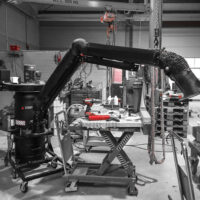
- Pickup: Show where collection needs to happen, including existing machine connections and the space available nearby. Include the approximate hose route and any limits on access. The equipment must fit the collection point and leave room for routine service.
- Emptying: Explain where the waste should go after collection and who will remove it. A removable bag or container serves a different workflow from transfer to a shared waste area. Collection capacity and emptying access should suit the production schedule.
Also flag food or pharmaceutical requirements, adhesive materials, and any known dust hazards. These can affect filtration, construction, material separation, and equipment suitability; the presence of a filter alone does not establish that a vacuum is appropriate for the application.
Packaging Trim Extraction FAQs
Can one system collect both packaging trim and dust?
Sometimes, but the combination must be evaluated. Larger scraps and fine particles place different demands on collection and filtration. The material mixture, pickup points, and production rate determine whether one system is practical or whether separate collection methods are the better fit.
Why does lightweight film clog some vacuums?
Thin film and long strips can tangle, span an opening, or collect against a filter instead of settling into the container. The problem may involve the inlet, hose route, or collection arrangement. More motor power alone does not necessarily correct a material-handling mismatch.
Will a pre-separator help with packaging scrap?
An appropriately selected interceptor or pre-separator can collect bulk scrap before it reaches the main vacuum, reducing the amount of material reaching its filter. It must match both the waste and the vacuum. A general-purpose cyclone is not automatically suitable for flexible or entangling strips.
Can a trim extractor handle continuous ribbons or label matrix?
These materials need individual review. An unbroken ribbon must be removed in a way that suits the moving web, while adhesive label waste adds another handling challenge. Line speed, adhesion, material dimensions, and the waste destination may call for specialized trim handling rather than a standard local vacuum.
When should multiple machines use a central system?
Consider an engineered system when several pickup points need shared suction or waste must travel to a common collection area. The design needs to account for which points operate together, the distances involved, and material compatibility. Multiple machines do not automatically belong on one shared system.
Does machine-connected extraction replace routine cleaning?
No. Collecting waste during production can reduce how much spreads around the line, but it does not eliminate settled residue or material missed by the pickup point. Floors, machine surfaces, and surrounding areas still need a suitable cleaning routine, including appropriate cleaning during maintenance and changeovers.
Find the Right Collection Setup for Your Packaging Line
The right collection setup starts with what your packaging line produces, not simply the size of the vacuum. Loose trim, fine dust, and settled debris may require different approaches, even when they come from the same machine. Understanding those collection jobs helps narrow the options without making equipment selection more complicated than it needs to be.
Depureco USA can help you evaluate dedicated trim extraction, compact machine-side vacuums, dust collectors, or an engineered multi-point system. Share your material, collection point, and current challenges so our team can identify an approach that fits your production line.
What to share about your packaging line
Show us the film, paper, cardboard, or powder. Note whether the waste is loose, continuous, sticky, or mixed.
Share a photo of the machine connection, cutting area, or cleanup location, along with the space available for equipment.
Tell us how often waste is generated, how quickly the container fills, and whether collection serves one machine or several.
Describe recurring clogs, escaping dust, frequent emptying, or cleanup interruptions so we understand what needs to improve.
Get help matching your packaging waste to the right collection approach.
Discuss My Packaging Application