





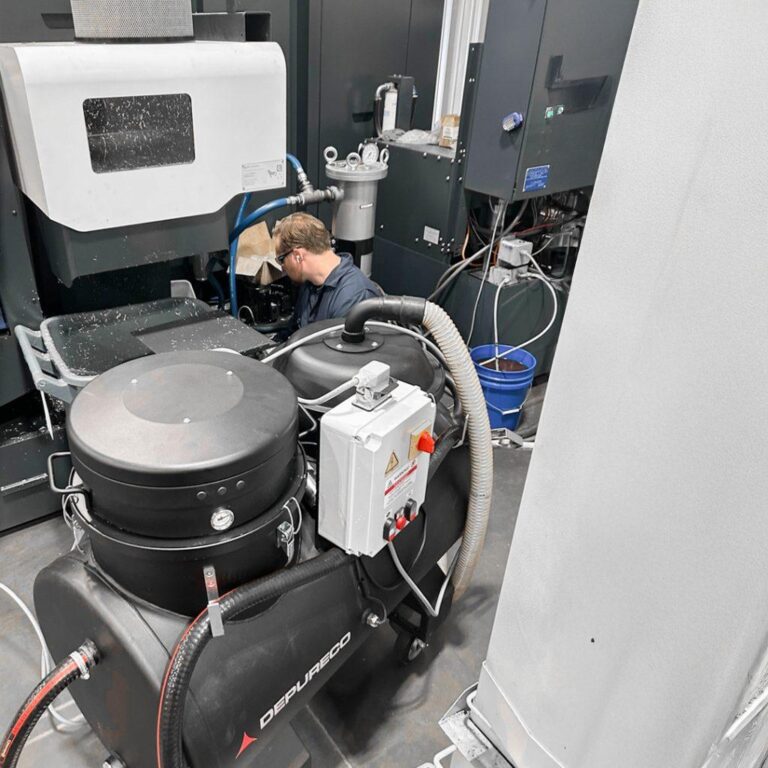
Walk through almost any CNC machine shop, and you will hear terms such as chips, swarf, shavings, turnings, spirals, and stringers used to describe machining waste. The terms often overlap, but the material itself does not always behave the same way.
Short, broken chips move differently than long stringers that curl, tangle, or form bird nests. Add coolant or cutting oil, and the recovery problem changes again. Fine material that settles into the bottom of a CNC sump becomes sludge and may require a different separation and filtration approach than the larger chips above it.
That matters when selecting an industrial vacuum.
The important question is not only what the material is called. It is how its size, shape, and condition affect the hose, separator, filter, and collection system needed to recover it.
Metal Chip Terminology at a Glance
Machining terminology varies between shops, processes and operators. Chips, swarf, shavings and turnings may overlap in everyday use, so the most useful distinction is the material’s actual shape and condition.
Metal Chips
A broad term for material removed during cutting operations such as milling, turning, drilling, boring and sawing. Chips may be short, curled, coarse, sharp or mixed with smaller particles.
Swarf
A general shop term for machining waste. Depending on the facility, swarf may include chips, shavings, turnings, curls or a mixture of several forms.
Shavings & Turnings
Shavings generally describes thinner pieces produced during cutting, while turnings commonly refers to material produced during lathe and turning operations. Either may be short and broken or long enough to curl and tangle.
Spirals & Helical Chips
Curled chips that form spring-like, corkscrew or helical shapes. Short spirals are typically easier to move than longer coils that occupy more volume or catch inside the material path.
Stringers & Ribbon Chips
Long, continuous or nearly continuous chips. These can wrap around themselves, form birdnests, and create greater bridging or tangling problems in hoses, inlets, and separators.
Sludge
Fine machining residue that settles or remains suspended in coolant or cutting oil. Sludge is a different recovery problem from larger swarf because much of the material may pass through a coarse chip-separation basket.
Metal Chips
A broad term for material removed during milling, turning, drilling, boring and other cutting operations.
Swarf
A general shop term that may describe chips, shavings, turnings, curls or a mixture of machining debris.
Shavings & Turnings
Thin or curled cuttings that may remain short or become long enough to wrap, pack and tangle.
Spirals & Helical Chips
Spring-like or corkscrew-shaped chips whose length and curl diameter can affect transport and separator loading.
Stringers & Ribbon Chips
Long continuous chips with greater potential to bridge, tangle or form bulky birdnests.
Sludge
Fine machining residue suspended or settled in coolant or oil, often requiring finer separation than bulk chips.
Why Chip Shape Changes Vacuum Selection
Two machine shops may both say they need to collect “steel swarf” while needing very different equipment.
One may generate short, broken chips that move relatively predictably through a hose. Another may produce long stringers that curl, bridge across an inlet, catch at bends, or tangle with other chips before they ever reach the collection container.
Simple Rule:
The longer and more irregular the chip, the more important the entire material path becomes.
That includes:
- pickup-tool opening;
- hose diameter;
- hose length;
- number and severity of bends;
- reducers or restrictions;
- separator inlet;
- collection-bin geometry;
- discharge method;
- available suction and duty cycle.
A larger hose is not automatically the answer. Hose size, vacuum performance and the rest of the material path should be evaluated together.
Common Mistake:
Sizing a vacuum from the word “swarf” alone.
Short cast-iron chips, long stainless stringers and coolant-heavy aluminum swarf may all be called swarf on the shop floor, but they should not automatically be treated as the same collection application.
Common Mistake: Sizing From the Word “Swarf” Alone
Short cast-iron chips, long stainless stringers and coolant-heavy aluminum swarf may all be called swarf on the shop floor. Chip geometry, wet/dry condition, fines, volume and the actual hose run should be confirmed before equipment is selected.
Which Depureco Recovery Path Fits?
Once the chip shape is understood, the next question is whether the material is dry, mixed with coolant or oil, or settled into sludge. That distinction can change the separator, filtration, and discharge system required.
Mostly Dry Metal Chips & Swarf
If the material is primarily dry chips, shavings or turnings, the main challenge is usually moving and containing the solids without excessive bridging, tangling or filter loading.
This is the primary path for Depureco’s metal chip and swarf vacuum systems.
Best for:
- dry CNC chips;
- machine-bed cleanup;
- shavings and turnings;
- dry fixture and part cleanup;
- localized chip recovery.
Coolant, Oil & Wet Swarf
Once significant coolant or cutting oil enters the material stream, the recovery problem changes.
The system may need to collect the liquid and solids together, separate larger chips before they reach downstream filtration, and then hold, discharge, or return the recovered liquid.
For these applications, start with a dedicated CNC sump vacuum.
Recommended path:
Mostly dry chips → Metal Chip Vacuum
Coolant or oil + chips → CNC Sump Vacuum
Fine or Heavy Sump Sludge
Sludge can be more difficult because much of the material may be fine enough to pass through a coarse chip basket.
Selection should consider:
- solids concentration;
- particle size;
- coolant or oil type;
- viscosity;
- sump volume;
- desired filtration level;
- hose distance and elevation;
- liquid discharge or reuse requirements.
Confirm before ordering: Heavy, unusually viscous, or heavily contaminated sludge should be reviewed as an application rather than assumed compatible with every liquid-recovery vacuum.
Dry Chips & Swarf
Start here when the main challenge is collecting solid machining debris without a significant coolant load.
- Dry CNC chips
- Shavings and turnings
- Machine-bed cleanup
- Localized chip recovery
Coolant + Wet Swarf
Use a sump-recovery path when coolant or oil must be collected and separated from the machining debris.
- Wet swarf
- CNC sump cleanout
- Coolant recovery
- Chip/liquid separation
Fine or Heavy Sludge
Sludge requires closer review because fine solids, viscosity and liquid handling can affect the entire recovery configuration.
- Settled machining fines
- Contaminated coolant
- Dense sump residue
- Liquid filtration requirements
Hose, Separator & Filter Selection
Choosing a vacuum for machining debris is not only about suction power. The hose, separator, and filtration stages have to match the material being collected.
A system that works well for short, dry chips may struggle when the same hose is asked to move long stringers, coolant-heavy swarf, or fine sump sediment.
Hose: Start With the Largest Material
Hose selection should begin with the actual chip geometry and the distance the material needs to travel.
Useful application details include:
- maximum chip length;
- approximate chip width or curl diameter;
- whether the chips form nests or bundles;
- dry, damp, oily or submerged condition;
- hose length;
- vertical lift;
- number of bends;
- pickup-tool opening.
Long stringers can make a relatively small-volume application more difficult than a much larger quantity of short broken chips.
Simple rule: Avoid evaluating hose diameter by itself. Hose size, vacuum performance, transport distance, and restrictions should be considered together.
Separator: Remove Bulk Chips Before They Become a Problem
Large chips and swarf should be separated before they interfere with downstream filtration or liquid-handling stages.
Depending on the application, that may involve:
- an internal chip basket;
- a larger collection receiver;
- a pre-separator;
- a hopper;
- direct discharge into a bin or downstream process.
For coolant and oil recovery, the separator’s first job is typically to retain larger chips while allowing the liquid portion to continue into the recovery and filtration stages.
Filter: Match the Fines, Not the Word “Swarf”
A material described as swarf does not automatically require one specific filter.
The important question is what remains after the larger material has been separated.
Coarse dry chips, fine metallic particulate, and sediment suspended in coolant represent three different filtration problems.
Important compatibility note: If the material stream includes significant fine metal dust, the application should be reviewed separately from ordinary coarse-chip recovery. Filtration and final equipment configuration depend on the actual material, particle size, process, and hazard profile.
Hose & Pickup
Start with the largest and most difficult material that must enter and move through the system.
- Chip length and curl diameter
- Stringers or birdnesting
- Hose length and bends
- Vertical lift
- Pickup-tool opening
Bulk Separation
Remove larger chips before they interfere with downstream filtration, liquid handling or discharge.
- Chip basket
- Pre-separator
- Collection receiver
- Hopper or bin discharge
Filtration
Select filtration around the fines that remain after the bulk material has been separated.
- Dry machining fines
- Suspended sump sediment
- Liquid filtration needs
- Material-specific dust concerns
Which Depureco Recovery Path Fits?
Once the material and recovery conditions are defined, the equipment path becomes much easier to narrow.
The main distinction is whether the job involves mostly dry solids, coolant-heavy mixed media, or a repetitive/high-volume recovery process that may benefit from a fixed system.
Mostly Dry Chips, Shavings & Swarf
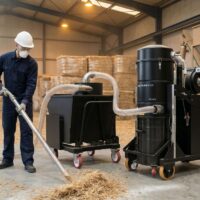
For dry machining debris, start with Depureco’s Metal Chip & Swarf Vacuums.
This path is intended for applications where the primary job is collecting solid material such as:
- CNC chips;
- metal shavings;
- turnings;
- dry swarf;
- machine-bed debris;
- recovered chips being transferred into a bin or downstream process.
For repetitive machine-side recovery, a fixed vacuum may make more sense than moving a portable unit between machines.
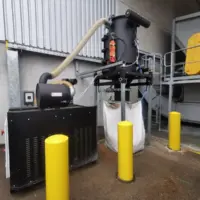
The HF 300 stationary industrial vacuum is one example of a fixed high-vacuum configuration used for dry chip and swarf recovery.
Coolant, Oil, Wet Chips & Sump Cleaning
When significant liquid is part of the material stream, start with Depureco’s CNC Sump Vacuums.
These systems are designed around a different recovery sequence: collect the liquid and chips together, separate the larger solids, then manage the recovered coolant or oil through the appropriate filtration and discharge configuration.
The RAM OIL 200 MP is one example of this architecture, using bulk chip and swarf separation before the recovered liquid reaches the collection and filtration stages.
Best for:
- CNC sump cleanout;
- coolant and oil recovery;
- wet chips and swarf;
- chip/liquid separation;
- machining sludge where the application is compatible.
Fixed, Centralized or Automated Chip Recovery
Some applications go beyond periodic machine cleanup.
If chips need to be collected repeatedly from the same machines, moved over longer distances, served from multiple pickup points or transferred directly into another process, a centralized vacuum system may be the better starting point.
These applications should be evaluated around the complete system, including:
- material geometry;
- pickup locations;
- piping diameter and routing;
- transport distance;
- simultaneous users;
- separation method;
- collection capacity;
- final discharge or downstream process.
For these projects, Depureco’s central vacuum system design and engineering team can evaluate the recovery process as a complete material-handling system.
Recommended path: Use the material and process to choose the system category first. Select the individual vacuum configuration only after the application has been qualified.
Metal Chip & Swarf Vacuums
For dry CNC chips, shavings, turnings, machine-bed debris and localized solid-material recovery.
Explore Metal Chip VacuumsCNC Sump Vacuums
For coolant, oil, wet swarf, sump cleanout and applications requiring solid/liquid separation.
Explore CNC Sump VacuumsFixed & Central Systems
For repeated pickup points, longer transport runs, multiple machines or integrated material-transfer applications.
Explore Central SystemsCoarse Metal Chips Are Not the Same as Fine Metal Dust
Machining debris should not be classified by the metal name alone.
Large chips, shavings, and stringers behave differently from finely divided metal particulate generated by grinding, polishing, or other processes. As particle size decreases, filtration, static-control and combustible-dust considerations can change substantially.
When Additional Review Is Needed
The application should receive closer review when the collected material includes:
- significant fine metal dust;
- very small machining fines mixed with coarse chips;
- aluminum, magnesium, titanium or other potentially reactive particulate;
- dry particulate from grinding or polishing;
- material collected in or near a classified area;
- known combustible-dust concerns;
- unusual material temperatures.
Compliance-Aware Note
Do not assume that equipment suitable for coarse swarf is automatically suitable for fine metal dust.
Final equipment selection depends on the material, particle characteristics, process, wet or dry condition, facility requirements, collection method and complete system configuration.
Conductive hoses, antistatic components, filtration or other safety-related features may form part of the required configuration, but no individual vacuum, filter or accessory should be represented as making an entire facility or process compliant.
Recommended path: If significant fine metal particulate is present, identify that material separately when requesting an application review rather than describing the entire waste stream simply as “swarf.”
Fine Metal Dust Requires Separate Qualification
Equipment selected for coarse chips or swarf should not automatically be assumed suitable for fine metallic particulate. Material properties, particle size, wet/dry condition, process, area requirements and the complete collection configuration should be reviewed before equipment is selected.
What to Send Depureco for a Better Recommendation
You do not need every technical specification before contacting Depureco. A few details about the actual machining debris and recovery process can narrow the equipment path considerably.
Start With the Material
Tell us:
- the metal or material being machined;
- whether the debris is mostly short chips, curls, spirals, shavings or long stringers;
- approximate maximum chip length;
- whether significant fine particulate is mixed with the chips.
A photo of the actual material can be especially useful when terms such as “swarf” or “turnings” do not fully describe how the chips behave.
Describe the Recovery Conditions
We also need to understand how and where the material is being collected.
Useful details include:
- dry, damp, oily or submerged condition;
- coolant or cutting-oil type;
- whether sludge or fine sediment is present;
- approximate chip or liquid volume;
- sump capacity, if applicable;
- expected hose length and vertical lift;
- one pickup point or multiple machines;
- desired chip separation;
- desired coolant filtration, reuse or discharge;
- expected operating frequency or duty cycle.
Confirm Any Special Requirements
Also identify any known conditions that could change equipment selection, including:
- available electrical power;
- compressed-air availability;
- unusual material temperature;
- known classified-area requirements;
- combustible-dust concerns;
- conductive or static-control requirements.
Recommended path: Send the material information first. Depureco can then help determine whether the application belongs in a mobile chip vacuum, CNC sump vacuum, fixed vacuum or engineered centralized system.
What Are You Collecting?
- Metal or material type
- Chip shape
- Maximum chip length
- Amount of fine particulate
Dry, Wet or Mixed?
- Dry, damp, oily or submerged
- Coolant or cutting oil
- Sludge or fine sediment
- Material temperature
How Will It Be Recovered?
- Approximate volume
- Sump size if applicable
- Hose length and vertical lift
- One or multiple pickup points
What Needs to Happen Next?
- Chip separation
- Coolant filtration or reuse
- Discharge method
- Power and duty requirements
Frequently Asked Questions
What is swarf in machining?
Swarf is a broad shop term for machining waste such as chips, shavings, turnings and curls. Because it can describe several physical forms, vacuum selection should be based on the actual chip geometry, condition and material behavior.
What is the difference between metal chips and shavings?
The terms often overlap. Metal chips is generally the broader term, while shavings often describes thinner or more curled material. For recovery equipment, shape, dimensions, volume and wet/dry condition matter more than the label.
What are stringer chips?
Stringers are long continuous or nearly continuous machining chips. They may curl, wrap or form birdnests and can create more bridging and tangling problems than short broken chips.
Can the same industrial vacuum collect dry chips and coolant?
Some configurations may handle incidental liquid, but full CNC sump cleaning is a different application. Significant coolant, sludge, liquid filtration or pump-out requirements should start with a dedicated CNC sump vacuum evaluation.
Do metal chips require HEPA filtration?
Not automatically. Coarse machining chips and fine metallic particulate require different filtration approaches. The correct filter depends on the fines, material, process and hazard profile.
Are metal chips combustible?
That depends on the material, particle characteristics and process conditions. Coarse chips should not automatically be treated as equivalent to fine combustible metal dust, but material and hazard conditions should still be confirmed before equipment selection.
Get a Vacuum Recommendation for Your Chips, Coolant, or Sludge
The fastest way to narrow down the right recovery system is to show us what you are actually collecting.
Send Depureco USA the material type, chip shape, dry or wet condition, approximate volume, sump size if applicable, and expected hose run. A clear photo of the chips, swarf, or sludge can also help us identify whether the application belongs in a mobile chip vacuum, CNC sump vacuum, fixed system, or centralized recovery setup.
Recommended path: Start with the material and application details. We can help narrow the equipment category and configuration from there.
Get a Vacuum Recommendation for Your Chips, Coolant or Sludge
Send us the material type, chip shape, dry or wet condition, approximate volume, sump size if applicable, and expected hose run. A photo of the actual chips, swarf or sludge can also help us narrow the correct mobile, sump, fixed or centralized recovery path.
Request a Vacuum Recommendation