



When choosing an industrial vacuum for fine or hazardous dust, M-Class and HEPA filtration are often treated like two versions of the same thing. They are not.
M-Class commonly serves as the vacuum’s primary working filtration for fine dust, while HEPA H13 or H14 can provide a higher-efficiency final filtration stage when the application requires tighter particulate control. In many applications, the right choice is not M-Class or HEPA. A properly configured industrial vacuum may use both.
The right filtration setup ultimately depends on the material being collected, particle size, dust volume, hazard profile, operating conditions, and how the collected material will be contained and disposed of.
HEPA vs. M-Class: The Difference at a Glance
The key distinction is that M-Class and HEPA refer to different parts of the filtration decision.
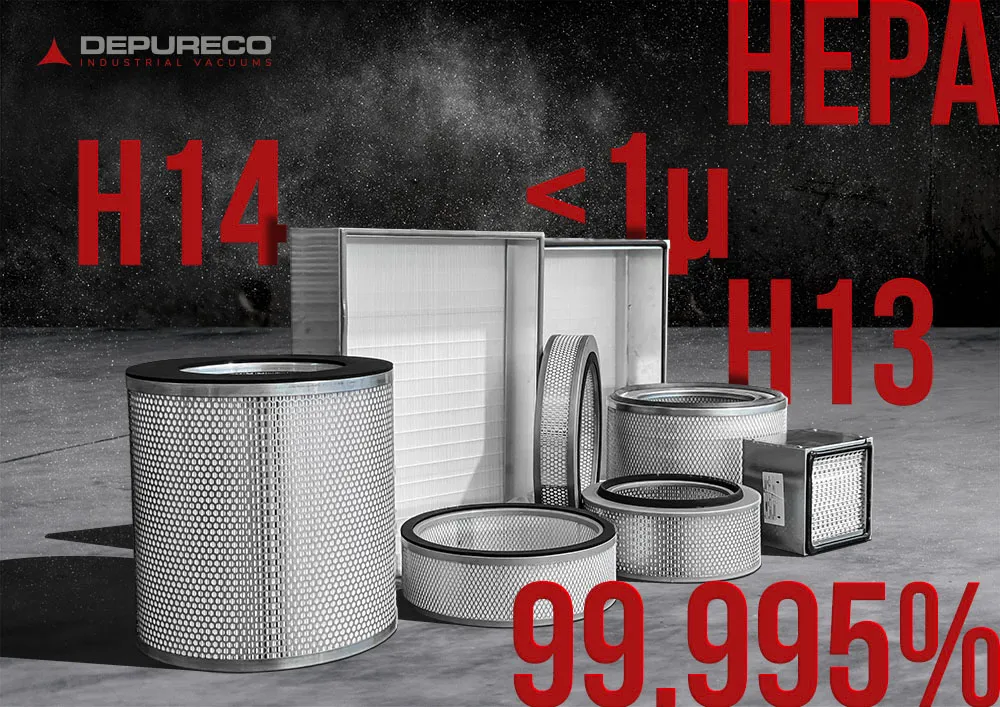
M-Class is commonly associated with the vacuum’s primary filtration for hazardous or fine-dust applications. HEPA H13 or H14 is a high-efficiency filtration stage used when finer particulate retention is required, often downstream of the primary filter.
That means HEPA does not automatically replace M-Class filtration. In many industrial vacuum configurations, the primary filter handles the bulk of the dust while the HEPA filter serves as the final filtration stage before air is exhausted.
| Comparison | M-Class | HEPA H13 / H14 |
|---|---|---|
| Typical role | Primary working filtration for fine or hazardous industrial dust. | Higher-efficiency final filtration for finer particulate control. |
| Where it sits | Usually the main filter handling the incoming dust load. | Often installed downstream of the primary filter. |
| Main purpose | Capture dust while supporting airflow, filter loading, and routine industrial operation. | Reduce the amount of very fine particulate passing through the final exhaust air. |
| Common applications | Fine dry dust, powders, sanding dust, wood dust, mineral dust, and general industrial particulate. | Lead dust, pharmaceutical powders, very fine hazardous particulate, and applications requiring tighter final filtration. |
| Can they be used together? | Yes. Many industrial vacuum systems use M-Class primary filtration together with a downstream HEPA filter. | |
Which Filtration Does Your Application Need?
A practical way to choose is to start with the material and hazard, not the filter label.
For many routine fine-dust applications, M-Class primary filtration may be the appropriate starting point. Where tighter control of very fine or hazardous particulate is needed, a downstream HEPA stage may also be appropriate. For combustible, conductive, reactive, hot, wet, or otherwise unusual materials, filtration is only one part of the equipment-selection process.
M-Class Primary Filtration
A strong starting point for many fine, dry industrial dusts where the primary filter needs to handle the working dust load efficiently.
Examples: wood dust, sanding dust, mineral dust, general production dust, and dry powders.
M-Class + HEPA
Consider staged filtration when the application needs strong primary dust handling plus tighter control of very fine particulate in the final exhaust air.
Examples: lead dust, pharmaceutical powders, fine process dust, silica-related cleanup, and other higher-control applications.
Hazard-Specific Review
Some materials require more than a filtration upgrade. The complete vacuum configuration must be reviewed before equipment is selected.
Examples: combustible dust, conductive powders, reactive metal powders, hot material, liquids, oily debris, or unusual process dust.
Filtration Is Only Part of the Vacuum
Choosing the right filter is important, but filtration alone does not determine whether an industrial vacuum is suitable for a hazardous material or process.
Combustible dust, conductive powders, reactive metal powders, hot material, liquids, and oily debris can introduce additional equipment requirements beyond M-Class or HEPA filtration. The complete configuration may need to account for grounding, conductive components, collection method, temperature, filter loading, area classification, and safe disposal procedures.
For combustible-dust applications, start with the material hazard and complete vacuum configuration rather than assuming a HEPA or M-Class filter makes the equipment suitable. Depureco’s combustible dust vacuum systems and explosion-proof industrial vacuums cover these applications separately.
Compliance-aware note: Final suitability depends on the material, application, facility requirements, and full system configuration. An antistatic filter, HEPA filter, or M-Class filter by itself does not make a vacuum suitable for every hazardous or combustible dust application.
Important: Filtration Does Not Solve Every Hazard
Combustible, conductive, reactive, hot, wet, or oily materials may require additional equipment features beyond M-Class or HEPA filtration.
Final suitability should be evaluated by material, application, operating conditions, collection method, hazard profile, and the complete vacuum configuration.
For combustible-dust applications, review combustible dust vacuum systems or explosion-proof industrial vacuums .
FAQs
Not necessarily. They serve different roles. M-Class is commonly used as primary working filtration, while HEPA H13 or H14 may be used as a higher-efficiency final filtration stage. The right choice depends on the material and application.
Yes. Many industrial vacuum configurations use a primary M-Class filter to handle the working dust load and a downstream HEPA filter for higher-efficiency final filtration.
No. HEPA filtration addresses particulate capture, not every ignition or combustible-dust hazard. Equipment selection may also need to account for grounding, conductive components, material characteristics, area classification, collection method, and the complete vacuum configuration.
Start with the exact material, particle characteristics, dust volume, wet or dry condition, hazard profile, operating environment, and collection method. Final filtration and vacuum configuration should then be confirmed for the specific application.
Need Help Choosing the Right Filtration?
The right industrial vacuum should be selected based on the material and application first, then the filtration system.
If you are unsure whether your application needs M-Class filtration, HEPA H13/H14, or a combination of filtration and containment features, Depureco can review the material, dust characteristics, operating conditions, and cleanup requirements with you.
For a broader overview of filter media and filtration options, see our Industrial Vacuum Filter Types Guide.
Confirm before ordering: Final suitability and filter compatibility should be confirmed by vacuum model, material, wet/dry condition, temperature, collection method, operating environment, and hazard profile.
Not Sure Which Filtration Setup You Need?
Tell us what material you are collecting and how the vacuum will be used. Depureco can help determine whether your application calls for M-Class filtration, HEPA final filtration, containment features, or a different vacuum configuration altogether.
Help Me Choose the Right Filtration Read the Industrial Vacuum Filter Types Guide