





Cleaning a CNC sump costs more than the time it takes to remove dirty coolant.
The full cost may include maintenance, labor, machine downtime, replacement coolant, waste hauling, repeated tank-emptying steps, and time spent separating chips, swarf, and sludge from the liquid.
A dedicated CNC sump vacuum can change that workflow, but the financial result depends on your shop. A machine cleaned twice per year is different from a production cell cleaned every month. A small job shop is different from a high-utilization machining department where one stopped machine can affect the next operation.
That is why this page does not use a universal savings percentage.
Use the calculator below to estimate the impact from your own:
- cleanout frequency
- technician time
- loaded labor cost
- machine downtime
- recoverable coolant value
- disposal cost
- equipment investment
The result is an estimate, not a guaranteed savings claim. The quality of the result depends on the quality of the inputs.
Compare CNC Sump Vacuums
Review CNC Machine Shop Solutions
CNC coolant tank cleaning ROI calculator for estimating sump vacuum savings, machine downtime reduction, labor cost reduction, coolant tank maintenance costs, and payback period for industrial sump vacuums used in CNC machining, metalworking, coolant recovery, chip removal, and tank cleaning.
CNC Coolant Tank Cleaning ROI Calculator
See the Cost of Manual Tank Cleaning
Estimate how much downtime, labor, and production value your shop can save by cleaning CNC coolant tanks with a Depureco sump vacuum instead of manual cleanouts.
Estimated Yearly Savings
$0
0.0 month estimated payback
Enter Your Shop Assumptions
Use your real numbers, or start with the default example values.
Manual cleaning
Using a Depureco sump vacuum
Estimated Savings
The biggest savings usually come from reducing machine downtime, cleanup labor, and repeated manual tank cleanouts.
$0
Yearly savings
0.0 mo.
Payback period
$0
3-year net savings
$0
Savings per tank cleaning
Manual
$0
Depureco
$0
Manual cleaning cost
Production downtime$0
Labor cost$0
Total annual cost$0
Depureco cleaning cost
Production downtime$0
Labor cost$0
Total annual cost$0
Request a Sump Vacuum Quote
This calculator is an estimate for planning purposes only. Actual savings depend on coolant tank size, contamination level, chip volume, labor rates, cleaning process, and production value per machine hour.
Where CNC Sump Vacuum ROI Actually Comes From
A CNC sump vacuum does not create value from a single line item. The business case usually comes from a combination of reduced cleanout labor, shorter machine downtime, recoverable coolant value, and lower disposal volume.
The importance of each category depends on the shop. A lightly used machine cleaned twice per year may produce a very different result than a high-utilization CNC cell with frequent sump maintenance, multiple technicians involved in each cleanout, and expensive production downtime.
01
Cleanout Labor
How many people and total labor-hours are tied up in each sump cleanout?
02
Machine Downtime
How long is the CNC unavailable, and what is that lost production time actually worth?
03
Coolant Recovery
How much recovered fluid can realistically remain in service after your normal evaluation process?
04
Disposal Cost
What liquid volume is currently hauled, containerized, or otherwise managed as waste?
Simple rule: The most credible ROI calculation uses your actual current process as the baseline. Start with what a representative sump cleanout really requires today, not what a vendor says the process should take.
Cleanout Labor: How Much Technician Time Goes Into the Sump?
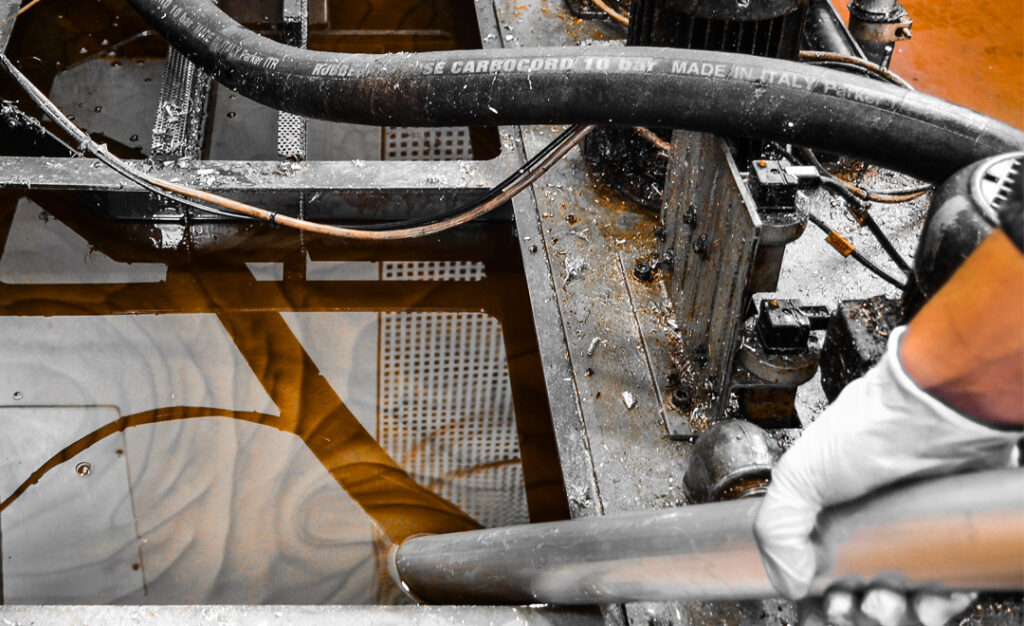
Manual CNC sump cleaning can involve draining coolant, removing wet chips and swarf, clearing stringers, cleaning settled sludge, transferring liquid, and preparing the machine to return to service. The real labor cost should therefore reflect the full cleanout—not only the time spent removing fluid.
For ROI purposes, compare total labor-hours under the current process with the proposed sump-vacuum workflow:
Hours per cleanout × people involved × loaded labor cost per hour
A three-hour cleanout with two employees represents, not three. Use a loaded labor rate when possible so the estimate reflects the labor-cost method your company normally uses for maintenance or process-improvement decisions.
Elapsed Cleanout Time
3 Hours
Employees Involved
2 People
Actual Labor Used
6 Labor-Hours
Common mistake:
Counting elapsed cleanout time without multiplying by every employee
routinely involved in the work.
Machine Downtime: What Does a Stopped CNC Actually Cost?
For many shops, machine downtime can outweigh the direct labor cost of sump cleaning. A one-hour reduction in cleanout time has a very different value on a lightly used backup machine than on a fully scheduled CNC, a bottleneck operation, or a machine feeding downstream production.
For ROI purposes, use an hourly downtime value your operation can reasonably defend. Depending on the business, that may be based on lost contribution margin, missed throughput, overtime needed to recover production, or another internally approved cost.
Downtime hours avoided per cleanout x economic downtime cost per hour = estimated downtime savings per cleanout
Downtime Avoided
2 Hours
Downtime Value
$150 / Hour
Estimated Downtime Savings
$300 / Cleanout
Avoid double counting:
If your downtime cost already includes the maintenance labor entered
elsewhere in the calculator, do not add that same labor twice.
Coolant Recovery: What Is Recoverable Fluid Worth?
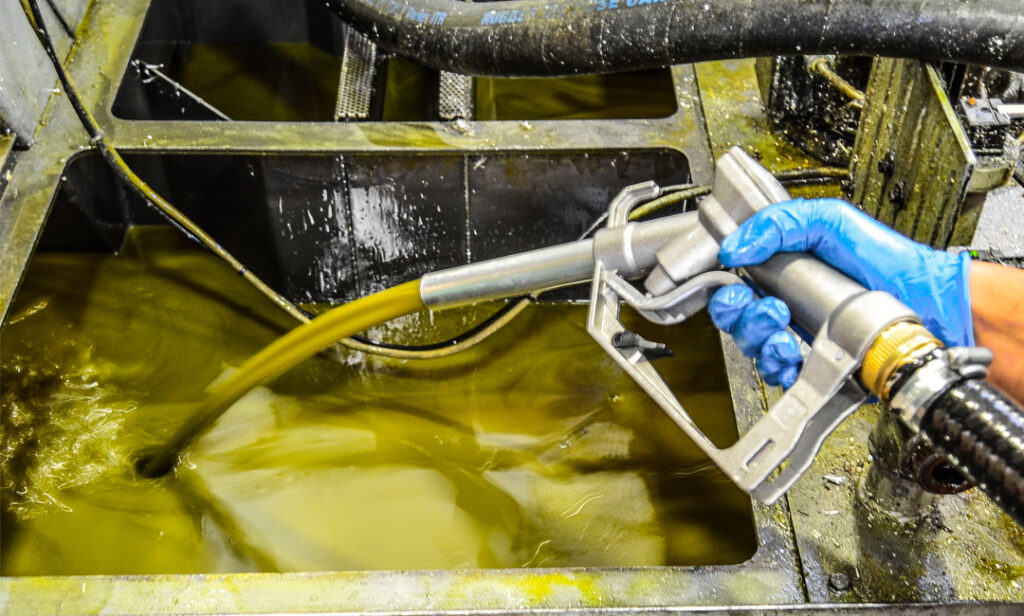
Recovering coolant can create value by allowing fluid that would otherwise be discarded to remain in service after your shop’s normal evaluation process.
For ROI purposes, count only the volume you reasonably expect to recover and approve for reuse:
Reusable gallons recovered per cleanout x effective working-fluid value per gallon = estimated coolant recovery value.
For water-mix coolant, avoid using the full concentrate price as the value of one gallon of working fluid. Use your actual effective replacement cost whenever possible.
Reusable Coolant Recovered
40 Gallons
Effective Fluid Value
$3 / Gallon
Estimated Recovery Value
$120 / Cleanout
Important:
Recovered fluid is not automatically suitable for reuse.
Evaluate concentration, pH, contamination, tramp oil, microbial
condition, and your coolant supplier or facility criteria before
returning fluid to service.
For a condition-based review of coolant and sump warning signs, use the CNC Coolant Maintenance & Sump Clean-Out Scheduler.
Disposal Cost: What Volume Are You Paying to Remove?
Disposal cost can add another layer to the ROI calculation when liquid that is currently hauled away can instead remain in service after appropriate recovery and evaluation.
For ROI purposes, use your actual effective disposal cost whenever possible:
Avoided disposal gallons per cleanout × actual disposal cost per gallon = estimated disposal savings
Include the costs your facility actually pays, such as hauling, container charges, minimum pickup fees, or other applicable waste-management costs.
Disposal Volume Avoided
40 Gallons
Disposal Cost
$2 / Gallon
Estimated Disposal Savings
$80 / Cleanout
Compliance-aware note:
A sump vacuum does not determine waste classification.
Fluid chemistry, contaminants, facility procedures, and applicable
requirements still control how recovered or spent material is managed.
CNC Sump Vacuum vs Manual Sump Cleanout
A sump vacuum should be compared with the process your shop actually uses today, not with an idealized manual cleanout.
The biggest differences usually come from how liquid, chips, sludge, transfer steps, and machine downtime are handled throughout the full maintenance event.
Cost Factor |
Manual / Current Process |
Dedicated Sump-Vacuum Workflow |
ROI Question |
|---|---|---|---|
Liquid Removal |
Pumping, draining, wet vacuuming, or multiple steps |
Industrial suction centered on sump recovery |
How many steps and labor hours change? |
Chip Removal |
Scooping, shoveling, baskets, and manual handling |
Vacuum recovery with separation depending on configuration |
How much manual solids handling remains? |
Bottom Sludge |
Scraping and manual removal |
Application-specific suction and tools |
Does dense sludge remain the bottleneck? |
Fluid Separation |
Often handled as a separate process |
Separation path depends on model and configuration |
How much fluid can realistically be recovered? |
Tank Capacity |
Repeated stops may be required |
Discharge and pump workflows vary by model |
Can the workflow continue on a larger sump? |
Refill / Return |
Separate transfer step |
Pump-back or discharge may be available on appropriate systems |
Is a second transfer step reduced? |
Machine Outage |
Depends on the current process |
Depends on the actual recovery workflow |
How much shorter is the maintenance window? |
Fluid Condition |
Must be evaluated |
Must still be evaluated |
Is recovered fluid acceptable for continued use? |
Simple rule: The strongest ROI case comes from reducing real process steps, not assuming every manual task disappears. Compare the current workflow honestly, then identify which steps the proposed sump-vacuum process can actually shorten, combine, or eliminate.
What Changes ROI by Chip, Swarf, Sludge, and Process Type?
Two CNC machines with the same sump volume can create very different cleanout problems. Chip geometry, fines, sludge density, and abrasive content can all affect labor time, separation, filter loading, and the amount of manual cleanup that remains.
That is why sump-vacuum selection should consider the material in the tank, not only the number of gallons.
Material / Condition |
Typical Behavior |
Selection Impact |
|---|---|---|
Broken Chips |
Settle and are generally easier to separate |
Basket capacity and solids volume matter |
Curled Chips |
Settle, pile, and consume more solids capacity |
Review basket size and cleanout frequency |
Spiral Chips |
Can tangle, bridge, and obstruct screens or tools |
Confirm chip geometry before selection |
Long Stringers |
Tangle, trap liquid, and may require manual breakup |
Review hose, basket, and manual clearing needs |
Fine Swarf |
Suspends in fluid or settles in low-flow areas |
Filtration and bottom-cleanout performance matter |
Metallic Sludge |
Dense, sticky, and concentrated at the sump bottom |
Sludge handling can matter more than tank gallons |
Abrasive Slurry |
Fine solids can increase filter loading and wear |
Application review is recommended |
Tramp-Oil Layer |
Floats on coolant and affects fluid condition |
Recovery alone may not correct the condition |
Process type also changes the cleanup problem. Milling often produces broken chips, curls, and fines, while turning may create long stringers and ribbons. Grinding can generate fine swarf and dense sludge, and honing or lapping may introduce abrasive slurry.
For these applications, tank capacity alone is not enough to size the equipment.
Milling
Broken chips, curls, fines, and mixed coolant loads
Turning
Stringers, ribbons, curls, and tangling risk
Drilling
Spiral chips that may bridge or tangle
Grinding
Fine swarf, metallic mud, and dense settled sludge
Honing / Lapping
Fine abrasive slurry and higher filter-loading concerns
When a Sump Vacuum Is, and Is Not, the Right Equipment
A common mistake is choosing equipment from the word “vacuum” instead of from the material and process.
A sump-vacuum path is most relevant when the primary problem involves coolant, cutting oil, wet chips, swarf, sludge, machine-tank cleanout, or liquid recovery. Dry chips, fine airborne dust, graphite, or combustible powders may require a different collection strategy.
Coolant, Oil, Wet Chips, Swarf or Sludge
Start with a dedicated sump-vacuum path when liquid recovery,
wet solids, tank cleaning, or separation is the main problem.
Compare CNC Sump Vacuums
Multiple CNC Cleanup Problems
Use the broader CNC path when the shop has coolant at one process,
dry chips at another, or fine dust elsewhere.
Review CNC Shop Solutions
Recurring Tank Evacuation, Oil and Swarf
Use this path when machine-tank evacuation, sludge removal,
fluid transfer, and recurring maintenance are central.
Review Tank Cleaning Vacuums
CNC Coolant Sump Cleaner Selection
Compare equipment around tank size, coolant and solids mix,
and the required discharge or pump-back workflow.
Review CNC Sump Cleaners
Confirm before ordering: Final suitability depends on the material, fluid chemistry, wet or dry condition, solids behavior, temperature, collection method, discharge requirements, facility procedures, and hazard profile.
How to Use Your ROI Result to Size the Next Step
A strong ROI result can help justify changing the current sump-cleaning process, but it does not automatically identify the right vacuum.
Final selection should consider sump volume, solids type, solids loading, fluid type, discharge workflow, and available utilities. Two machines with similar tank capacities may still require different equipment if one contains mostly coolant and broken chips while the other accumulates dense sludge or long stringers.
01
Sump Volume
Record nominal tank size, normal operating volume, and expected
recovery volume.
02
Solids Present
Broken chips, curls, spirals, stringers, fine swarf, sludge,
or abrasive slurry.
03
Solids Loading
A similar tank size can be a light recovery application or a
heavy sludge application.
04
Fluid Type
Water-mix coolant, semisynthetic, synthetic, straight cutting oil,
or another process fluid.
05
After Recovery
Gravity drain, drum transfer, holding tote, evaluated fluid return,
or another discharge workflow.
06
Available Utilities
Confirm voltage, phase, compressed air if relevant, and other
facility constraints.
Recommended path: Use the ROI result to establish the potential business case, then use the actual material, sump, discharge, and utility details to confirm the equipment fit.
Related CNC Coolant and Sump Cleaning Resources
Use these related resources to compare sump-vacuum options, review broader CNC cleanup applications, evaluate coolant condition, or narrow the equipment path for recurring tank cleaning.
CNC Sump Vacuums
Compare sump-vacuum options for coolant, oil, wet chips, swarf,
sludge, and machine-tank recovery.
Compare CNC Sump Vacuums
CNC Machine Shop Vacuum Solutions
Review broader cleanup paths for coolant, wet materials,
dry chips, fine dust, and mixed CNC applications.
Review CNC Shop Solutions
CNC Tank Cleaning Vacuums
Review recurring tank evacuation, oil and swarf recovery,
sludge removal, and transfer workflows.
Review Tank Cleaning Vacuums
Coolant Maintenance Scheduler
Review coolant condition, sump warning signs, contamination,
tramp oil, sludge, and cleanout timing.
Use the Coolant Scheduler
CNC Coolant Sump Cleaners
Narrow the equipment path by tank size, coolant and solids mix,
and the required recovery or discharge workflow.
Review CNC Sump Cleaners
Faqs
Compare the current cleanout process with the proposed sump-vacuum
workflow. Measure the difference in labor cost and machine downtime,
then compare the estimated annual savings with equipment investment.
Coolant recovery and avoided disposal can be evaluated separately
when those values are known and appropriate for the application.
There is no universal time saving. The result depends on sump volume,
chip type, sludge load, machine access, current cleanout method,
discharge workflow, and the number of people involved.
Use measured cleanout times from your own shop whenever possible.
Potentially, depending on the condition of the fluid and your
facility’s criteria.
Physical recovery and solids separation do not automatically correct
concentration, pH, microbial condition, tramp oil, chemical
degradation, or incompatibility. Evaluate recovered fluid before
returning it to service.
Use an hourly value your operation can reasonably defend.
Depending on the business, this may be based on lost contribution
margin, bottleneck cost, missed throughput, overtime needed to recover
production, or another internally approved downtime value.
Use your actual effective cost whenever possible.
That may include hauling, container charges, minimum pickup fees,
disposal invoices, or other applicable waste-management costs.
Convert the total to a useful per-gallon value when needed.
A general wet and dry vacuum is intended for broad mixed-material cleanup.
A machining-focused sump vacuum is selected around applications such as
coolant or oil recovery, wet chips, swarf, sludge, solids separation,
and liquid discharge or pump-back where supported by the model and
configuration.
Appropriate sump-vacuum configurations are designed to recover liquid
and solids, with separation methods that vary by model.
Performance depends on chip geometry, chip size, solids loading,
filtration, basket configuration, and fluid condition. Long stringers
or unusual debris should be reviewed before equipment selection.
Do not select equipment from tank gallons alone.
For fine swarf and dense sludge, review sludge depth, solids
concentration, abrasiveness, fluid chemistry, filtration needs,
discharge requirements, and cleanout frequency.
There is no universal interval for every machine.
Cleanout timing may depend on coolant condition, concentration, pH,
odor, contamination, tramp oil, sludge, chip accumulation, production
warning signs, and supplier guidance.
For a condition-based review, use the
CNC Coolant Maintenance & Sump Clean-Out Scheduler
.
A standard sump-vacuum path may not be appropriate when the primary
problem is dry airborne fine dust, graphite dust, combustible dry
powder, a reactive material, or an unusual corrosive or
high-temperature liquid.
Final suitability depends on the material, application, wet or dry
condition, temperature, collection method, facility requirements,
and hazard profile.
Turn Your ROI Result Into an Equipment Recommendation
The ROI result can help establish the potential business case for changing the current sump-cleaning process. The next step is matching the equipment to the actual application.
Before selecting a sump vacuum, confirm the sump volume, fluid type, chip geometry, sludge loading, discharge needs, available utilities, and how the recovered material will be handled after collection.
Ready to Compare the Equipment Path?
Use the ROI result to support the business case, then compare
equipment around the actual coolant, chips, swarf, sludge,
tank size, and recovery workflow.
Compare CNC Sump Vacuums
Request a Sump Vacuum Quote
Final fit note: This calculator and guide are starting points, not universal compatibility guarantees. Confirm final suitability by model, material, fluid chemistry, wet or dry condition, solids behavior, temperature, collection method, discharge requirements, facility procedures, and hazard profile.
