


1.5 HP

5,270 in²

12 gal
A powerful and easy-to-handle industrial vacuum designed for the safe removal of combustible dust in non-hazardous areas. Equipped with a 1.5 HP brushless motor, it ensures reliable continuous operation and an extended service life of over 20,000 hours. The unit is fitted with an advanced dual-stage filtration system, featuring an antistatic polyester star filter equipped with a Jet Clean system for efficient filter cleaning, combined with a secondary fiberglass HEPA H14 filter to guarantee maximum protection for both operators and the working environment. Designed in compliance with NFPA 79, it meets key safety requirements for electrical equipment in industrial applications. Complete grounding throughout the system further enhances operational safety. Its durable 12-gallon stainless steel container provides increased capacity while maintaining excellent handling and reliability. The integrated vacuum gauge allows for constant monitoring of performance levels.

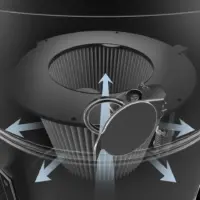
The suction mechanism of this vacuum cleaner utilizes a high-powered brushless motor, designed to operate continuously. The motor head incorporates two filters: one that safeguards the motor itself and another placed on the air outlet. Notably, the expelled air is completely free of carbon emissions.
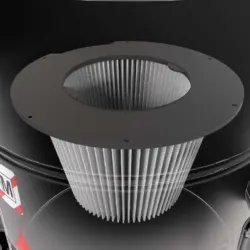
The unit features a two-stage, progressive filtration system arranged in series, designed to ensure maximum efficiency. It includes an antistatic polyester cartridge filter rated Class M (1-micron filtration efficiency), followed by a secondary H14 HEPA filter for superior fine particle retention.
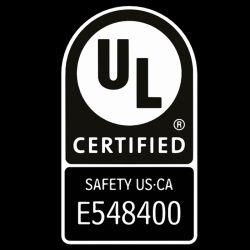
The unit is UL certified, ensuring compliance with recognized safety standards for industrial equipment. Its conformity has been verified in accordance with UL 2011, NFPA 79, and UL 508A, confirming adherence to strict electrical and machinery safety requirements. The certification also includes CSA C22.2 No. 14 for Canada, supporting safe use across North American markets.

The unit is completely grounded to ensure maximum safety during operation, especially when handling fine or potentially reactive dust. All components are designed to prevent the buildup of electrostatic charges, significantly reducing the risk of sparks or discharge. This continuous grounding system protects both the operator and the surrounding environment, contributing to a safer and more controlled cleaning process.
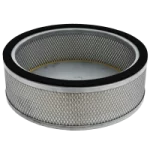
H14 Absolute Filter (EN 1822) Glass fiber
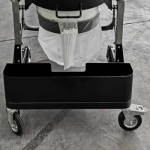
Accessories basket
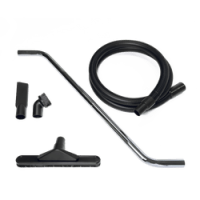
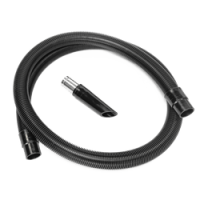
Get answers about using the BL45 JC ORD LOC for ordinary-location combustible-dust housekeeping, fine powder recovery, JetClean® filter cleaning, Class M and H14 filtration, material compatibility, model selection, and the difference between ORD LOC and classified-location vacuum requirements.
The BL45 JC ORD LOC is a single-phase brushless industrial vacuum designed for dry combustible-dust and fine-powder housekeeping in ordinary, non-classified locations where the material and application have been reviewed for suitability.
It provides up to 130 CFM of airflow and 108 inH₂O of vacuum through a 2-inch inlet. Collected material is contained in a 12-gallon AISI 304 stainless-steel bin.
The BL45 JC configuration is particularly useful for repeated fine-dust and powder cleanup because it combines a 5,270 in² antistatic Class M cartridge with Depureco’s JetClean® filter-cleaning system and H14 absolute filtration in the current U.S. configuration.
Typical applications can include production-floor housekeeping, machine-side cleanup, powder spills, settled dust removal, equipment cleaning, and recovery of suitable dry particulate from manufacturing and processing areas.
The vacuum should be selected only after the material, dust characteristics, cleanup location, collection volume, and facility area classification are understood.
ORD LOC refers to an ordinary-location configuration. The BL45 JC ORD LOC is intended for combustible-dust housekeeping where the cleanup area is ordinary or non-classified and the application has been reviewed for the material being collected.
It should not be treated as interchangeable with equipment selected for a Class II, Division 1 or Division 2 location, an ATEX Zone, or another documented hazardous classified area.
A material can be combustible even when the area where settled dust is being cleaned is not electrically classified. Conversely, a facility’s Dust Hazard Analysis or area-classification assessment may determine that equipment entering a particular location requires a different hazardous-location configuration.
Before selecting the BL45 JC ORD LOC, the facility should establish the material being collected, available SDS or dust data, the documented area classification, whether the dust is conductive or reactive, and any grounding, bonding, hose, tool, or collection requirements.
“Combustible dust,” “ORD LOC,” “explosion proof,” “Class II,” and “ATEX” should not be used as interchangeable equipment descriptions.
The BL45 JC ORD LOC is designed for dry combustible-dust and fine-powder housekeeping, but material suitability must be confirmed for the specific application rather than assumed from the product category alone.
Potential applications can include suitable food and ingredient powders, flour or grain residue, plastic and resin dust, wood dust, carbon black, graphite, pharmaceutical or chemical powders, additive-manufacturing powders, and other fine dry production particulate.
Metal and conductive powders require particular attention. Aluminum, other metal powders, battery materials, reactive dusts, and unknown mixtures may have properties that require a different collection method, additional controls, or another vacuum configuration.
Before recommending the BL45 JC ORD LOC, review the material or SDS, particle characteristics, combustibility or explosibility data where available, conductivity, reactivity, moisture, temperature, quantity generated, cleanup frequency, disposal method, and facility area classification.
The fact that a material is listed as combustible does not by itself determine which vacuum configuration is appropriate.
JetClean® uses the pressure differential inside the vacuum to help remove accumulated dust from the primary cartridge filter.
During the cleaning cycle, the airflow condition inside the filter chamber is changed so a strong pressure differential acts on the cartridge and helps dislodge dust that has collected on its surface. The BL45 JC configuration also uses a guillotine inlet shutoff to help create the vacuum condition needed for effective JetClean operation.
This allows the filter to be cleaned without relying on a traditional manual filter shaker and without requiring a separate compressed-air supply for the JetClean system.
JetClean is particularly useful when fine, dry powders progressively load the primary filter during repeated housekeeping because regular filter cleaning helps restore the airflow lost as dust accumulates.
JetClean is a filter-cleaning method. It does not determine whether a vacuum has HEPA filtration, whether a material is suitable for collection, or whether the machine can be used in a classified location.
The current U.S. BL45 JC ORD LOC configuration uses staged filtration built around a large antistatic Class M primary cartridge and H14 absolute filtration.
The primary filter is a 5,270 in² conical cartridge made from antistatic polyester and classified as Class M under EN 60335-2-69. This is the working filter that receives the dust load during normal collection and is cleaned with the JetClean system.
The current A1350/UL/H14 configuration also specifies H14 fiberglass absolute filtration. E11 filtration is used in the cooling-air path.
These filtration stages perform different functions. The Class M cartridge handles the primary dust load, while the H14 stage provides higher-efficiency downstream filtration.
Neither HEPA H14 filtration nor antistatic filter media by itself makes a vacuum suitable for every combustible dust or for a hazardous classified location. The complete machine configuration, material, accessories, grounding path, and location requirements still need to be reviewed.
The main difference is the primary filtration and filter-cleaning system, not suction performance or collection capacity.
Both configurations use a 1.5 HP brushless motor, provide up to 130 CFM airflow and 108 inH₂O vacuum, and use a 12-gallon stainless-steel collection bin.
The BL45 ORD LOC uses a 2,500 in² Class M antistatic polyester star filter with manual filter cleaning.
The BL45 JC ORD LOC increases primary filter surface area to 5,270 in², changes to a conical cartridge, and adds the JetClean® filter-cleaning system.
Choose the standard BL45 ORD LOC when its manual filter-cleaning workflow is appropriate for the dust load and cleaning frequency. Choose the BL45 JC ORD LOC when fine powder loading, repeated cleanup, or filter-maintenance demands make the larger cartridge and JetClean system more useful.
The JC model should not be selected because it has more suction; the current published airflow and vacuum ratings are the same.
The BL20 JC ORD LOC and BL45 JC ORD LOC use a very similar suction and filtration platform, so the biggest selection difference is collection capacity and machine size.
Both use a 1.5 HP brushless motor, provide up to 130 CFM airflow and 108 inH₂O vacuum, and use a 5,270 in² Class M antistatic polyester cartridge with JetClean filter cleaning.
The BL20 JC ORD LOC has a 6-gallon stainless-steel collection bin and a more compact 42-inch machine height.
The BL45 JC ORD LOC increases collection capacity to 12 gallons and is 52 inches tall.
Choose the BL20 JC when minimizing machine size and handling smaller dust volumes are the priorities. Choose the BL45 JC when the same general JetClean filtration approach is desired but the application generates enough material that a larger collection bin can reduce emptying frequency.
Material suitability and location classification must still be confirmed for either model.
The BL45 JC ORD LOC is not automatically the correct choice simply because a facility has combustible dust.
A different solution may be required when the vacuum will operate inside a documented hazardous classified location, the material is reactive or unusually conductive, the application involves flammable liquids or vapors, hot or burning material is present, or the dust requires specialized inerting or other hazard controls.
It may also be the wrong equipment type when the primary problem is airborne dust generated continuously at a process source. In that situation, an engineered source-capture dust collector may be more appropriate. Repeated facility-wide cleanup across many machines or fixed pickup points may instead justify a centralized vacuum system.
To confirm vacuum selection, provide the material and SDS, available combustible-dust or explosibility data, facility area classification, whether the material is dry or mixed, approximate quantity per cleanup, cleaning frequency, hose distance, pickup method, available electrical power, required accessories, and how the collected material will be emptied or disposed of.
When material behavior is uncertain, the application can also be reviewed or tested before the final vacuum and accessory configuration is selected.